
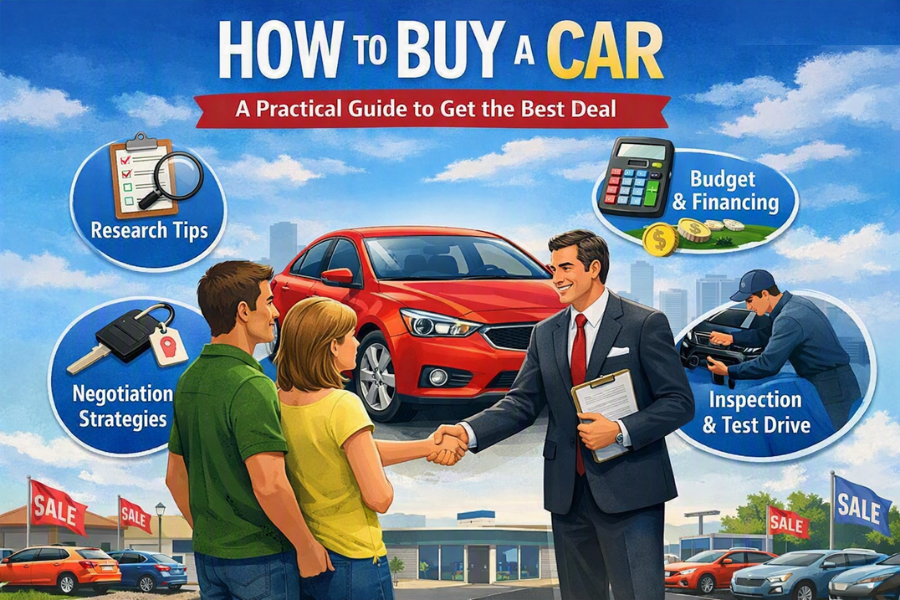
Do you want to buy a car in the United States and need a place to start? You face thousands of options, dozens of websites, and prices that shift every week. This guide gives you a clear order. You will learn how to search, compare, fund, and seal the deal with confidence.
The moment favors you. The July 2026 consumer price index shows that used vehicle prices fell 1.9% from a year earlier, and new vehicle prices rose 0.5%. Used cars now give your budget more room.
What Should You Decide Before You Search?
Start with your real budget. Add the price of the car, taxes, registration, insurance, gas, and maintenance. A cheap car that burns a lot of fuel costs more in the end.
Market numbers keep your plan grounded. Experian reports that the average used vehicle loan reached $27,852 in the second quarter of 2026, with an average monthly payment of $542. Compare those figures with your own income before you open a single ad.
Next, choose between new and used. A new car comes with a warranty and recent technology, but it loses value fast. A used car that is two to five years old often gives the best balance of price and quality.
Then ask yourself how you will use the car. A compact sedan fits a daily commute. An SUV fits a family. A pickup fits heavy work.
Where Can You Search for Cars in the United States?
Each site has its own strength. Use several and compare the results.
Autolist shows how long a car has been on sale and whether the price went up or down. It also links to the Carfax report and offers a Spanish version. Its SUV filter helps family buyers narrow the field fast.
Cars.com, CarGurus, and Autotrader collect large dealer inventories. Their filters cover make, model, year, price, and mileage. CarGurus also tells you if a price sits above or below the market.
Carros.com connects you with private sellers in Spanish. Use it if you prefer to deal directly with the owner.
Carvana and CarMax let you buy almost all of the process from your phone. CarMax also runs physical stores with fixed prices, so you skip the haggle. Read the return policy before you decide.
Copart runs daily auctions for used, recovered, and damaged vehicles. You can find low prices, yet many cars carry salvage or rebuilt titles. You need experience to judge the repairs. Skip auctions on your first purchase.
Facebook Marketplace and Craigslist offer real bargains and higher scam risk. Meet the seller in a public place in daylight.
Should You Visit Local Dealers in Your City?
Yes, especially in cities with large Hispanic communities. Miami, Houston, Los Angeles, and New York have dealers and used-car lots with Spanish-speaking staff. A search for “used cars Miami” gives you a wide list in minutes.
Read the recent reviews of each lot before you visit. Compare its prices with the online portals too. A serious dealer welcomes that comparison.
Which Filters Save You Time and Money?
Use the filters as a funnel. First set your maximum price and body type. Then adjust year, mileage, and make.
Mileage deserves special attention. Common industry references place the yearly average between 12,000 and 13,500 miles per driver. A car with far more miles has worn its parts faster. A car with far fewer miles raises a question: why did the owner barely use it?
Check the days on the market as well. An ad that has sat online for weeks gives you negotiating power. The seller wants to close, and you know it.
Why Should You Check the VIN and Vehicle History?
The VIN is the 17-character number that identifies each vehicle. Ask for it before you visit the car. Then run a report on Carfax or AutoCheck.
These reports show accidents, owner changes, title problems, and maintenance records. They can also expose odometer tampering. A seller who hides the VIN sends you a clear alert.
A clean report does not tell the full story. Some damage never reaches the records. That gap leads to the next step.
How Does a Mechanical Inspection Protect You?
Take the car to an independent mechanic you trust. Skip the mechanic the seller recommends. An inspection costs a fraction of a major repair. It also hands you concrete arguments to lower the price.
On the test drive, watch for these points:
- Odd noises from the engine, brakes, or suspension
- Shaking when you brake or drive at high speed
- Lights on the dashboard
- A/C, windows, and electronics that work as they should
- Uneven tire wear
What Interest Rate Can You Expect on a Used Car Loan?
This step is where you win or lose the most money. Experian reports that the average used car rate reached 11.19% in the second quarter of 2026, down from 12.12% in the same quarter of 2024. Rates fall, but they stay high.
Your credit history makes the biggest difference. Experian data shows that super prime borrowers, with scores of 781 or higher, paid an average of 6.30% in the first quarter of 2026. Other sources report different averages. Edmunds put the July 2026 average for used car loans at 10.6%. Figures vary between reports, so treat them as a guide. Your real rate depends on your profile.
Used cars also cost more to fund. Their rates usually run one to three percentage points above new car rates, because lenders view them as riskier collateral. Keep that gap in mind when you weigh new against used.
How Do You Choose the Right Loan Term and Lender?
Get preapproved before you step into a dealership. Ask your bank, a credit union, or an online lender. Applying for preapproval with several lenders helps you secure the best rate. Armed with that offer, you can measure the dealer’s proposal against real data.
Credit unions often sit at the low end of the rate range. Compare the APR, not only the interest rate. The APR adds the lender’s upfront fees to the interest rate.
Look at the total cost, not just the monthly payment. A long term lowers the payment and raises the interest. LendingTree research found that borrowers with terms over six years pay nearly $6,000 more in interest than borrowers with shorter loans. Pick the shortest term your budget can handle.
Question the extras in the finance office too. Extended warranties and add-on protections can inflate the final price. Ask for a written breakdown and sign without rush.
How Do You Negotiate the Price of a Car?
Always talk about the out-the-door price. It includes taxes, documentation fees, and registration. You avoid last-minute surprises this way.
Research the market value on Kelley Blue Book (KBB) or Edmunds. Use the same model, year, and mileage. A hard number carries more weight at the table than an opinion.
Negotiate the value of your current car separately if you trade it in. A mixed deal muddles the math. And remember that you can stand up and walk away. Another car always waits.
What Paperwork Do You Need After the Purchase?
Every state sets its own rules. In general, you need these documents:
- The vehicle title, or proof that the title is in process if a loan applies
- The purchase contract or bill of sale
- Auto insurance, which you must activate before you drive
- Registration and plates from your state DMV
- Your driver’s license and proof of address
Confirm the exact requirements and deadlines on your state’s official website. They change often.
How Do You Avoid Car Scams?
Doubt any price that looks too low. Fraudulent sellers often claim the owner is “traveling” or “moving urgently.” Doubt anyone who asks for a deposit before you see the car.
Watch for other red flags:
- Payment requests by wire transfer, gift cards, or cryptocurrency
- A title in another person’s name with no clear reason
- Refusal to allow an inspection or a test drive
- Constant pressure to decide today
Follow one simple rule. Send money only after you see the car in person and verify the title and the VIN.
What Final Checklist Should You Review Before You Sign?
- Total budget set, not just the car price
- Prices compared on at least three platforms
- Price checked against KBB or Edmunds
- VIN verified and history report reviewed
- Test drive completed
- Inspection done by an independent mechanic
- Loan preapproved and compared
- Insurance active before you drive
- Contract read in full, without rush
What Is the Best Advice for Your Car Purchase?
The best car balances price, reliability, and real ownership cost. The cheapest option rarely wins that contest. Use several platforms, verify every fact, and resist pressure from anyone. Lean on a mechanic and your bank before you commit.
Do you already have a budget and a body type in mind? Those two facts make your search much faster.
I kept the same 2026 statistics from Experian, LendingTree, Edmunds, and Bankrate. The yearly mileage range comes from general industry references, so verify it with an official source if you need a hard citation. I can also write a meta description, add a primary SEO keyword, or deliver the article as a Word file.
- Data Analysis and Research:
- Study all data provided by the user as a competitor resource or insightful reference.
- Extract information from these sources to enhance content quality and outperform competitors.
- When instructed, use your own research capabilities to gather additional data, ensuring it complements the user-provided information.
- Prioritize information accuracy, relevance, and SEO value when analyzing both user-provided and self-researched data.
- Sentence Structure:
- Write short sentences using an active voice.
- Use a direct approach without making the language complex.
- Do not start sentences with:
- with
- while
- by
- for
- whether
- gerunds or words with the ‘-ing’ suffix
- Always begin sentences with an independent clause.
- Avoid complex structures.
- No negating sentences are allowed like “isn’t just…”, “doesn’t only”…etc
- Vocabulary Usage:
- Do not use words with the ‘-ing’ suffix, especially in clauses or at the start of sentences.
- Avoid starting sentences with ‘this’ or ‘these’.
- Do not use whether statements.
- Avoid using verb or noun phrases directly as subjects. Use foregrounding with connectors or phrases instead.
- Tone and Engagement:
- Write in short, connected paragraphs.
- Address the reader directly using ‘you’.
- Maintain a readable and engaging tone.
- Ensure the content has a coherent flow using discourse markers and transition words.
- Include questions throughout the content to engage readers.
- Statistical and Reference-Based Content:
- Use statistics and references in every 2-3 paragraphs to support claims.
- Target NLP entities to ensure contextual relevance and boost SEO.
- Headings and Content Structure:
- Create headings in a question format.
- Keep statements precise and to the point, aligning with competitor analysis.
- Avoid using phrases like:
- not only … but also
- this is … for …
- these …
- Competitor Analysis:
- Treat all user-provided data as high-priority competitor insights.
- Use competitor data strategically to craft content that outperforms and ranks higher on Google.
- When instructed by the user, leverage your own research abilities to gather relevant and complementary information.
How to Buy a Car in the United States: A Practical Guide
Do you want to buy a car in the United States? You face thousands of ads, dozens of websites, and prices that shift every week. Our guide gives you a clear order. You will learn how to search, compare, borrow, and close the deal with confidence.
The market favors you today. The July 2026 consumer price index shows used vehicle prices fell 1.9% from a year earlier, and new vehicle prices rose 0.5%. Used cars now give your budget more room.
What Should You Decide Before You Search for a Car?
Start with your real budget. Add the car price, taxes, registration, insurance, gas, and maintenance. A cheap car that burns a lot of fuel costs you more in the end.
Market data keeps your plan realistic. Experian reports that the average used vehicle loan reached $27,852 in the second quarter of 2026, with an average monthly payment of $542. Compare those numbers with your income before you open any ad.
Next, choose between a new and a used car. A new car comes with a warranty and fresh technology. It also loses value fast. A used car that is two to five years old often offers the best balance of price and quality.
Then decide how you will use the car. A compact sedan suits a daily commute. An SUV suits a family. A pickup suits heavy work. Which one fits your life?
Where Can You Search for Cars in the United States?
Each site has its own strength. Use several and compare the results. Which portal suits your search style?
Autolist shows how long a car has been on sale. It also shows if the price went up or down. The site links to the Carfax report and offers a Spanish version. Its SUV filter helps family buyers narrow the field fast.
Cars.com, CarGurus, and Autotrader hold large dealer inventories. Their filters cover make, model, year, price, and mileage. CarGurus also tells you if a price sits above or below the market.
Carros.com connects you with private sellers in Spanish. Pick it if you prefer to deal with the owner directly.
Carvana and CarMax let you handle most of the purchase from your phone. CarMax also runs physical stores with fixed prices, so you skip the haggle. Read the return policy before you decide.
Copart runs daily auctions for used, recovered, and damaged vehicles. You can find low prices there. Many cars carry salvage or rebuilt titles, though. You need experience to judge the repair costs. Skip auctions on your first purchase.
Facebook Marketplace and Craigslist offer real bargains and higher scam risk. Meet the seller in a public place in daylight.
Should You Visit Local Dealers in Your City?
Yes, and the choice is wide in some cities. Miami, Houston, Los Angeles, and New York have dealers and used-car lots with staff who speak Spanish. A search for “used cars Miami” gives you a long list in minutes.
Read recent reviews of each lot before you visit. Compare its prices with the online portals too. A serious dealer welcomes that comparison.
Which Filters Save You Time and Money?
Use the filters as a funnel. First set your maximum price and body type. Then adjust year, mileage, and make.
Mileage deserves extra care. Industry references place the yearly average between 12,000 and 13,500 miles per driver. A car with far more miles has worn its parts faster. A car with far fewer miles raises a question. Why did the owner use it so little?
Check the days on the market too. An ad that stays online for weeks gives you room to negotiate. The seller wants to close, and you know it.
Why Should You Check the VIN and Vehicle History?
The VIN is a 17-character code that identifies each vehicle. Ask the seller for it before you visit the car. Then run a report on Carfax or AutoCheck.
Reports show accidents, owner changes, title problems, and maintenance records. They can also expose odometer fraud. A seller who hides the VIN sends you a clear red flag.
A clean report still leaves gaps. Some damage never reaches the records. Your next move fills that gap.
How Does a Mechanical Inspection Protect You?
Take the car to an independent mechanic you trust. Skip the mechanic the seller recommends. An inspection costs a fraction of a major repair. It also hands you concrete arguments to lower the price.
Watch for the points below on the test drive:
- Odd noises from the engine, brakes, or suspension
- Vibration when you brake or run at high speed
- Dashboard lights that stay on
- A/C, windows, and electronics that work as they should
- Uneven wear on the tires
What Interest Rate Can You Expect on a Used Car Loan?
Here you win or lose the most money. Experian reports that the average used car rate reached 11.19% in the second quarter of 2026, down from 12.12% in the same quarter of 2024. Rates fall, but they stay high.
Your credit history makes the biggest difference. Experian data shows that super prime borrowers, with scores of 781 or higher, paid an average rate of 6.30% in the first quarter of 2026. Sources differ on the overall average. Edmunds put the July 2026 average for used car loans at 10.6%. Treat each figure as a guide. Your own rate depends on your profile.
Used cars also cost more to fund. Their rates usually run one to three percentage points above new car rates. Lenders see a used car as riskier collateral. Keep that gap in mind as you compare new and used cars.
How Do You Choose the Right Loan Term and Lender?
Get preapproved before you step into a dealership. Ask your bank, a credit union, or an online lender. Bankrate advises you to apply with several lenders before you accept an offer. Then compare the dealer’s offer with real numbers.
Credit unions usually offer rates at the low end of the range. Compare the APR instead of the bare interest rate. The APR adds the lender’s upfront fees to the interest rate.
Look at the total cost. A long term lowers your payment and raises your interest. LendingTree research found that borrowers with terms over six years pay nearly $6,000 more in interest than borrowers with shorter loans. Pick the shortest term your budget can handle.
Question the extras in the finance office. Extended warranties and add-on protections can inflate the final price. Ask for a written breakdown. Sign only when you feel ready.
How Do You Negotiate the Price of a Car?
Always talk about the out-the-door price. It includes taxes, documentation fees, and registration. You avoid last-minute surprises that way.
Research the market value on Kelley Blue Book (KBB) or Edmunds. Use the same model, year, and mileage. A hard number carries more weight than an opinion.
Negotiate your trade-in value separately. A mixed deal muddles the math. Remember that you can stand up and walk away. Another car always waits.
What Paperwork Do You Need After the Purchase?
Every state sets its own rules. In general, you need the documents below:
- The vehicle title, or proof that the title is in process if a loan applies
- The purchase contract or bill of sale
- Auto insurance, which you must activate before you drive
- Registration and plates from your state DMV
- Your driver license and proof of address
Confirm the exact requirements and deadlines on your state’s official website. They change often.
How Do You Avoid Car Scams?
Doubt any price that looks too low. Scammers often claim the owner travels or must move fast. Doubt anyone who asks for a deposit before you see the car.
Watch for more red flags:
- Payment by wire transfer, gift card, or cryptocurrency
- A title in another person’s name with no clear reason
- A refusal to allow an inspection or a test drive
- Constant pressure to decide today
Follow one simple rule. Send money only after you see the car in person and verify the title and the VIN.
What Final Checklist Should You Review Before You Sign?
- Total budget set
- Prices compared on three platforms
- Price checked against KBB or Edmunds
- VIN verified and history report reviewed
- Test drive complete
- Independent mechanic inspection done
- Loan preapproved and compared
- Insurance active before you drive
- Full contract read
What Is the Best Advice for Your Car Purchase?
The best car balances price, reliability, and real ownership cost. The cheapest option rarely wins that contest. Use several platforms and verify each fact. Resist pressure from anyone. Lean on a mechanic and your bank before you commit.
Final Thoughts
The car market in 2026 gives you leverage. Used vehicle prices fell 1.9% while new cars rose 0.5%. That shift favors buyers who want value. Your best deal comes from discipline: set a full budget, compare prices on at least three platforms, verify the VIN, and lean on a mechanic before you sign. Preapproval from a bank or credit union arms you with real numbers. Always negotiate the out-the-door price, not just the sticker. Resist pressure, question extras, and walk away if needed. The right car balances price, reliability, and ownership cost. Cheap alone never wins.
FAQs
What budget should I set before searching?
- Add car price, taxes, registration, insurance, gas, and maintenance. Experian reports the average used vehicle loan reached $27,852 in Q2 2026 with a $542 monthly payment. Compare your income first.
Should I buy new or used?
- A new car offers warranty and tech but loses value fast. A 2–5 year-old used car often balances price and quality.
Which websites help me find cars?
- Autolist, Cars.com, CarGurus, Autotrader, Carros.com, Carvana, CarMax, Copart, Facebook Marketplace, and Craigslist each serve different buyer needs.
Why check the VIN and history report?
- Reports from Carfax or AutoCheck reveal accidents, title issues, and odometer fraud. A seller who hides the VIN signals risk.
How does a mechanic inspection protect me?
- An independent inspection costs less than repairs and gives you leverage to lower the price.
What interest rate can I expect on a used car loan?
- Experian shows an average of 11.19% in Q2 2026. Super prime borrowers (781+ credit score) averaged 6.30%. Edmunds reported 10.6% in July 2026.
How do I choose the right loan term?
- Shorter terms save thousands in interest. LendingTree found loans over six years cost nearly $6,000 more.
What paperwork do I need after purchase?
- Title, bill of sale, insurance, registration, plates, and driver’s license. Check your state DMV for exact rules.
How do I avoid scams?
- Never pay before seeing the car. Avoid sellers who demand wire transfers, gift cards, or crypto. Verify VIN and title in person.
CarRevix is an automotive platform offering expert car insights, automotive SEO, guest posts, link building, sponsored content, repair promotion, and performance-focused advertising solutions.