
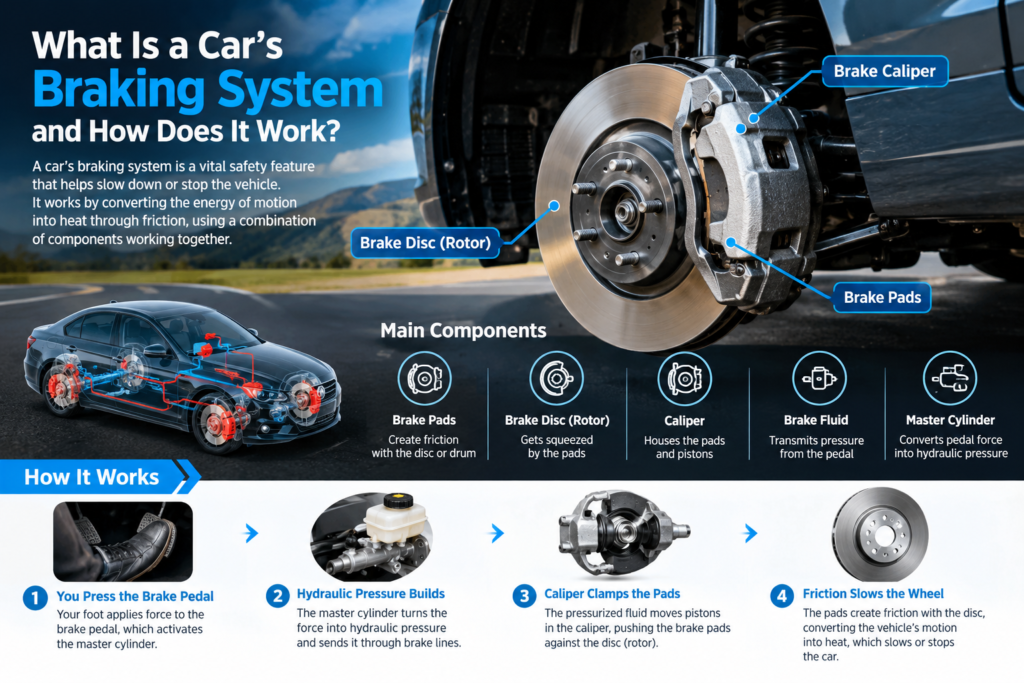
Your car’s braking system is the single most important safety feature you own. It converts your vehicle’s kinetic energy into heat, and it does this through friction. Every time you press the pedal, a chain of mechanical and hydraulic parts works together in a fraction of a second to slow you down or bring you to a full stop.
Front brakes handle roughly 70% of a car’s stopping power. Why? Braking shifts the car’s weight forward onto the front wheels, so engineers design the front brakes to work harder than the rear ones. This is why most vehicles pair front disc brakes with either disc or drum brakes at the rear.
How Does the Brake Pedal Turn Into Stopping Power?
Pressing the pedal starts a precise sequence. Here’s the full breakdown:
- You press the pedal. This creates mechanical force through a push rod.
- A servo boosts that force. Most cars use vacuum from the engine’s intake manifold to multiply your foot pressure, so stopping never feels like a workout.
- The master cylinder builds hydraulic pressure. A piston inside forces brake fluid through the lines.
- Fluid reaches every wheel. Pressure spreads evenly through the hydraulic circuit, filling small cylinders at each corner of the car.
- Friction does the work. Fluid pressure pushes caliper pistons against a disc, or forces drum shoes outward against a spinning drum.
Have you ever wondered why the pedal only needs a light push to stop two tons of steel? The master cylinder’s piston travels several inches for every fraction of an inch the wheel pistons move. Think of it like a long lever lifting a heavy weight with minimal effort. Fluid physics does the heavy lifting for you.
Why Do Cars Use Two Separate Brake Circuits?
Safety demands redundancy. Nearly every modern car runs twin hydraulic circuits with two master cylinders working in tandem, so one circuit can fail without leaving you without brakes entirely. Manufacturers split these circuits a few different ways:
- One circuit runs the front brakes, the other runs the rear.
- Each circuit controls both front wheels plus one rear wheel.
- One circuit powers all four wheels, the other backs up the front pair only.
A failure in one line still leaves you with partial stopping power. That single design choice has saved countless lives.
Disc Brakes vs. Drum Brakes: What’s the Real Difference?
This question comes up constantly, and the answer shapes how your car performs in every driving condition.
Disc brakes use a rotor that spins with the wheel. A caliper straddles the rotor and squeezes friction pads against both sides when you brake. Their open design lets air flow freely, so heat escapes fast. That’s why performance and luxury vehicles often run disc brakes on all four wheels.
Drum brakes use curved shoes that press outward against the inside of a hollow, rotating drum. They cost less to manufacture and last a long time, but their enclosed design traps heat. Repeated hard braking causes “brake fade,” a temporary loss of stopping power until the drum cools.
| Feature | Disc Brakes | Drum Brakes |
| Heat dissipation | Excellent — open design | Poor — heat gets trapped |
| Stopping power | High, consistent | Moderate |
| Fade resistance | Strong | Weak under repeated use |
| Typical location | Front (sometimes all 4) | Rear, older/economy cars |
| Maintenance | Simpler adjustment | Often needs manual adjustment |
Roughly 8 in 10 new vehicles sold today pair front discs with rear drums or rear discs, balancing cost against performance. Do you know which setup your own car uses? A quick look through the wheel spokes usually tells you: a flat metal disc means discs, a solid enclosed hub means drums.
What Keeps Your Rear Wheels From Locking Up?
Heavy braking shifts weight forward and lightens the rear wheels. Lock the rear tires under those conditions, and a dangerous skid can follow. Engineers solve this two ways:
- Weaker rear brakes by design. Manufacturers deliberately build less stopping force into rear brakes than front ones.
- A load-sensitive pressure-limiting valve. This valve closes once hydraulic pressure climbs high enough to risk rear-wheel lockup, cutting off further fluid flow to the back brakes.
Advanced vehicles go a step further with anti-lock braking systems. Wheel sensors detect when a tire is about to lock, and the ABS module pulses brake pressure on and off rapidly, letting you stop hard while keeping full steering control. Insurance data consistently links ABS-equipped vehicles to fewer loss-of-control crashes in wet or icy conditions.
How Does Power-Assisted Braking Reduce Pedal Effort?
Nobody wants to stomp hard on a pedal every time traffic slows. Power brake boosters solve that problem using vacuum pressure from the intake manifold.
A direct-acting servo sits between your pedal and the master cylinder. Both sides of a rubber diaphragm stay exposed to vacuum when the brakes are off. Press the pedal, and a valve seals off that vacuum on one side while letting outside air rush in. The pressure difference pushes the diaphragm forward, multiplying your effort against the master-cylinder piston.
What happens if the engine stalls? The mechanical link between pedal and master cylinder still works, but the pedal gets noticeably harder to push without vacuum assistance. Some vehicles instead use an indirect-acting servo mounted elsewhere in the engine bay, triggered by hydraulic pressure rather than pedal position directly.
What Is the Handbrake and When Does It Actually Save You?
Every car carries a fully mechanical backup system, separate from the hydraulic circuit entirely. The handbrake pulls a cable connected to levers at the rear wheels, bypassing fluid and pistons altogether. A ratchet locks the lever in place once engaged, and a release button frees it.
Two jobs define the handbrake: parking your car securely on a slope, and offering limited stopping power if the hydraulic system fails completely. Neither job should be underestimated. A handbrake that hasn’t been tested in months might not hold when you actually need it.
What Warning Signs Mean Your Brakes Need Attention?
Catching brake problems early saves money and prevents accidents. Watch for these symptoms:
- Squealing or grinding noises — usually worn pads eating into the rotor surface.
- A spongy or soft pedal — often points to trapped air or a fluid leak in the lines.
- Vibration through the pedal — commonly caused by warped rotors.
- Pulling to one side while braking — frequently a frozen caliper or uneven pad wear.
- A dashboard warning light — many cars embed wear sensors in the pads that short-circuit against the disc once linings run thin, triggering an instant alert.
Ignoring any of these signs risks turning a simple pad replacement into a full rotor or caliper repair. Why wait for a cheap fix to become an expensive one?
Frequently Asked Questions
What is the brake system in a car?
A brake system slows or stops a vehicle by converting kinetic energy into heat through friction. Hydraulic fluid carries force from the pedal to each wheel, where pads or shoes press against a rotor or drum. Every wheel gets stopping power at the same time, so the car slows down evenly.
What are the three types of brakes?
Most vehicles use three brake types: disc brakes, drum brakes, and the parking brake. Disc brakes clamp pads against a spinning rotor and dissipate heat fast. Drum brakes push shoes outward against a rotating drum and cost less to build. The parking brake works mechanically through a cable, independent of the hydraulic system entirely.
What is CBS and ABS?
ABS stands for Anti-lock Braking System. Wheel sensors detect when a tire is about to lock, and the system pulses brake pressure to prevent skidding. CBS stands for Combined Braking System, found mainly on motorcycles and scooters. One lever or pedal in a CBS setup applies both front and rear brakes together, so the rider gets balanced stopping power without coordinating two separate controls.
What are the four types of braking systems?
Engineers generally group braking systems into four categories: hydraulic, mechanical, air, and electromagnetic. Hydraulic systems use fluid pressure and appear in most passenger cars. Mechanical systems rely on cables and levers, like a handbrake. Air brakes use compressed air and power heavy trucks and buses. Electromagnetic systems use magnetic resistance to slow a vehicle, often paired with hydraulic brakes in hybrid and electric cars for regenerative braking.
How does a hydraulic brake system work?
A hydraulic brake system moves fluid through sealed lines to transmit force. You press the pedal, the master cylinder pressurizes the fluid, and that pressure reaches the wheels almost instantly. Fluid can’t compress, so pressure travels evenly and applies equal force at every wheel. This design gives drivers consistent, predictable stopping power.
Do all cars have the same braking system?
No. Braking systems vary by vehicle weight, cost, and performance goals. A compact economy car might run rear drums to cut manufacturing costs. A sports car typically runs discs on all four wheels for better heat dissipation and stronger stopping power at high speed. Heavy trucks often need air brakes, since hydraulic systems alone can’t generate enough force to stop that much mass safely.
Final Thoughts
Your braking system blends hydraulics, mechanics, and precision engineering into one life-saving package. Front discs handle most of the workload, rear brakes stay intentionally weaker to prevent skids, and backup systems like the handbrake and twin circuits protect you when something goes wrong. Regular inspections, quick attention to warning signs, and a basic understanding of how discs and drums differ keep you safer on every drive.
CarRevix is an automotive-focused website covering car care, maintenance, repairs, detailing, performance parts, and automotive SEO/marketing services.