
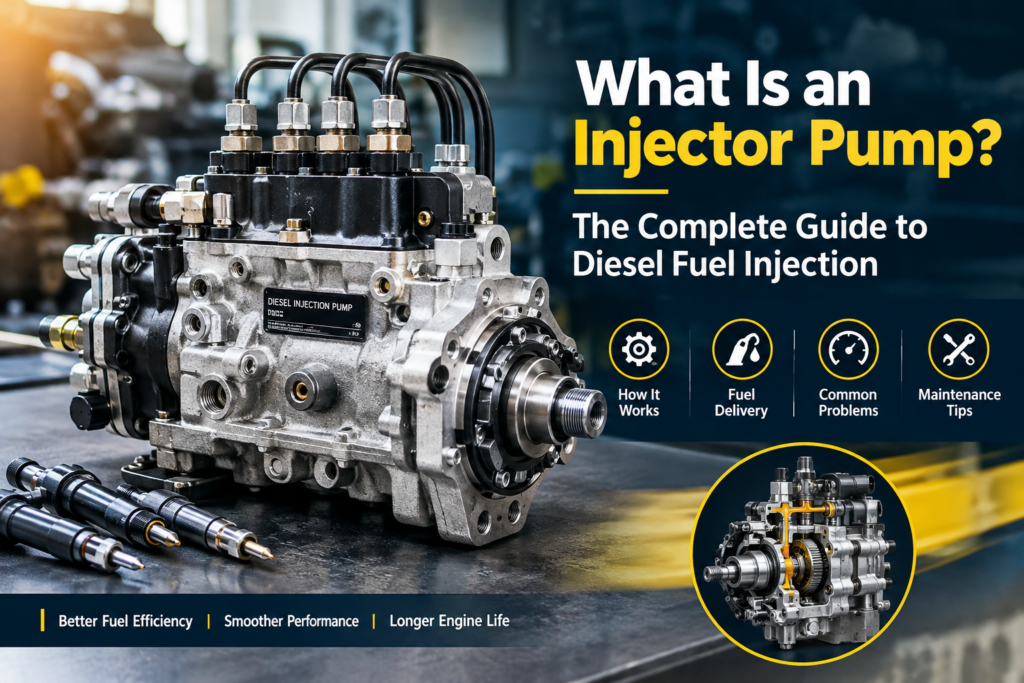
Diesel engines skip spark plugs entirely. Compressed air alone generates enough heat to ignite the fuel, and the injector pump makes that possible. It pressurizes diesel to extreme levels, times delivery to the microsecond, and sprays it into each cylinder as a fine mist. A single miscalibration anywhere in that chain and the whole engine suffers.
How does one component control power, fuel economy, and emissions all at once? Let’s break it down.
What Does an Injector Pump Actually Do?
An injector pump draws fuel from the tank and raises it to the pressure the injectors need. Modern common rail systems typically exceed 2,000 bar (29,000 psi), compared to roughly four bar in a standard petrol engine’s fuel pump. Some Bosch piezo-injector systems push that figure even higher, reaching up to 2,700 bar for maximum output. That pressure atomizes the fuel into a fine spray, so combustion stays clean and complete rather than rough and incomplete.
Timing matters just as much as pressure. The pump has to deliver fuel to each cylinder at exactly the right moment in the combustion cycle. Miss that window and you’ll notice it fast: rough idling, power loss, or a knock audible from the driver’s seat.
Heavy-duty vehicles depend on this precision more than most. Trucks, buses, tractor units, and construction machinery run long duty cycles under high torque demands. A worn or poorly calibrated pump shows its symptoms faster here than it would in a light passenger car.
How Does the Fuel Injection Process Work?
Four stages happen every time you press the accelerator.
Suction and filtering come first. A low-pressure lift pump pulls diesel from the tank and runs it through a fuel filter to strip out debris and water before it reaches the injection pump.
Pressurization follows. Plungers driven by a precision camshaft force fuel into a sealed chamber inside the pump housing. Pressure builds fast, and it has to build evenly across every cylinder, or the engine runs unbalanced.
Metering and timing come next. A mechanical governor or an electronic control unit decides how much fuel moves forward and how much bypasses back to the tank. Advanced systems can fire up to seven partial injections within a single combustion cycle, a technique that lowers noise and helps regenerate particulate filters. Sensor data on throttle position, engine speed, and load feeds this calculation in real time.
Combustion spray finishes the sequence. Pressurized fuel exits through the injector nozzle as a fine mist, timed to hit the cylinder right as the piston nears peak compression.
Do all four stages sync up correctly? You get full power, tighter emissions, and better mileage. Does any stage fall out of sync? You’ll feel it immediately in how the engine runs.
What Are the Main Types of Injector Pumps?
Four designs dominate the diesel world, and each fits a different use case.
Inline pumps give each cylinder its own dedicated plunger and barrel. Simplicity drives the appeal here. Mechanics favor inline pumps for heavy-duty trucks and older tractors, since the design is rugged, easy to service, and tolerant of demanding conditions.
Rotary, or distributor, pumps use one central plunger and a rotary head to send fuel to each injector in firing order. Compact size makes this design a natural fit for smaller engines where space under the hood stays tight.
Common rail pumps run the show in most modern diesel vehicles. The pump’s job shifts here: instead of feeding cylinders directly, it keeps a shared high-pressure rail primed with fuel, and electronic injectors pull from that rail on command from the ECU. Precision goes up, and so does fuel efficiency. The shift toward this architecture has real market weight behind it too. The global diesel common rail injection system market reached $22.6 billion in 2024 and is projected to grow 5.7% between 2025 and 2034, pushed largely by tighter emissions standards worldwide.
Unit injectors combine the pump and injector into a single assembly per cylinder. The ECU controls each unit based on sensor input, a setup that simplifies the layout even as it demands tighter electronic control.
Which design sits under your hood usually comes down to the vehicle’s age and duty cycle. Older heavy-duty trucks lean inline. Modern cars and light trucks run common rail almost exclusively.
What Are the Warning Signs of a Failing Injector Pump?
Contamination, wear, and electrical faults all wear down an injector pump over time, and the symptoms tend to appear in a predictable order.
Hard or delayed starting is often the first sign, especially in cold weather. Poor fuel delivery makes ignition difficult for the engine.
Rough idling and power loss follow next. Inconsistent metering means the cylinders aren’t getting even fuel delivery, so the engine hesitates or struggles to reach full RPM under load.
Exhaust smoke tells its own story. Black smoke points to unburnt fuel. White smoke usually signals incorrect timing. Blue smoke means fuel leaking into the oil chambers, a problem worth catching early since it can compound engine damage quickly.
Knocking or whining noises from the pump area point to internal wear. Rising fuel consumption signals a drop in atomization quality. And a fuel smell on the oil dipstick means worn seals are likely letting pressurized diesel leak into the crankcase.
More than one of these symptoms at once? That combination usually means the pump itself needs inspection, not just a filter swap.
How Often Should You Maintain an Injector Pump?
Most manufacturers recommend inspection every 30,000 to 50,000 miles, though severe driving conditions or heavy loads shorten that window considerably.
A few habits extend pump life between checkups. Fuel filters need replacement on schedule, since contaminated fuel wears down internal components faster than almost anything else. Fuel that meets your engine’s specifications protects the pump long-term. Bleeding air from the fuel system and proper storage during long idle periods both matter too.
Routine care alone isn’t enough. A qualified technician should check seals, fittings, and pressure output at regular intervals. Small leaks and pressure drift stay easy to miss until they turn into expensive repairs. When replacement time comes, genuine-quality components from a trusted OEM-grade brand hold up far better than budget alternatives under heavy-duty conditions.
How Much Does an Injector Pump Cost to Replace?
Cost varies widely by pump type, vehicle make, and your choice between OEM and aftermarket parts. Common rail pumps for modern passenger vehicles typically cost less than the larger inline pumps used in heavy-duty trucks, since truck pumps handle higher pressure output and larger displacement engines. Labor adds a significant chunk too, because calibration and timing work demand precision most shops can’t rush.
Your vehicle’s year, make, and engine model narrow the estimate fast. A local parts supplier or dealer can quote an exact figure based on your specific pump type.
Frequently Asked Questions
What are the symptoms of a bad injector pump?
Hard starting, rough idling, power loss, unusual exhaust smoke color, knocking noises, and fuel smell on the oil dipstick all point to a failing pump.
How does an injector pump work?
The pump pulls fuel from the tank, pressurizes it through plungers or a rotary mechanism, times its release to match engine load, and forces it through the injectors as a fine atomized spray.
What are the two main types of fuel injection pumps?
Inline and rotary (distributor) pumps represent the two classic mechanical designs, though most modern vehicles now run common rail systems instead.
What’s the difference between inline and rotary pumps?
Inline pumps give each cylinder a dedicated plunger and barrel, built for durability in heavy-duty engines. Rotary pumps use a single plunger and distributor head, built for compact engines with tighter space constraints.
How often should an injection pump be serviced?
Every 30,000 to 50,000 miles under normal conditions, though severe duty cycles call for more frequent checks.
Final Thoughts
An injector pump rarely fails without warning. Small signs show up first, a slightly rougher idle, a puff of extra smoke, a start that takes half a second longer than usual. Catch those moments early, and a simple filter change or seal replacement solves the problem before it spreads.
Wait too long, and the cost climbs fast. Worn plungers strain the whole fuel system. Leaking seals contaminate engine oil. Poor timing drags down every cylinder at once, not just one. None of that damage happens overnight, but all of it compounds.
Your engine’s long-term health rests on a simple habit: pay attention, service on schedule, and choose parts built to OEM standards. Do that consistently, and the injector pump keeps doing its job quietly for hundreds of thousands of miles. Skip it, and you’ll be reading this article again after an expensive repair bill.
CarRevix is your automotive knowledge hub for expert car care, maintenance, repairs, detailing, performance, and automotive SEO insights—helping drivers keep their vehicles safe, reliable, and looking their best.