
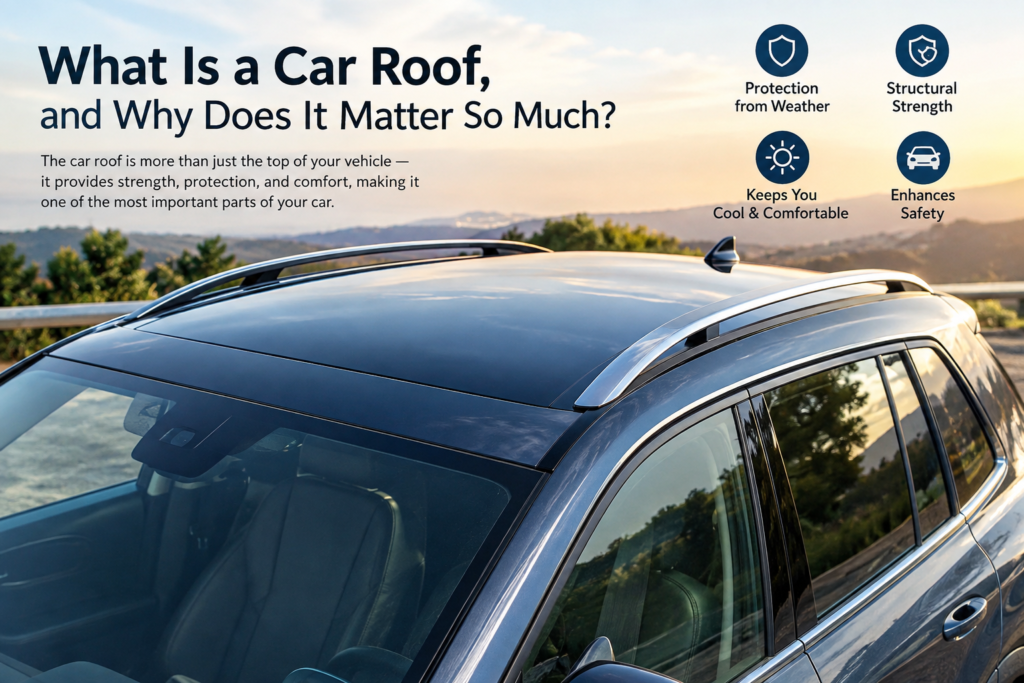
A car roof does more than block rain. Engineers treat it as a safety part, a style statement, and a lifestyle feature all at once. You sit under it every drive, yet you rarely think about its real job. Do you know how many roof types exist, or why some feel flimsy while others feel bulletproof? Let’s break it down.
What Is the Car Roof Called?
Most people just say roof. Automakers use other terms too. Car top appears in older manuals. The ceiling names the interior side, the part lined with fabric above your head. Car roof and car ceiling differ in meaning. The roof is the exterior panel. The ceiling, or headliner, is the part you see and touch from inside the cabin.
What Does “Car Roof” Actually Mean?
A car roof is the upper panel that covers the passenger compartment. Manufacturers weld it directly to the body frame in most vehicles. The panel does three jobs at once. It shields you from weather. It adds rigidity that helps the vehicle survive a rollover. It also anchors interior parts like the headliner, electrical wires, and sometimes solar panels or antennas.
What Are the Three Types of Car Roofs?
You’ll hear this question often, and the answer depends on who asks. Engineers group roofs into three broad categories: fixed, retractable, and open-panel. Each category splits into specific styles.
Fixed roofs never move. The classic hardtop falls into this group. It’s a solid metal or composite panel bolted and welded into place. You’ll find it on the Toyota Camry, Honda Accord, and Jeep Grand Cherokee. It offers the best rigidity and the simplest build, so it costs less to make and repair.
Retractable roofs fold away completely. Convertibles lead this group. A soft-top, like the one on a Mazda MX-5 Miata, folds fast and stays light. A retractable hardtop, seen on older BMW 4 Series models, adds insulation and a clean look when closed. A Targa top, made famous by the Porsche 911, sits between a coupe and a full convertible.Open-panel roofs let in light and air, yet the roof stays mostly intact. Sunroofs, moonroofs, and panoramic roofs belong here, along with the retro T-top. Demand for these roofs has climbed fast: new car models with sunroofs rose to 40 percent by 2017, up from 33 percent in 2011.
Sunroof vs. Moonroof: What’s the Real Difference?
People use these words interchangeably, but the two differ. A sunroof usually carries a solid metal panel. You tilt it or slide it open by hand or motor to let in air and light directly. Picture it as a window built into the roof itself.
A moonroof goes a step further. It swaps the metal panel for tinted glass, so light still filters through even when closed. Moonroofs slide back into a pocket in the roof frame. A sunroof tilts outward instead. You’ll spot moonroofs on higher trims, like the Honda CR-V Touring or Kia Sportage SX Prestige. No strict industry standard splits the two terms apart, so overlap happens often, and that explains the mix-up.
What Makes a Panoramic Roof Different?
A panoramic roof stretches across both the front and rear seat rows. Some panels stay fixed in place. Others slide open partway, like a large sunroof. Either way, everyone inside gets a wide view of the sky, not just the front seats.
Automakers have leaned hard into this feature over the past decade. You’ll find panoramic glasson family SUVs like the Hyundai Palisade, sleek crossovers like the Ford Edge Titanium, and even EVs like the Tesla Model Y. The numbers back up the trend: roughly 11 percent of new passenger cars worldwide already carry a panoramic sunroof, and one leading mass-market brand tops a 40 percent equipment rate. The broader automotive sunroof market reached $19.95 billion in 2025 and is on track to hit $54.26 billion by 2035. Shade systems or electrochromic glass often go with these panels, so the cabin stays cool on a hot afternoon. Road-trip drivers love this style, since it turns a long highway stretch into an observatory on wheels.
Why Do T-Tops Still Have a Fan Base?
The T-top brings pure nostalgia. You remove two roof panels above the driver and passenger, but a center bar stays in place, and that bar forms the T-shape that gives the design its name. Classic muscle cars like the Chevrolet Corvette C3 and Pontiac Firebird Trans Am made this style iconic. It gives you an open-air feel, yet it keeps the structural bar that ties the roof together.
What Structural Parts Support a Car Roof?
A roof panel can’t stand alone. Several hidden parts carry the load and add crash protection.
- Pillars (A, B, C, and D): Vertical supports connect the roof to the body and absorb crash energy during a collision or rollover.
- Roof rails and crossbars: SUVs, wagons, and crossovers often carry these tracks. They spread weight evenly when you mount a cargo box or bike rack, so the roof doesn’t buckle under an uneven load.
- Headliner: The fabric ceiling you see from inside holds insulation, sound-block material, and wires. Some owners upgrade it with a custom starlight kit.
Roof rails and roof racks often get mixed up too. A rail runs along the roofline and stays fixed usually. A rack sits on top of the rails and holds the actual cargo, so both work together to carry heavy loads. Adoption of roof-opening features overall keeps climbing: more than 60 percent of new vehicle platforms in North America and Europe now include at least one roof-opening variant, up from under 40 percent just five years earlier.
Which Roof Type Fits Your Lifestyle?
Ask yourself how you drive before you pick a car by its roof.
- Want zero maintenance and top durability? A hardtop wins every time.
- Chase sunny weekend drives? A soft-top convertible gives pure open-air fun.
- Want light without full exposure? A sunroof or moonroof splits the difference.
- Road-trip often, or love a big sky view? A panoramic roof turns every drive into a scenic one.
- Miss the muscle car era? A T-top gives that retro edge.
FAQ: Quick Answers About Car Roofs
What is the car roof called?
Most people just call it the roof. Some manuals use car tops. The interior side has its own name too — that’s the headliner, or ceiling.
What are three types of roofs?
Engineers group them as fixed, retractable, and open-panel. Fixed roofs never move, like a hardtop. Retractable roofs fold away, like a convertible. Open-panel roofs include sunroofs, moonroofs, and panoramic glass.
Is it the car ceiling or roof?
Both terms exist, but they mean different things. The roof is the exterior panel. The ceiling, or headliner, is the fabric layer you see from inside the cabin.
What is the meaning of “car roof”?
A car roof is the upper panel that covers the passenger compartment. It protects you from weather, adds rollover strength, and anchors interior parts like wires and the headliner.
Final Thoughts
A car roof carries more science, history, and personality than most drivers realize. From the rock-solid hardtop to the sky-wide panoramic glass, each style solves a different problem and fits a different driver. The next time you climb into your car, look up for a second. More happens above your head than you might think.
CarRevix is your automotive knowledge and service hub, offering expert car care insights, maintenance guidance, repair information, and automotive-focused solutions to help drivers keep their vehicles safe, reliable, and looking their best.