
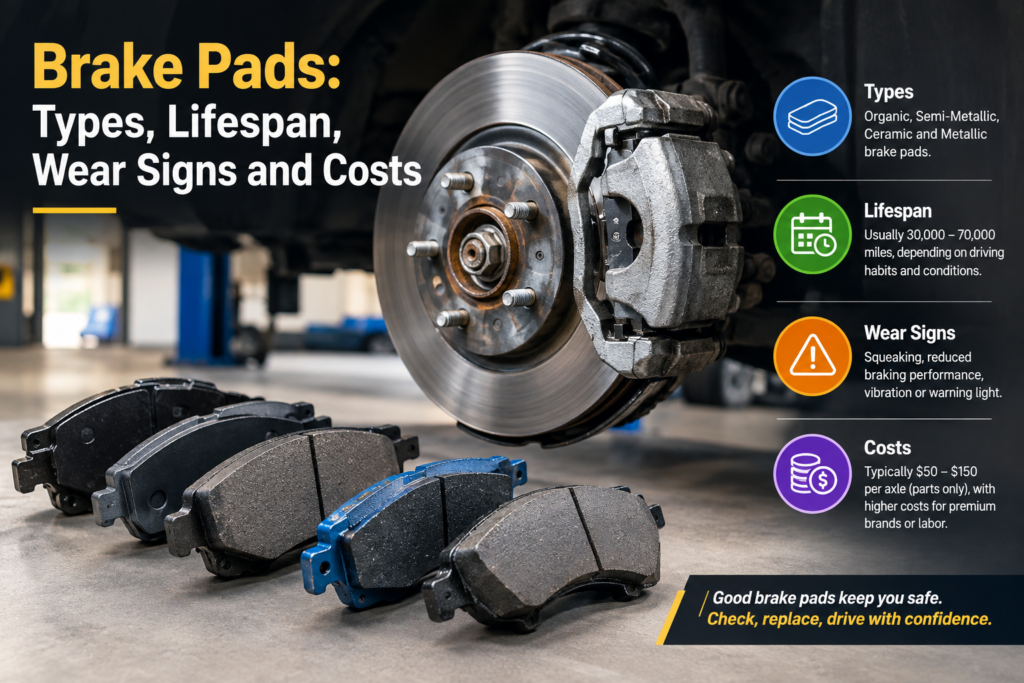
Meta title: Brake Pads Guide: Types, Lifespan, Wear Signs and Costs
Meta description: Learn how brake pads work, how long they last, when to replace them and what they cost. Get clear answers before you book a repair.
Brake pads control how fast your car stops. Each time you slow at a junction, the pads clamp onto the brake disc. Friction turns motion into heat. Would you trust a worn set with your family? Most drivers say no. The good news is that pads give clear signs long before they fail.
You can use this guide to answer every question about them. You will learn how pads work, which type fits your car, when to replace them, and what the job costs.
What Are Brake Pads and How Do They Work?
A brake pad is a steel plate with a layer of friction material bonded to it. Each wheel has a pair of pads, one disc (also called a rotor) and one caliper. You press the pedal, and hydraulic fluid pushes the caliper piston. The piston squeezes the pads against both sides of the disc. Friction slows the wheel, and the car’s kinetic energy turns into heat.
Pads do this thousands of times a year, so they wear down slowly. The Highway Code lists about 96 metres as the total stop distance at 70 mph. Worn pads add to that figure. Do you know how much material your pads have left?
What Is the Difference Between Brake Pads and Brake Discs?
The pad is the soft, sacrificial part. The disc is the hard metal surface it grips. Pads wear faster because they take the friction first.
Discs usually outlast pads. Even so, they thin over time, and worn pads speed up that damage. Many garages therefore check both parts at each replacement. The manufacturer sets the minimum disc thickness, and your mechanic measures it.
What Types of Brake Pads Can You Choose From?
The right compound depends on your car, your budget and your habits. Which one fits your routine?
| Feature | Organic | Semi-Metallic | Ceramic |
| Best for | Small cars, light use | Trucks, trailers, spirited drivers | Daily commutes, luxury cars |
| Noise | Quiet | Can squeal when cold | Near silent |
| Brake dust | Moderate | Heavy and dark | Low and light |
| Lifespan | Shortest | About 40,000–50,000 miles | Often 60,000+ miles |
| Disc wear | Gentle | Higher | Low |
| Heat resistance | Limited | Excellent | Moderate |
| Price | Lowest | Mid-range | Highest |
Organic pads use rubber, glass and resin. They stay quiet and cheap, but they wear fast and struggle in extreme heat.
Semi-metallic pads contain roughly 30% to 65% metal, such as steel, iron and copper. They bite hard when cold and shed heat well. Heavy vehicles and keen drivers favour them. The trade-off is more noise, more dust and faster disc wear.
Ceramic pads combine dense ceramic fibres with copper. They stay clean and quiet, and they last longest. Expect a higher price.
Low-metallic pads sit between organic and semi-metallic. They outlast organic pads, but they can be noisy.
How Long Do Brake Pads Last?
Most drivers get between 30,000 and 70,000 miles from a set of pads. Some need a change much sooner. Others go much further. Why is the gap so wide? Many factors shape wear, and you control several of them.
What Affects How Fast Brake Pads Wear?
Your driving style. Hard, late stops wear pads fast. Smooth, early stops make them last far longer. Sit close behind other cars, and you press the pedal more often.
Your route. City roads mean constant stop-start traffic, so your pads work harder there than on open motorways. Motorway jams also hurt. You slow from high speed, and the pads take more heat.
Your vehicle weight. SUVs, vans and electric cars need more force to stop. Roof boxes, full boots and caravans add load. A family of five puts more strain on pads than a couple does.
Your pad material. Ceramic pads outlast organic pads. Semi-metallic pads last well, but they wear discs faster.
Your axle. Front pads usually wear out first. They handle most of the stopping load.
Your maintenance. Stuck calipers and old brake fluid speed up wear. Regular services catch those faults early.
How Long Do Brake Discs Last?
Discs often last up to 80,000 miles. Many cars need two sets of pads before the discs need attention.
Hard stops, trailer loads and heavy city traffic shorten disc life. Cheap discs also wear faster than quality or performance-grade ones. Worn pads and seized calipers add damage. Do you plan to keep your car for years? Then quality discs repay their cost.
How Do You Know Your Brake Pads Need Replacement?
Your car tells you if you know where to look and listen.
Wear sensor light. Many cars have wear sensors. A dashboard light appears when pad thickness reaches about 3 mm. Not every car has sensors, so do not rely on the light alone.
A squeal. A high-pitched screech often means the pads are low. Some pads include a metal tab that makes this noise on purpose.
A grind. A grind means the friction material is gone. Metal now rubs on metal. Park the car and arrange a repair straight away.
Longer stop distances. Does your car feel slower to halt than before? Worn pads cause that change.
A pull to one side. Uneven wear or a stuck caliper drags the car sideways when you slow.
Vibration. A shaking pedal or steering wheel often points to warped discs.
A spongy pedal. A soft pedal can signal air or moisture in the fluid. Get it checked promptly.
When Should You Replace Brake Pads and Discs?
Replace pads when the friction material reaches 3 mm. Later replacement risks disc damage and a weaker stop. The MOT test also flags pads at or below that thickness.
Always replace pads in axle sets. Fit both front pads together and both rear pads together. Uneven pads cause uneven stops.
Should you replace the discs at the same time? Often yes. Fresh pads settle best on a smooth, even disc. Your mechanic will measure the discs against the manufacturer’s minimum and advise you.
How Can You Check Brake Pad Thickness?
You have two easy options.
- Look through the wheel spokes. On many cars you can see the outer pad against the disc. Less than 3 mm of pad means you should book an inspection.
- Remove the wheel. This method gives the most accurate result. Jack the car on level ground, support it with axle stands, and inspect the pads through the caliper.
Do you feel unsure? Ask a trusted garage to remove the wheels at your next service. A glance through the spokes is not a full inspection.
Can You Replace Brake Pads Yourself?
You can, but the job demands real mechanical skill. It is far harder than a tyre pressure check or an oil top-up. Brakes are a critical safety system, and errors can be severe.
The basic steps look like this:
- Lift the car safely and remove the wheel.
- Remove the caliper guide pin bolts.
- Lift off the caliper and take out the old pads.
- Inspect the disc for damage.
- Push the caliper piston back with a clamp. Watch the fluid reservoir for overflow.
- Apply a thin layer of copper grease to the pad edges and backs. Keep grease off the friction surface.
- Fit the new pads and secure the caliper.
- Press the pedal several times before you move the car. Top up the fluid if needed.
Which mistakes should you avoid?
- Never skip the axle stands.
- Keep grease off the friction surface.
- Tighten every caliper bolt fully.
- Replace both pads on an axle.
- Press the pedal before the first trip.
Have doubts about any step? Hand the job to a professional. Brake failure gives you no second chance.
How Much Does It Cost to Replace Brake Pads?
Costs vary by car and location. UK figures from August 2026 give a useful guide:
- Front and rear pads together: about £150 to £700
- Front pads only: around £128 on average
- Rear pads only: around £121 on average
- New discs as well: roughly £150 to £250 extra for small cars, and £200 or more for larger ones
Labour rates, your make and model, and part quality all affect the final bill. Will a cheap set save you money? Rarely. Budget pads often wear faster, and you pay for the job twice.
How Do You Choose the Right Brake Pads?
Match the pad to your needs. Ask yourself these questions:
- What do you drive? Small cars suit organic or ceramic pads. Heavy or powerful cars often need semi-metallic or ceramic.
- How do you drive? Commuters usually prefer ceramic for low noise and low dust. Trailer loads and track days call for semi-metallic pads that resist heat.
- How much noise can you accept? Ceramic is quietest. Metallic pads are loudest.
- Do you hate clean wheels less than dirty ones? Ceramic pads make the least dust.
- What is your budget? Weigh the cost per mile, not just the sticker price.Trusted brands include Akebono, Bosch, Brembo and EBC. Akebono ceramic pads have a strong name for quiet, low-dust daily use. Bosch QuietCast kits often include the hardware you need. Brembo and EBC suit enthusiasts who want sharp bite and strong heat control.
Always match the pad to your exact year, make, model and axle. Which axle do you need: front, rear or both?
How Can You Make Brake Pads Last Longer?
Small habit changes save real money.
- Look ahead and slow early and gently.
- Keep a safe gap from the car in front.
- Accelerate smoothly to avoid heavy stops.
- Remove roof racks and loads you do not need.
- Change the brake fluid on the schedule in your handbook. Two years is a common interval.
- Book regular services so a mechanic can spot stuck calipers early.
- Choose quality pads and discs.
Do Electric Cars Need Brake Pads?
Yes, they do. Regenerative brakes recover energy and cut pad wear. Pads often last longer as a result. Yet electric cars weigh more, and unused pads can corrode. Uneven wear also appears. Have a garage inspect the brakes every year, even if the pads look fine.
Are Brake Pads Checked in an MOT?
Yes. The MOT tests the whole brake system, including pads, discs and calipers. Pads at 3 mm or below should be replaced. Do not wait for the test. Book a check as soon as you notice a sign of wear.
Brake Pads FAQ
How often should you change brake pads?
Most sets last 30,000 to 70,000 miles. Your habits and car type set the real figure.
Can you drive on worn brake pads?
squeal gives you a short window to act. A grind means you must park the car and call for help.
Should you replace pads and discs together?
Often yes, especially if the discs are thin, scored or warped.
Why do new brake pads squeal?
New pads need a short bed-in period. Persistent noise means a mechanic should check the fit.
Which brake pads last longest?
ceramic pads usually win on lifespan and cleanliness. Semi-metallic pads last well but wear discs faster.
Do front or rear pads wear faster?
Front pads wear faster because they carry more of the stopping load.
Final Thoughts: Your brakes protect you, your passengers and other road users. Listen for noise, watch the dashboard, and check pad thickness often. Replace pads at 3 mm. Choose a type that matches your route and your habits.
.
CarRevix is your trusted destination for automotive insights, car maintenance tips, repair guides, and expert advice. From engine diagnostics and brake systems to vehicle care, detailing, and performance upgrades, we help car enthusiasts and vehicle owners make informed decisions and keep their vehicles running smoothly, safely, and efficiently.