
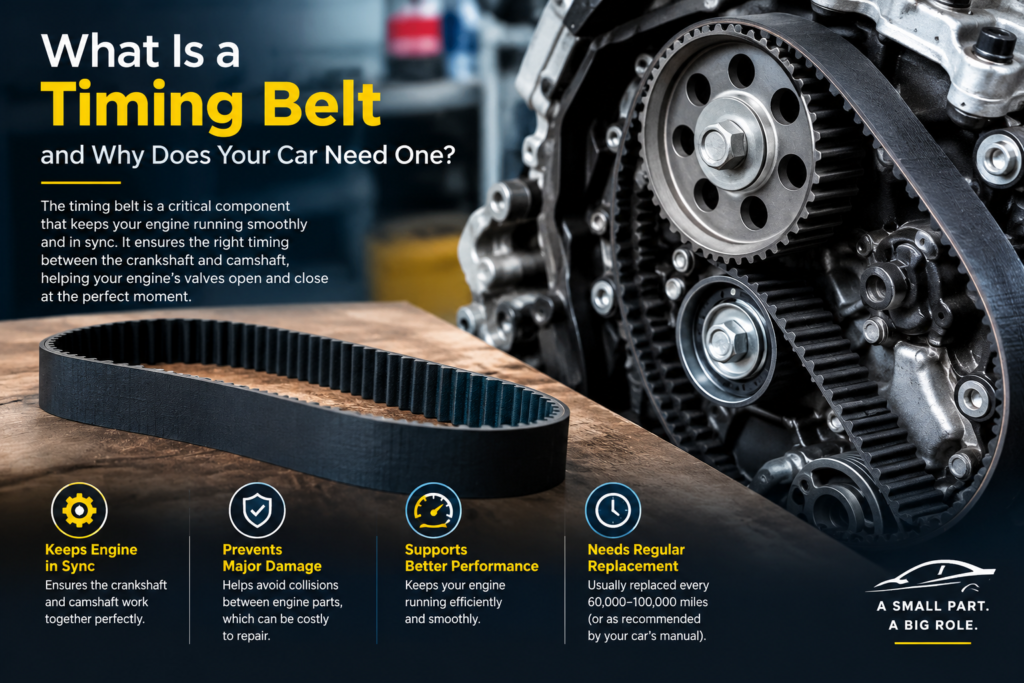
Your engine relies on perfect timing. A timing belt makes that timing possible. This toothed rubber belt connects your crankshaft to your camshaft, and it keeps both parts in sync. A break in this sync can cause pistons and valves to collide inside the engine.
Why does a small rubber belt get so much attention from mechanics? The answer is simple. A broken timing belt can destroy an entire engine in seconds. This guide covers the belt’s function, the right replacement schedule, the typical cost, and the early warning signs.
What Does a Timing Belt Actually Do?
A timing belt transfers rotational motion from the crankshaft to the camshaft. The camshaft then opens and closes your engine’s intake and exhaust valves at exact moments. Correct valve timing lets fuel and air enter the cylinder, then lets exhaust gases exit, all in the right order.
Manufacturers build these belts from reinforced rubber compounds like neoprene or polyurethane. Teeth on the belt’s inner surface grip matching teeth on the crankshaft and camshaft pulleys. Slippage stays rare because of this design, so timing remains precise even at high engine speeds.
Many engines also use the timing belt to power other components. Your water pump, for example, often draws power from the same belt. A shared belt is one reason mechanics recommend a water pump swap during timing belt jobs, since the labor to access both parts overlaps by a wide margin.
How Does a Timing Belt Work Inside the Engine?
Your crankshaft sits at the bottom of the engine and spins fast. It converts the up-and-down motion of your pistons into rotational force. A pulley on the crankshaft carries the timing belt upward to pulleys on one or more camshafts.Tensioner pulleys and idler pulleys keep the belt tight and aligned during operation. A loose belt would skip teeth, and a skipped tooth throws off valve timing right away. A properly tensioned belt, in contrast, holds every rotation accurate for years.This mechanical link shapes your engine’s entire combustion cycle. Intake valves open just as pistons descend to draw in air and fuel. Exhaust valves open just as pistons rise to push out spent gases. One damaged tooth can throw the whole sequence out of alignment, and the results can reach every cylinder in the engine.
When Should You Replace a Timing Belt?
Most manufacturers set a replacement window between 60,000 and 100,000 miles. That range equals roughly 100,000 to 160,000 kilometers, depending on your region’s measurement standard. Your owner’s manual lists the exact figure for your specific engine.Time matters as much as mileage. Rubber degrades from heat, cold, and age, even on a car that sits unused for long stretches. A ten-year replacement mark applies in most cases, regardless of the odometer reading. A ten-year-old belt with low mileage can still crack.
Do you drive a diesel or a turbocharged vehicle? Your belt may face extra stress from higher engine loads. A shorter interval often applies in these cases, so check your manual for the manufacturer’s specific number.
What Are the Warning Signs of a Failing Timing Belt?
Timing belts rarely warn drivers before a snap. Still, several symptoms can point to trouble ahead. Early detection can save you from a much larger repair bill.
- A ticking or rattling noise. A worn belt often produces a repeated click near the front of the engine.
- A rough idle or misfires. A stretched or slipped belt throws off valve timing, and the engine runs unevenly as a result.
- Trouble at startup. A severely damaged belt can let the engine crank without a fire-up.
- Visible cracks or fraying. A quick visual check can catch wear before it turns dangerous.
- Oil leaks near the timing cover. Leaked oil speeds up rubber degradation and shortens belt life.
A mechanic can also measure belt tension directly or scan for related error codes. Regular inspections catch problems your ears might miss.
What Happens If a Timing Belt Breaks?
The outcome depends entirely on your engine design. Two categories exist: interference engines and non-interference engines. Your risk level changes completely based on this one distinction.
Interference engines pack pistons and valves into overlapping space at different points in the cycle. A belt break during a drive stops the camshaft, but the pistons keep moving. Open valves sit in the piston’s path, and a violent collision follows. Repair costs in this scenario often reach thousands of dollars, since bent valves, damaged pistons, and cylinder head repairs all enter the picture.
Non-interference engines keep pistons and valves apart at all times. A snapped belt here simply stalls the engine. A tow and a new belt solve the problem, and internal components stay safe. Your owner’s manual, or a quick search by make and model, will confirm which type applies to your car.
How Much Does Timing Belt Replacement Cost?
Costs vary by vehicle size, engine complexity, and local labor rates. A general breakdown by category looks like this:
| Vehicle Type | Estimated Cost |
| Small or compact cars | 350–600 |
| Mid-range sedans and SUVs | 600–1,000 |
| Luxury vehicles and complex engines | 1,000–2,500 |
Labor accounts for a large share of this total. Several engine covers and accessories must come off just to reach the belt. Parts costs climb further if the tensioner, idler pulleys, or water pump also need a swap.
A full kit costs more upfront, yet it saves money down the road. A skipped water pump today often means a second round of the same labor tomorrow. Most technicians strongly recommend the full-kit approach for this reason.
Timing Belt vs. Timing Chain: What’s the Difference?
Some engines use a timing chain instead of a belt. Both parts serve the same function, yet they differ in material and lifespan.
Timing belts run quieter and weigh less than metal chains. Lower manufacturing and replacement costs follow from this lighter design. Rubber wears out faster than metal, though, so belts need a scheduled swap. Timing chains, in contrast, often last the life of the engine, despite the extra noise and weight they carry.
Which option suits you better? Neither answer fits every driver. A timing chain lowers scheduled maintenance costs over time. A timing belt keeps the upfront engine costs lower and runs quieter day to day. Your vehicle’s engineers already made this choice for you, so your real task is knowing which type sits under your hood.
What Does a Full Timing Belt Replacement Involve?
A qualified technician starts with the removal of covers, accessory belts, and sometimes engine mounts to reach the timing components. Next, the technician marks the exact position of the crankshaft and camshaft pulleys. Correct reassembly and accurate timing depend on this step.
The old belt, tensioner, and idler pulleys come out as a set. A new kit goes in, matched to your engine’s exact specifications. Many shops add a water pump swap at this stage, since the same disassembly grants access to both parts.
A hand-rotation of the engine confirms proper alignment before the first startup. Timing errors get caught at this check, well before they cause real damage. A careful shop will also inspect related parts, like the accessory drive belt and seals, while access remains open.
Frequently Asked Questions
How long does a timing belt last on average?
Most timing belts last between 60,000 and 100,000 miles, or 7 to 10 years, whichever comes first. Your specific mileage depends on the engine type and driving conditions.
Can I drive with a bad timing belt?
A worn timing belt can fail at any moment. Driving with visible cracks, unusual noise, or a stretched belt risks a sudden break, and the consequences range from a stall to severe engine damage.
Is a timing belt replacement the same as a timing chain replacement?
No. A timing belt needs replacement on a set schedule because rubber wears out over time. A timing chain, on the other hand, often lasts the life of the engine and rarely needs a scheduled swap.
What happens if a timing belt breaks while driving
The result depends on your engine type. An interference engine suffers piston-to-valve collisions and often needs a full rebuild. A non-interference engine simply stalls, and a tow plus a new belt gets you back on the road.
Does a timing belt replacement include the water pump?
Not always, but most mechanics recommend the swap at the same time. The labor to access both parts overlaps closely, so a combined job saves money on a second labor charge later.
How do I know if my car has a timing belt or a timing chain?
Your owner’s manual lists this detail directly. A quick search by your car’s make, model, and year also confirms the answer within seconds.
What are the first signs of timing belt failure?
A ticking noise near the front of the engine often comes first. Rough idling, misfires, and trouble at startup can follow as the wear progresses.
Does timing belt cost vary by car brand?
Yes, significantly. Luxury vehicles and complex engine layouts push costs toward the 1,000–2,500 range, while small and mid-range cars typically fall between $350 and $1,000.
Final Thoughts
Your timing belt works out of sight, yet it carries huge responsibility for your engine’s health. Regular inspections and on-time replacement protect you from catastrophic damage and steep repair bills. Do you know your vehicle’s specific replacement interval? A check of your owner’s manual today can answer that question, or you can share your car’s make, model, and year for a precise number.
CarRevix is an automotive-focused platform covering car care, maintenance, repairs, detailing, performance parts, and automotive SEO and content solutions. It provides practical automotive information and professional services to help vehicle owners and automotive businesses