
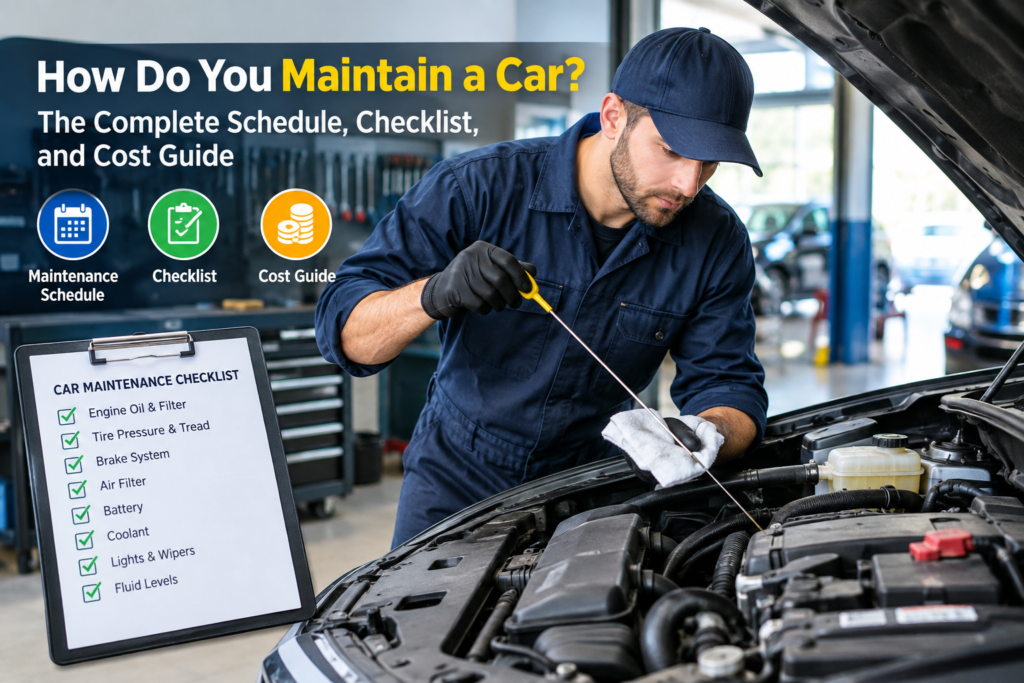
Do you know what your car needs right now? Most drivers guess. A guess can turn a small fix into a costly repair.
A clear routine solves that problem. The guide below gives you a full car maintenance schedule, a simple checklist, and real US prices. You will also learn what 30-60-90 maintenance means and what your car needs at 100,000 miles. Are you ready to save money and stay safe?
Why Does Car Maintenance Matter So Much?
Routine care keeps you safe first. Worn brakes, low tire pressure, and a weak battery cause breakdowns and crashes. Regular service also protects your wallet. AAA’s 2025 Your Driving Costs study puts maintenance, repairs, and tires for a new vehicle at 11.04 cents per mile. At 15,000 miles a year, that adds up to about $1,656. Older cars often cost more.
Age matters here as well. S&P Global Mobility reports that the average US light vehicle reached 12.8 years old in 2025. Your car likely has many miles ahead. A steady routine pays you back through fewer repairs, better fuel economy, and a higher resale value. Do you plan to sell your car someday? A full service record adds real value.
What Does a Basic Car Maintenance Checklist Include?
What should you check, and how often? The table below gives common US ranges. Your owner’s manual always has the final word.
| Task | Typical interval | Why it matters |
| Oil and filter change | 5,000–7,500 miles (up to 10,000 with full synthetic) | Cuts friction and heat |
| Tire rotation | 5,000–7,500 miles | Evens out tread wear |
| Tire pressure check | Monthly | Protects safety and fuel economy |
| Brake inspection | Every 10,000–12,000 miles | Keeps stopping distances short |
| Fluid check | Monthly | Prevents overheating and power loss |
| Engine air filter | 15,000–30,000 miles | Keeps airflow clean |
| Cabin air filter | 15,000–20,000 miles | Cleans the air you breathe |
| Battery test | Yearly after year three | Prevents a no-start |
| Wiper blades | Yearly | Clears your view |
| Belts and hoses | At every major service | Prevents sudden failure |
| Timing belt | 60,000–100,000 miles (see manual) | Protects the engine |
Dusty roads shorten the air filter interval. Short trips and heavy loads shorten the oil interval. Do you tow or haul often? Then follow the severe-service schedule in your manual.
What Is the Most Common Maintenance on a Car?
The oil change wins. Oil lubricates moving parts, cools the engine, and carries away debris. Old oil loses those skills.
Many drivers still follow the old 3,000-mile rule. Older engines that use conventional oil may still need short intervals. Newer cars rarely do. AAA Auto Club Group says modern oils and engines now allow 5,000 to 7,500 miles between changes. Meanwhile, full synthetic oil often lasts 7,500 to 10,000 miles. Which number applies to you? Your owner’s manual and your dashboard oil-life monitor decide.
Prices vary by oil type. Conventional oil changes usually cost $35 to $75, and synthetic changes run $65 to $125. Watch for dark, gritty oil, a louder engine, or a lit oil light. Any of those signs means you should book service now.
How Often Should You Rotate and Check Your Tires?
Your tires connect your car to the road. They deserve a monthly look. Start with pressure. Air-filled tires lose about 1 to 2 psi each month. An NHTSA study of 2004–2011 models found that 12 percent of passenger vehicles had at least one tire underinflated by 25 percent or more. Low pressure stretches stopping distances and raises blowout risk. The Department of Energy estimates that proper inflation improves fuel economy by about 3.3 percent.
Where do you find the right pressure? Look at the sticker on the driver’s door jamb. Do not use the number on the tire sidewall. That number shows the maximum, not the target.
Rotate your tires every 5,000 to 7,500 miles. Many shops do it with every oil change. Expect to pay $20 to $50.
Next, check tread depth with the penny test. Place a penny upside down in a tread groove. If you see the top of Lincoln’s head, your tread is too shallow. Replace the tire. A set of four costs between $500 and $1,200 installed.
When Should You Inspect Your Brakes?
Brakes are your top safety system. Check them every 10,000 to 12,000 miles, or at each tire rotation. AAA Auto Club Group suggests a brake check with every rotation.
Listen for a squeal or a grind. Feel for a soft pedal or a shake when you press it. Notice if the car pulls to one side. Any of those signs means you should act at once. Brake pads often last 30,000 to 70,000 miles, and city drivers wear them faster. A fast fix protects your rotors. A full brake job can cost up to $1,000 or more.
How Do You Care for Your Battery and Fluids?
How long does a car battery last? Plan on about four years. The average replacement costs around $414. Clean corrosion from the terminals. Make sure the battery sits tight in its tray. Test it each year after year three, and again before winter. Cold weather cuts battery power, so a weak battery often fails on the first frosty day.
Which fluids need attention? Check coolant, transmission fluid, brake fluid, and washer fluid once a month. Keep each level between the min and max marks. Take action if the temperature gauge climbs, a dashboard light appears, or the wheel gets hard to turn. Those signs point to a fluid problem.
What Is 30-60-90 Maintenance?
Many manufacturers group service into big milestones at 30,000, 60,000, and 90,000 miles. Each stop adds tasks to the last one. Your manual lists the exact items. Use the table as a guide.
| Milestone | Typical tasks |
| 30,000 miles | Oil and filter, tire rotation and alignment check, engine and cabin air filters, brake inspection, fluid top-off, battery test |
| 60,000 miles | All 30,000-mile tasks, plus brake fluid, coolant service, belt and hose inspection, spark plugs on some engines, transmission fluid check |
| 90,000 miles | All 60,000-mile tasks, plus transmission, differential, and transfer-case fluid service, timing belt inspection or replacement, spark plugs, shock and strut check |
What Maintenance Does a Car Need at 100,000 Miles?
Six figures on the odometer call for a full checkup. Book these items:
- Timing belt: Replace it between 60,000 and 100,000 miles unless your car uses a chain. A snapped belt can wreck an engine.
- Spark plugs: Replace them around this mark on many engines.
- Fluids: Service the coolant, transmission fluid, and brake fluid.
- Belts and hoses: Inspect each one for cracks and soft spots.
- Shocks and struts: Expect wear, since they often last 50,000 to 100,000 miles.
- Battery and tires: Test the battery and check tread and alignment.
- Brake pads and rotors: Measure the wear and replace parts as needed.
Ask your shop for a written estimate before any work starts. Should you repair or sell? Compare the repair bill with your car’s value first.
How Much Is Car Servicing in the USA?
How much should you budget? AAA’s numbers give you a baseline. At 11.04 cents per mile, a driver who covers 15,000 miles a year spends about $1,656, or roughly $138 a month, on maintenance, repairs, and tires. That figure covers a new vehicle. Older cars usually need more room in the budget.
Your bill depends on the shop, your vehicle, and your location. A full synthetic oil change costs $90 to $130 at dealerships, $75 to $110 at independent shops, and $65 to $90 at quick-lube chains. Dealership visits may include extras such as a rotation or an inspection.
Which extras should you skip? Ask for an out-the-door price before you say yes. Advertised oil-change prices often exclude fees and synthetic oil.
Want to trim costs? Replace the cabin air filter yourself. Shop labor can push the total to $100, while an OEM-style filter costs under $25 at a parts store. Swap your wiper blades at home too. Also bundle services into one visit, since shops often discount rotation and inspection with an oil change.
How Does Seasonal Maintenance Change Your Routine?
Hot months stress your coolant system and tires. Test the A/C before the first heat wave. Check the coolant level and the radiator. Watch tire pressure, because heat raises it.
Cold months stress your battery and tires. Test the battery before the first frost. Switch to winter tires if you live in the Snow Belt. Fill the washer reservoir with a winter-grade fluid rated for low temperatures. Keep the fuel tank at least half full to limit condensation in the fuel line. Check tire pressure more often, since cold air lowers it.
Which DIY Checks Can You Do at Home?
Which checks take ten minutes or less? Try these:
- Tire pressure: Use a gauge on cold tires and match the door-jamb number.
- Tread depth: Run the penny test on every tire.
- Oil level: Pull the dipstick on level ground and read the mark.
- Lights and wipers: Test every bulb and replace streaky blades.
- Dashboard lights: Never ignore the check engine light or the oil pressure light. Many major parts stores, such as AutoZone and O’Reilly, read your diagnostic codes for free.
How Do You Find Cheap, Trusted Car Maintenance Near You?
Start with three options: independent shops, dealership service centers, and quick-lube chains. Each offers a different mix of price and expertise. Look at AAA too. The AAA Approved Auto Repair locator lists over 7,000 facilities across North America. Members get free maintenance inspections, written estimates, and warranty coverage of at least 24 months or 24,000 miles at those shops.
Then use a few simple filters. Ask about technician credentials, such as ASE certification. Request a written estimate. Compare two quotes on any repair above a few hundred dollars. Read recent local reviews. Keep every receipt. Do you want the best value? Choose a shop that explains each recommendation in plain words.
Do Hybrid and Electric Cars Need Maintenance Too?
Yes, but less. AAA’s analysis found that electric vehicles carry the lowest maintenance, repair, and tire costs, because they skip oil changes and engine air filter swaps. Still, rotate the tires, service the brakes, replace the cabin filter, and follow your manufacturer’s battery guidance.
What Should You Do Next?
Open your owner’s manual today. Note your current mileage. Find your next service milestone. Then book a visit and set a reminder on your phone. Small steps now prevent big bills later. Which task will you handle first?
I used your three sources as reference material and added current AAA, NHTSA, S&P Global Mobility, and 2026 price data from my own research. The AAA cost figure covers new vehicles, and the article says so. Do you want this as a Word or HTML file for publishing?
CarRevix is an automotive-focused website covering car care, maintenance, repairs, detailing, performance parts, and automotive SEO/marketing services.