
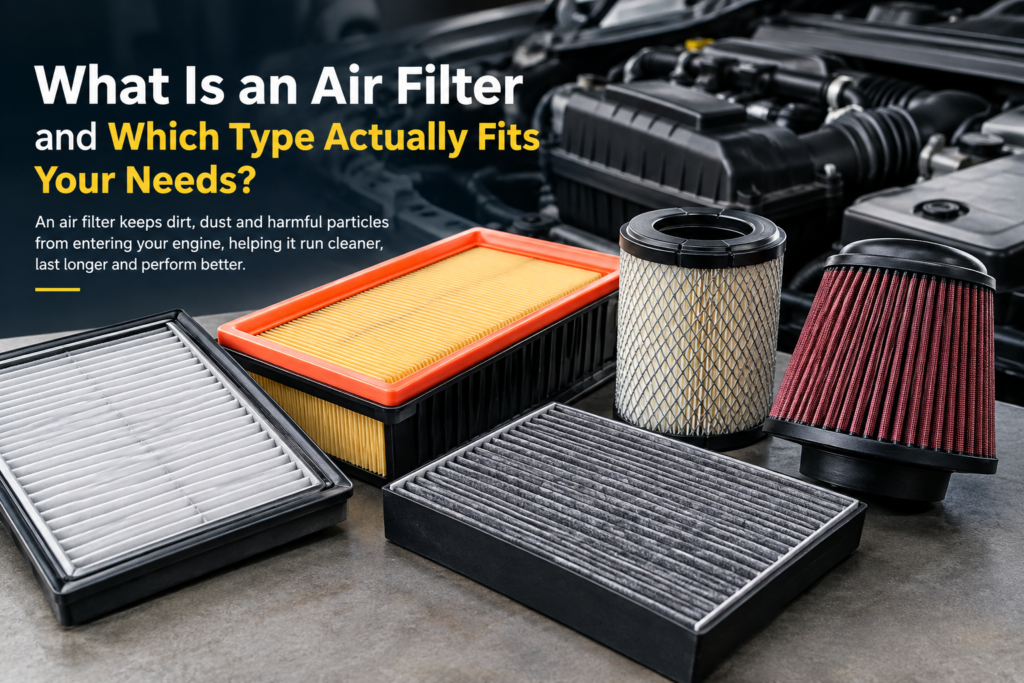
Dust, pollen, smoke, and microscopic debris surround you every day. Your engine breathes this air. Your home breathes it too. An air filter stands between contaminated air and the systems that keep your car running and your house comfortable. A wrong filter choice risks clogged airflow, poor engine performance, or allergens circulating through your living room. This guide breaks down every major filter type. You’ll learn how each one works, and you’ll find the right option for your car, your home, or your HVAC system.
What Does an Air Filter Actually Do?
An air filter traps unwanted particles before they reach sensitive equipment or your lungs. Dust, dirt, pollen, smoke, bacteria, and mold spores all get caught in the filter media as air passes through.
Your engine needs clean air to burn fuel efficiently. Your lungs need clean air to stay healthy. A good filter protects both. Manufacturers rate filtration performance using a scale called MERV, covered shortly, and that rating tells you exactly how fine a particle the filter can catch.
Statistics back up why this matters. A well-designed HEPA filter captures 99.97% of particles down to 0.3 microns in diameter. A basic fiberglass filter, by comparison, typically stops fewer than 20% of particles that small. The gap between filter types is enormous, and it directly affects the air you breathe.
How Does an Air Filter Work?
Contaminated air passes through a filter medium packed with microscopic openings. Particles larger than those openings get trapped on the surface or within the depth of the material.
Four mechanisms handle the actual capture: impaction, interception, diffusion, and electrostatic attraction. Impaction catches larger particles that crash directly into fibers. Interception grabs particles that drift close enough to brush against a fiber. Diffusion relies on erratic particle movement, known as Brownian motion, to trap the smallest contaminants. Electrostatic attraction pulls charged particles toward oppositely charged filter media.
Filters actually improve with use, up to a point. Do you know why? Accumulated particles on the upstream side create a denser barrier that catches even more debris. Push it too far, though, and airflow chokes. Regular replacement or cleaning keeps the balance right.
What Are the Main Types of Air Filters?
Air filters split into two broad categories first: pleated and non-pleated. Specific designs for cars, homes, and industrial systems branch out from there.
What Should You Know About Engine Air Filters?
Your engine air filter blocks dirt and debris before they enter the combustion chamber. A skipped replacement lets abrasive particles wear down piston rings, bushes, and cylinders like sandpaper.
Most engine filters need replacement every 15,000 to 30,000 miles, though driving conditions shift that range. Dusty roads and stop-and-go traffic shorten filter life considerably. Prices vary widely by vehicle brand in the Pakistani market, ranging from roughly Rs. 350 for budget aftermarket options up to Rs. 5,000 for premium or brand-specific parts.
Three common engine filter constructions exist. Standard pleated cellulose paper filters offer affordable, dependable protection for daily driving. Oiled cotton gauze filters, fully washable and reusable, boost airflow and throttle response for performance-focused drivers. High-density synthetic media filters push filtration efficiency toward 98%, and they prioritize engine longevity over airflow gains.
What Should You Know About Cabin Air Filters?
A cabin filter cleans the air flowing into your car’s interior through the heating and air conditioning system. Built from multi-layered paper media, the filter also protects your AC components from particulate buildup.
Cabin filters follow a different replacement schedule than engine filters, since they face different contaminants and airflow demands. Skipped cabin filter changes bring reduced airflow from your vents, musty odors, and weaker air conditioning performance over time.
What Should You Know About HVAC and Home Air Filters?
HVAC filters keep dust, dirt, and debris out of your heating and cooling system’s internal components. The filters also clean circulating air inside your home, reducing dust, pet dander, and mold spores.
AC filters and furnace filters fall under this category, and they share nearly identical design principles. Residential HVAC systems generally perform best with filters rated below MERV 13. A push past that threshold lets denser media restrict airflow enough to strain your system and spike energy consumption.
What Makes HEPA Filters Different?
HEPA filters set the gold standard for particulate removal. A filter must capture at least 99.97% of airborne particles measuring 0.3 microns to earn the HEPA label under military standard MIL-STD-282. European and ISO standards set a slightly different bar at 99.95%.
The filters use dense layers of borosilicate glass fibers or polypropylene fibers arranged in a random web pattern. Hospitals, cleanrooms, and chemical manufacturing facilities depend on HEPA filtration to protect people from microorganisms, allergens, and airborne irritants. Home air purifiers increasingly use HEPA H13-grade filters for the same reason, and this grade is now common in residential purifier replacement parts sold locally.
How Do Activated Carbon Filters Solve Odor Problems?
Odors and gaseous pollutants slip right past standard particle filters. Activated carbon filters solve that gap. Made from coconut shells or coal processed into a highly porous structure, the filters adsorb volatile organic compounds, smoke, cooking fumes, and chemical odors.
One limitation stands out: activated carbon filters can’t capture solid particles on their own. A pairing with a HEPA filter covers both gaseous and particulate contamination. Replacement timing is trickier here too, since carbon filters don’t show visible clogging the way paper filters do.
What Sets Washable Electrostatic and Ionizer Filters Apart?
Washable electrostatic filters use woven polypropylene or polyester media that generates a static charge as air passes through. That charge attracts and holds particles until you wash the filter clean. Typical MERV ratings land between 6 and 8, and the electrostatic property doesn’t fade with repeated washing.
Ionizer filters work differently. Air passes through a pre-filter, then an ionizer charges particles electrically before oppositely charged plates capture them. No traditional filter media gets used at all. MERV ratings here run lower, around 4 to 5, and a real drawback exists: the electrical charging process can generate ozone, and ozone may worsen asthma or other respiratory conditions.
What Is a MERV Rating, and Why Does It Matter?
MERV stands for Minimum Efficiency Reporting Value, developed by ASHRAE to standardize filter performance comparisons. The scale runs from 1 to 16 for conventional filters, covering particle sizes between 0.3 and 10 microns.
Higher numbers mean finer filtration. A MERV 1 to 4 filter, built from fiberglass or aluminum mesh, catches large particles like carpet fibers and pollen but lets nearly everything smaller pass through. A jump to MERV 13 traps 90% or more of particles as small as 1 micron, including bacteria and smoke.
Here’s the tradeoff you need to weigh: denser media at higher MERV ratings restricts airflow more. Your HVAC system works harder as a result, and that raises energy costs and mechanical strain if your equipment wasn’t designed for it. Always check your system’s specifications before you jump to a high-MERV filter.
Filters rated above MERV 16 cross into HEPA and ULPA territory, capturing 99.97% or more of airborne particles. ULPA filters push even further, removing particles down to 0.12 microns at 99.99% efficiency, though that performance comes with higher energy use and shorter service life.
How Do You Know When Your Air Filter Needs Changing?
Watch for reduced airflow first. A clogged filter chokes air movement, whether that’s through your car’s engine intake, your AC vents, or your furnace ducts.
Rising energy bills offer another clue. Your HVAC system compensates for restricted airflow by running longer and harder, and the extra cost shows up on your utility bill before you ever notice a visible problem. Visible dust buildup on the filter surface, musty odors, and weaker engine acceleration all signal a swap is due.
Lab testing shows just how much difference filter quality makes here. One controlled comparison found a premium filter held more than twice the contaminant volume of a competing product, specifically 128% better dust holding capacity, before it reached the same resistance threshold. The result? Longer intervals between replacements.
What Happens If You Ignore a Dirty Air Filter?
Ignored engine filters let restricted airflow throw off your fuel-to-air ratio. Fuel consumption climbs, acceleration weakens, and harmful emissions increase.
A dirty HVAC filter creates a different set of problems. Reduced airflow forces your system to run longer cycles, and the strain shortens equipment lifespan. Meanwhile, the filter itself grows less effective at trapping new particles, and air quality inside your home actually declines even though the filter is technically “working.”
A skipped cabin filter change lets allergens and musty smells accumulate inside your car’s cabin, and that undermines the exact comfort the filter is supposed to protect.
Which Air Filter Is Best for Your Home?
Your answer depends on what problem you’re solving. Standard dust and allergen control works fine with a pleated HVAC filter in the MERV 8 to 11 range. Homes with allergy sufferers or asthma benefit from a step up toward MERV 13, provided the system can handle the airflow restriction.
Persistent odors, smoke, or chemical fumes call for an activated carbon filter, typically layered alongside a particulate filter rather than used alone. A HEPA H13 filter in a dedicated air purifier captures 99.97% of micro-allergens, dust, and airborne pathogens, and that makes it the highest air purity standard available to consumers.
Budget matters too. Standard paper filters cost the least but need frequent replacement. HEPA filters cost more upfront, yet they deliver dramatically better filtration and often last longer between changes.
How Much Does an Air Filter Cost in Pakistan?
Prices swing based on filter type, brand, and application. Engine air filters for cars range from around Rs. 350 for budget aftermarket parts up to Rs. 5,000 for premium or brand-matched options, depending on your vehicle.
Local platforms like PakWheels and Daraz list both genuine OEM parts and aftermarket alternatives side by side, so a price comparison before buying makes sense. Home and purifier filters, particularly HEPA-grade options, typically carry a higher price point than standard automotive filters given their denser construction and higher filtration standards.
Bike air filters, HVAC replacement filters, and specialty industrial filters each carry their own pricing structure. A search by specific application, rather than an assumption that one price applies across categories, gets you a more accurate number.
How Do You Choose the Right Air Filter?
Your specific application comes first. A car needs a different filter than a home purifier, and a mismatch wastes money without a fix for your actual problem.
Compatibility comes next. A filter matched to your exact make and model matters for vehicles, since a poor fit compromises the seal and lets unfiltered air bypass the filter entirely. Quality seals matter more than people realize. Some manufacturers use specialized polyurethane gaskets rated for extreme temperatures specifically to prevent this bypass.
Your budget deserves a look against long-term value too. A cheaper filter that needs replacement every few months may cost more over a year than a pricier washable or long-life option. How often are you willing to perform maintenance, and does a reusable filter fit your routine better than a disposable one?
Filtration efficiency should match your actual needs last. A garage workshop doesn’t need HEPA-grade filtration, and a home with severe allergies shouldn’t settle for a basic fiberglass filter. The right match balances protection, airflow, and cost.
Frequently Asked Questions
What is the purpose of an air filter?
An air filter removes airborne particles like dust, pollen, and bacteria before they reach an engine, HVAC system, or the air you breathe indoors.
How do you know if your air filter needs changing?
Reduced airflow, visible dust buildup, rising energy costs, or weaker engine performance all point to a needed change.
What happens if an engine air filter is dirty?
Restricted airflow throws off the fuel-to-air ratio, and fuel consumption plus emissions increase while acceleration weakens.
Which air filter works best for a house?
A pleated MERV 8-13 filter handles general dust and allergens, while a HEPA H13 filter in a purifier offers the highest level of protection against fine particulates.
Final Thoughts
Clean air isn’t a luxury. It’s a baseline requirement for a healthy engine and a healthy home. Every filter type covered here solves a specific problem, and none of them solves every problem at once.
Where does your air quality risk actually come from? Dust and debris hitting your engine on rough roads bring one kind of risk. Allergens circulating through your living room bring another. Lingering odors and gaseous pollutants that particle filters can’t touch bring a third. Your answer points you toward the right filter type faster than any spec sheet can.
Visible symptoms shouldn’t be your trigger to act. Reduced airflow, rising energy bills, and weaker performance all show up after damage has already started. Regular inspection and timely replacement cost far less than the repairs or health issues that follow neglect.
One filter won’t fix every issue in a complex system. A HEPA filter paired with activated carbon delivers full-spectrum home air purification. Your engine filter’s MERV rating should match your vehicle’s actual driving environment, not just the cheapest option on the shelf. Small, informed choices at the filter stage protect the expensive equipment and the people downstream of it.
CarRevix is an automotive-focused platform offering expert car care insights, maintenance guidance, detailing, repair services, and automotive SEO and promotional solutions to help drivers and automotive businesses stay informed and grow online.