
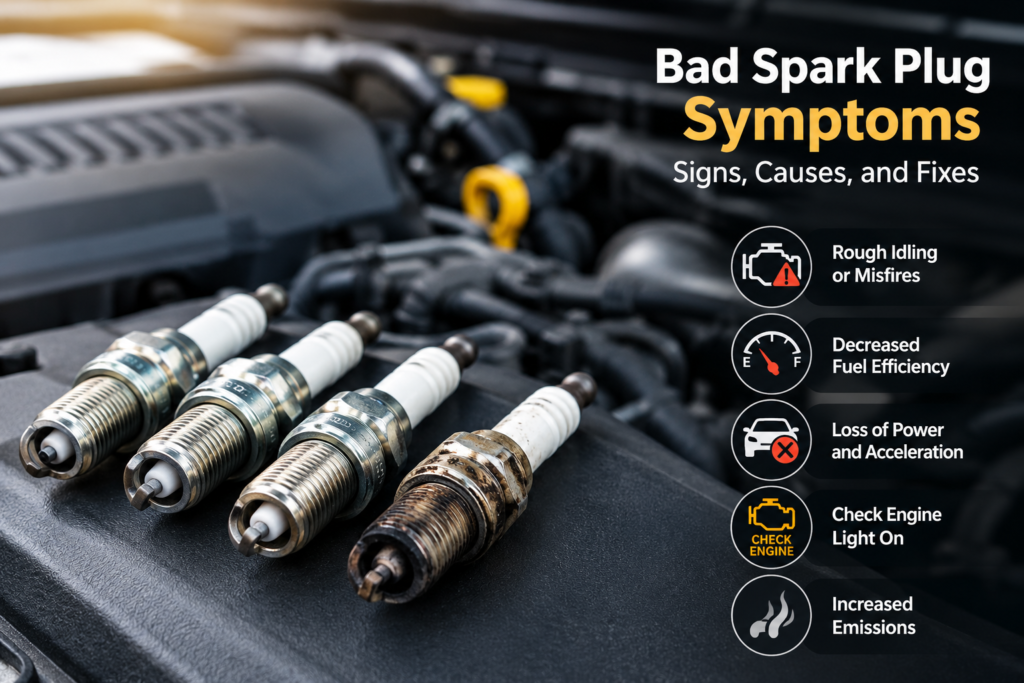
Your car cranks slowly and you blame the battery. Is that the right call? Worn spark plugs cause the same trouble, and they cost far less to fix. Firestone Complete Auto Care points out that many drivers overlook plugs when a car struggles to start. You can catch the problem early if you know what to watch for.
What Does a Spark Plug Do?
A spark plug screws into the cylinder head of your engine. It fires a small, strong spark that ignites the air-fuel mixture in the combustion chamber. That burn creates the power that moves your car. A plug fires hundreds of times each minute, even at idle.
What happens when the spark weakens? Fuel burns poorly, power drops, and emissions rise.
What Are the 8 Signs of Bad Spark Plugs?
1. Does Your Engine Misfire?
A misfire means one cylinder fails to ignite its fuel. You feel a stumble, a jerk, or a pause when you accelerate. Hills make it worse. Misfires are the most common sign of a worn plug.
2. Does Your Engine Idle Roughly?
A healthy engine runs smooth at a red light. A bad plug makes the steering wheel shake and the seat vibrate. You may hear uneven, sputter sounds. The cylinders fire out of rhythm, so the engine loses its balance.
3. Does Your Car Struggle to Start?
Worn plugs make a weak spark. The engine cranks longer than normal, or it stalls right after start-up. Cold weather makes the problem worse.
How do you tell plugs from the battery? Listen to the crank. A long, slow crank that never catches points to ignition. A weak crank or a single click points to the battery or starter. Firestone makes the same point: a car with no power at all usually has a battery issue.
4. Do You Burn More Fuel Than Before?
Unburned fuel wastes money. You visit the gas station more often. Track your mileage over three fill-ups before you decide. A sudden drop deserves a closer look.
5. Does Your Car Accelerate Slowly?
A weak spark gives weak power. You press the pedal and the car feels tired. Merges and passes take longer than they used to.
6. Is Your Check Engine Light On?
The engine computer tracks every misfire. It stores codes such as P0300, which means a random misfire. Codes P0301 to P0308 point to one cylinder. For example, P0303 means cylinder 3. An OBD-II scanner reads these codes in minutes.
A flashing light signals a severe misfire. Reduce speed and load, then get the car checked soon. Does the code prove the plug is bad? It does not. A code points to a misfire only. Coils, injectors, and vacuum leaks set the same codes.
7. Do You Hear Knock or Ping Sounds?
Rattle or ping sounds under load can come from overheated plugs or wrong timing. Low-octane fuel and carbon deposits cause them too. Treat the sound as a clue, and confirm the cause before you buy parts.
8. Do You See Higher Emissions or Smell Fuel?
Unburned fuel leaves through the exhaust. You may smell raw fuel or see black smoke. A failed emissions test is another clue.
What Causes Spark Plugs to Go Bad?
Plugs last long, but they do wear out. Heat and constant sparks erode the electrodes. The gap widens, and the spark weakens. Several other causes speed up the damage:
- Carbon buildup: A rich mixture, a clogged air filter, or many short trips leave black soot on the tip.
- Oil fouling: Worn piston rings or valve guides let oil into the combustion chamber.
- Overheat: A wrong gap, poor fuel, a lean mixture, or a hot engine blister the electrodes.
- Wrong plug or poor install: The wrong type or wrong torque causes early failure.
- Cracked insulator: Even a hairline crack in the white ceramic leaks current. Replace the plug at once.
Why does oil fouling matter most? It points to internal engine wear. Firestone calls the source a priority, so locate it fast.
How Can You Inspect a Spark Plug?
Remove one plug and read the tip. The color tells you a lot.
| What you see | What it means |
| Light tan or gray deposits | Healthy burn |
| Dry black soot | Rich mixture, clogged air filter, or weak ignition |
| Wet black oil | Oil enters the cylinder |
| White, blistered, or melted tip | Overheat or lean mixture |
| Rounded, eroded electrodes | Normal end of life |
| Cracked or chipped ceramic | Replace at once |
Can you clean a sooty plug? Sometimes. Remove the carbon with carbon cleaner and a wire brush. Then verify the electrode gap before you reinstall it. If the plugs are already out, replace them.
How Long Do Spark Plugs Last?
Firestone states that plugs often reach about 80,000 miles before they need replacement. Your plug material changes that number. Copper plugs wear fastest, often at 20,000 to 30,000 miles. Platinum plugs last about 60,000 miles. Iridium plugs often reach 80,000 to 100,000 miles or more. Treat those figures as typical ranges.
Does your usage matter? Yes. Short trips, heavy towing, and stop-and-go traffic shorten plug life. Your owner’s manual lists the exact interval for your car.
Is It the Plug, the Coil, or Another Part?
Many symptoms overlap, so test before you replace. Use this guide:
- Bad coil or wire: The misfire stays in one cylinder. A scan tool shows which one.
- Fuel injector or fuel pump: The engine hesitates under load.
- Dirty air filter or airflow sensor: Mileage falls and the car feels sluggish, but no clear misfire appears.
- Weak battery or starter: The engine cranks slowly or only clicks.
Try a coil swap. Move the suspect coil to a neighbor cylinder. Does the misfire code follow the coil? Then the coil is bad. If the code stays, check the plug.
Can You Drive With Bad Spark Plugs?
You can drive a short distance with mild symptoms. Repair the problem soon, though. Misfires waste fuel and strain the engine. Unburned fuel also reaches the exhaust and can overheat the catalytic converter. A new converter costs far more than a set of plugs.
A flashing check engine light signals a severe misfire. Reduce load and get help fast.
How Do You Replace Spark Plugs Correctly?
Follow these steps for a lasting repair:
- Check your owner’s manual for the replacement interval.
- Buy the plug type, heat range, and gap your maker specifies.
- Replace all plugs as a set so every cylinder performs evenly.
- Use a torque wrench. Too much torque damages the cylinder head threads. Too little torque causes overheating.
- Hire a mechanic if the rear plugs are hard to reach.
How Can You Prevent Early Plug Failure?
- Buy quality fuel.
- Change the air filter on schedule.
- Change the oil on time and fix leaks early.
- Take a longer trip now and then to burn off deposits.
- Scan any check engine light right away.
Frequently Asked Questions
How do I know if it is the plugs or the battery?
Listen to the crank. A normal crank with a slow start or rough run points to plugs. A weak crank or a click points to the battery or starter.
Do bad plugs turn on the check engine light?
Yes, often through misfire codes. A code alone does not prove the plug is the cause.
Do bad plugs hurt gas mileage?
Yes. Incomplete burn wastes fuel.
Are spark plugs expensive to fix?
Plugs cost little. Labor rises on engines with hard-to-reach plugs. Costs climb fast if a delay damages the catalytic converter.
What Should You Do Next?
Watch for misfires, rough idle, hard starts, weak acceleration, poor mileage, and a check engine light. Confirm the cause with a code scan or a plug inspection. Replace plugs to your maker’s specification. Act at once if the light flashes.
I built this from your three sources and used only their figures plus common plug-lifespan ranges. Want me to research fresh statistics, such as misfire rates or catalytic converter repair costs, to strengthen the data points?
CarRevix is an automotive knowledge and services platform covering car maintenance, repairs, parts, SEO, automotive advertising, and industry insights. It provides helpful automotive content while also supporting brands through automotive SEO, link building, sponsored content, reviews, and promotional solutions.