
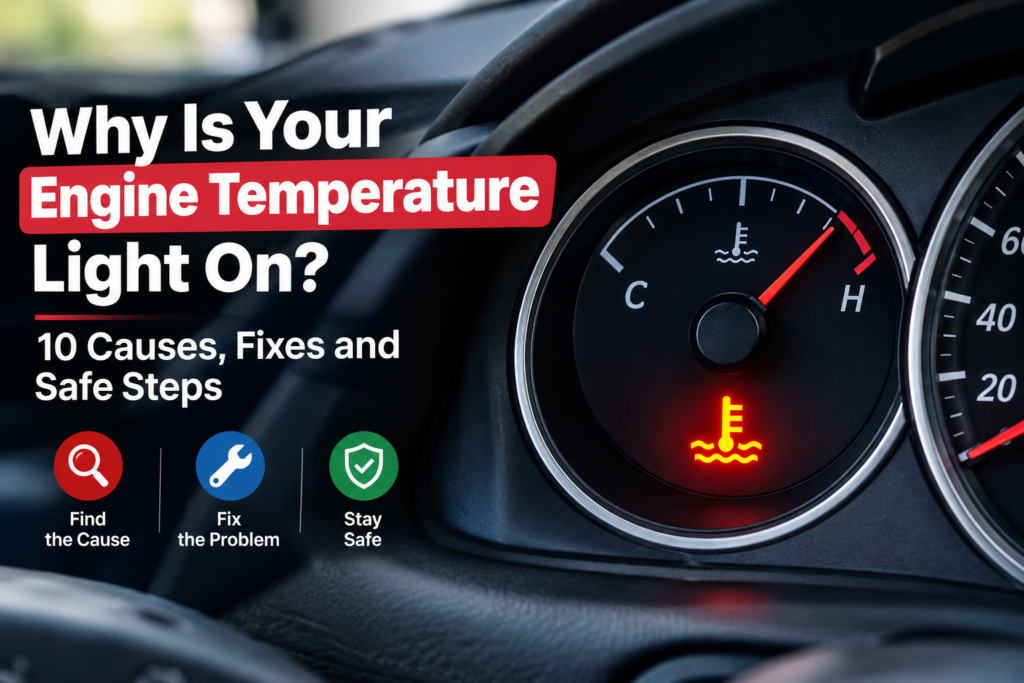
A red light glows on your dash. Your engine temperature light just came on. What should you do? Pull over and shut the engine off as soon as it is safe. A hot engine can wreck itself in minutes. A blown head gasket alone often costs $1,500 to $3,000 or more in the US. Read on, and you will learn what the light means, what to do first, which ten faults trigger it, and how to prevent a repeat.
What Does the Engine Temperature Light Mean?
The light tells you that your coolant is too hot. Most engines run best between 195°F and 220°F (90°C to 104°C). Coolant carries heat from the engine to the radiator. Roughly one-third of the fuel energy in your tank leaves the engine as heat, so the coolant works hard.
Plain water boils at 212°F. A 50/50 mix of antifreeze and water boils near 265°F under the 15 psi that the radiator cap holds. That margin sounds large. However, a dead fan or a worn pump can burn through it in minutes in slow traffic. Do you know where your gauge needle normally sits? Learn that spot, because a needle that climbs past it is your first alert.
What Do the Different Colors of the Light Mean?
Color tells you how urgent the problem is. Your owner’s manual shows the exact symbol for your car. Most makers use a thermometer inside wavy lines.
- Red: The coolant is too hot. Pull over and shut the engine off.
- Amber or yellow: Some makers use it as an early caution. Treat it as real and watch the gauge.
- Blue: The engine is still cold. The light goes off once the engine warms up. Drive gently until it does.
- Flashes red and blue: The coolant system has a sensor or electrical fault. Book an inspection soon.
- White or a text message: A few models show words instead of a symbol. Act on it the same way.
Is your light red, or does the needle touch “H”? Either one means stop.
What Should You Do the Moment the Light Turns Red?
Stay calm and follow the steps in order.
- Turn the heater to full heat and the fan to high. The cabin pulls heat from the engine. Open the windows to stay comfortable.
- Switch on your hazard lights and pull over. Choose a flat, safe spot far from traffic.
- Shut the engine off. Do not sit and idle.
- Wait 20 to 30 minutes. Pop the hood from inside the cabin, then step back until the steam clears.
- Keep the radiator cap and reservoir cap shut until the engine is cold. The system holds pressure, and hot coolant can spray out and cause severe burns.
- Check the coolant level once the engine feels cold. Add a 50/50 coolant mix if the level is low. Plain water works as an emergency fix. Replace it with the right mix soon.
- Look for clues. Puddles under the car, wet hoses, steam, and a sweet smell all point to a leak.
- Decide on the next move. Call a tow if the level is normal or if the needle climbs again. A short trip to a nearby shop makes sense only if the level was low, you topped it off, and the gauge stays mid-range.
Never pour cold water on a hot engine. A sudden temperature shock can crack the cylinder head or the block.
Do you have roadside help? Many AAA tiers tow from 5 miles up to 200 miles. Many insurers also add roadside cover to a policy. Call first, and do not limp the car far.
Why Does the Engine Temperature Light Come On? 10 Common Causes
A coolant system holds about 6 to 12 quarts of fluid. Any weak link in that loop can trigger the light. The ten faults below show up most often in repair shops. Costs are typical US ranges and vary by car and labor rate.
1. Is Your Coolant Level Too Low?
Low coolant is the top cause. Coolant pulls heat out of the engine, so less fluid removes less heat. Leaks from hoses, the radiator, or the water pump drain most systems. Top off the fluid and find the leak. Do you add coolant every few weeks? Then a leak exists. Expect to pay $20 to $150 for a hose or fluid service. A leaky radiator or pump costs more.
2. Has the Thermostat Failed?
The thermostat opens to send hot coolant to the radiator. A valve stuck shut traps heat, and the engine overheats in minutes. A valve stuck open keeps the engine too cold. That fault often triggers the blue light and weak cabin heat. Expect to pay $150 to $350.
3. Is the Radiator Fan Broken?
The fan pulls air through the radiator when you sit still. Does your engine run hot in traffic but cool down at highway speed? A dead fan motor, a bad relay, a blown fuse, or a wire fault is likely. Expect to pay $250 to $800.
4. Is the Water Pump Worn Out?
The pump pushes coolant through the engine. A worn pump may leak from a small weep hole, whine, or wobble. On many cars the serpentine belt turns the pump. A snapped belt stops the flow at once. Expect to pay $400 to $900. Some engines cost more because the pump sits deep inside.
5. Is the Radiator Clogged or Corroded?
Rust, scale, and old coolant build up inside the radiator. Flow drops, and the engine runs hotter. Dirt and bent fins on the outside block airflow too. A radiator past 10 years or 100,000 miles is a prime suspect. Expect to pay $400 to $1,200.
6. Is the Radiator Cap Worn?
The cap holds the pressure that raises the boil point. A weak seal lets pressure escape, and the coolant boils sooner. The part costs $10 to $30. Ask your mechanic to pressure-test it early.
7. Is the Head Gasket Blown?
A blown head gasket is the most serious cause on the list. Hot gas pushes into the coolant, or coolant leaks into the cylinders. Watch for white exhaust smoke, a sweet smell, bubbles in the reservoir, milky oil, and coolant that vanishes without a puddle. Rough idle and weak power often follow. Stop the car at the first sign. Expect to pay $1,500 to $3,000 or more. Some older Subaru 2.5L engines have a long record of this fault, so owners should check coolant often.
8. Is the Temperature Sensor Wrong?
A bad sensor or a loose plug can send a false signal. The needle may jump, or the light may flash while the engine feels normal. A mechanic can compare the dash display with a scan tool or an infrared thermometer. Expect to pay $100 to $300.
9. Is Air Trapped in the Coolant?
Air pockets form after a coolant change or a repair. Air creates hot spots and false data. Your heater may blow cold as the gauge climbs. A shop can bleed the system with a vacuum fill tool.
10. Is the Coolant Old, Mixed Wrong, or Is the Oil Low?
Old coolant loses its rust shield. Too much water lowers the boil point. Too much antifreeze slows heat transfer. Mixed coolant types can form sludge. Low oil adds friction heat, so the engine runs hotter. Follow your manual for fluid type and change intervals, since they vary by make.
How Can You Tell Which Cause You Have?
Symptoms narrow the list fast. Use the table as a first guide, then confirm with a mechanic.
| What you notice | Likely cause |
| Engine runs hot in traffic, cools at highway speed | Radiator fan, radiator, low coolant |
| Engine runs hot soon after a cold start | Thermostat stuck shut |
| Coolant level falls, no puddle | Head gasket or internal leak |
| White exhaust smoke with a sweet smell | Head gasket |
| Heater blows cold while the gauge runs hot | Low coolant, air pocket, worn pump |
| Needle jumps around | Sensor or wire fault |
| Whine from the front of the engine | Water pump or belt |
| Light flashes red and blue | Electrical or sensor fault |
Why Do the Check Engine Light and a Hot Engine Appear Together?
Heat upsets engine sensors and combustion. The computer (ECU) may log a misfire, a knock, or a coolant fault. Common OBD-II codes include P0217 (engine over-temperature), P0117 and P0118 (coolant sensor circuit), and P0128 (coolant below the set temperature, often a thermostat). A scan tool reads these codes in seconds, and many parts stores run the scan for free.
A steady check engine light with a hot engine signals a serious fault. A check engine light that blinks means an active misfire. Raw fuel can then reach the catalytic converter and ruin it. Stop in both cases and call a tow.
Can You Drive With the Temperature Light On?
Do not drive on a red light. Each extra mile raises the damage bill. Heat can:
- Blow the head gasket
- Warp or crack the cylinder heads
- Wear out piston rings and valves
- Ruin the catalytic converter
- Crack the block or seize the engine
Can you still drive if the engine overheats? Only for a very short emergency hop with the heater on full and the gauge below red. A tow costs far less than a new engine.
Can you drive four hours with the check engine light on? A steady light with no heat and no rough run usually allows a normal trip to a shop within days. A light that blinks, a hot engine, or a red temperature light rules out a long trip.
Why Does the Temperature Light Come On and Off?
Does the light flicker while the engine feels normal? Check these causes first:
- Low coolant: The level drops, and fluid slides away from the sensor on turns and hills.
- Air pockets: Bubbles pass the sensor and spike the signal.
- A bad sensor or plug: The signal cuts in and out.
- A sticky thermostat: It opens late, then catches up.
- A late fan: The engine runs hot at idle, then cools at speed.
Do not ignore a light that comes and goes. Most of these faults get worse over time. A brief blue light on a cold start is normal.
Does the Make of Your Car Change the Advice?
The basics stay the same on a Toyota, Honda, Ford, or Subaru. Symbols, change intervals, and weak points differ. Your owner’s manual lists the right coolant type and the exact symbol. Ask your shop about known issues for your engine. Some designs show repeat pump, thermostat, or gasket faults.
How Can You Prevent an Overheated Engine?
Prevention costs far less than repair. Build these habits:
- Check the coolant monthly, only on a cold engine.
- Change the coolant on the schedule in your manual.
- Use the coolant type your maker lists, and never mix types.
- Inspect hoses every few months for cracks, bulges, and damp spots.
- Pressure-test the radiator cap at each major service.
- Clear leaves and bugs from the front of the radiator.
- Keep the oil level up.
- Watch the gauge in summer traffic, on long hills, and under a trailer load.
- Fix small leaks early. A damp hose today becomes a roadside breakdown next month.
Quick Answers to Common Questions
What causes the check engine light and a hot engine at the same time?
A coolant fault such as a leak, a stuck thermostat, a dead fan, or a blown head gasket sits behind both lights. Heat then sets off sensor and misfire codes.
How long should you wait before you check the coolant?
Wait at least 20 to 30 minutes, until the engine feels cool to the touch.
Can you add water instead of coolant?
Yes. Use it in an emergency, then replace it with a 50/50 mix soon. Plain water lowers the boil point and offers no rust shield.
Is the temperature light the same as the gauge?
No. The gauge shows live data. The light is a fixed alarm that triggers at a set limit. A needle that climbs is your early alert.
What if the light is on but the engine feels normal?
Suspect a sensor fault, an air pocket, or low coolant. Get it checked, because a false alarm can hide a real fault.
Why does the engine run hot only at idle?
A weak fan, a clogged radiator, or low coolant is likely. Airflow at idle depends on the fan.
How much does it cost to fix a hot engine?
Fixes range from about $20 for coolant to $3,000 or more for a head gasket. Early action keeps you at the low end.
What Is the Bottom Line?
A red temperature light means stop. Pull over, shut the engine off, and let it cool. Check the coolant only on a cold engine. Call a tow if the light returns or the check engine light joins it.
Do you want to avoid the next roadside scare? Book a coolant system inspection. A technician can pressure-test the system, test the fan, thermostat, pump, and hoses, and catch weak parts before they fail. A short visit today protects your engine for years.
CarRevix is an automotive-focused website providing informative content about car maintenance, repair, automotive parts, troubleshooting, and vehicle care. It helps readers make smarter decisions about keeping their vehicles safe, reliable, and well-maintained.