
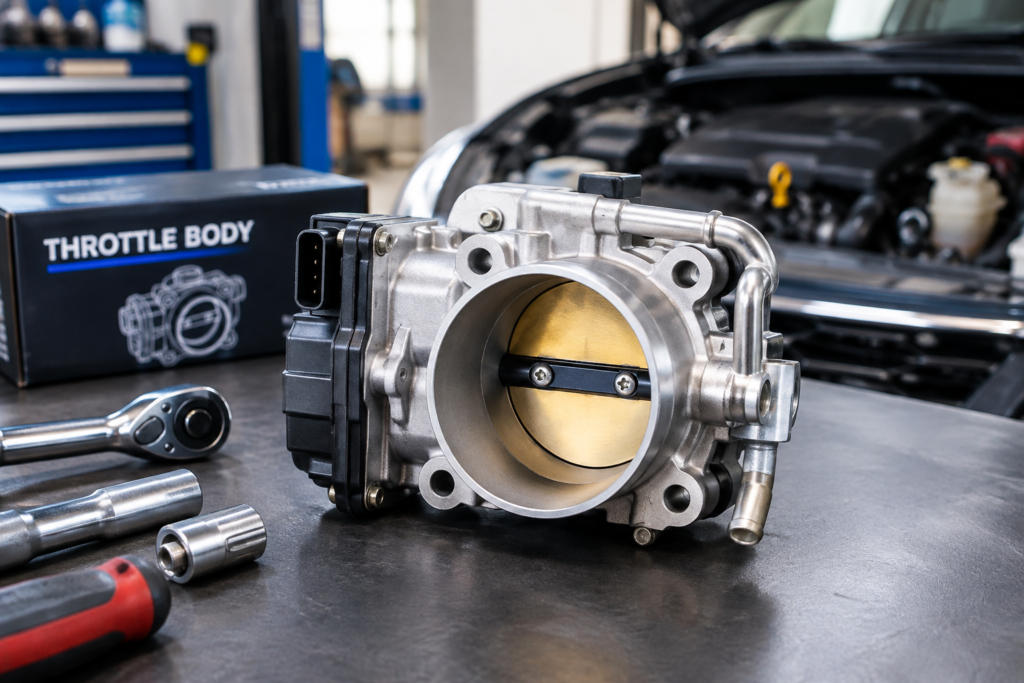
Your car shakes at a red light. The engine hesitates when you press the gas. Now you want a price for the fix, right? Most drivers pay $500 to $650 to replace a throttle body. Some pay under $200, and others pay $1,000 or more. Read on to learn what drives that range, how to confirm the fault, and how to cut your bill.
What Is a Throttle Body?
The throttle body controls how much air reaches your engine. Air matters because fuel needs oxygen to burn and make power. Think of the throttle body as the front door of your engine. A wide-open door lets in more air. A half-closed door lets in less. Every gasoline engine relies on that balance.
How Does a Throttle Body Work?
A throttle plate sits inside the throttle body. The plate is a butterfly valve that opens and closes. You press the gas pedal, and the plate swings open. More air then flows toward the cylinders.
The engine control unit (ECU) detects the extra air and tells the fuel injectors to add fuel. Power rises, and your car accelerates quickly. Older cars use a cable to move the plate. Newer cars use an electronic drive-by-wire motor and a throttle position sensor (TPS).
What Are the Symptoms of a Bad Throttle Body?
Does your car feel less smooth than before? A failed throttle body upsets the air-fuel ratio. Combustion suffers, and the engine runs less efficiently. Watch for the signs below:
- Rough idle: The RPM rises and falls even when you leave the pedal alone. The car may shake in park.
- Stalls: The engine can die when you slow down or try to accelerate.
- Misfires: A cylinder gets too much or too little air, so the fuel burns poorly.
- Jerks between gears: The engine struggles to hold a steady speed between shifts.
- Sluggish acceleration: The engine cannot make enough power for a quick response.
- Lower fuel economy: You visit the pump more often, and the ride feels rough.
- Check engine light: The light can come on for many reasons, but a bad throttle body often triggers it.
Do several signs sound familiar? Then test the part before you buy a new one. Other faults can copy the same symptoms.
Which Error Codes Point to a Throttle Body Problem?
Your ECU stores a diagnostic trouble code when it spots a fault. Codes P0120 through P0124 point to the throttle position sensor circuit. Codes P2111 and P2112 point to the throttle actuator control system.
An OBD-II scanner reads codes in minutes. Some auto parts stores offer a free scan. A code only points to a suspect, so a mechanic should confirm the cause before you replace any part.
What Is the Average Throttle Body Replacement Cost?
Most drivers pay between $500 and $650. That range covers the typical car on the road. Your quote can land far outside it, though.
| Scenario | Typical total cost |
| Lower-cost vehicle or aftermarket part | Under $200 |
| Most vehicles | $500 to $650 |
| Large, luxury, or OEM-part repair | Up to $1,000 or more |
Why such a wide gap? Parts and labor make up the bill, and parts vary the most.
What Affects the Throttle Body Replacement Cost?
Labor stays low because the job is quick. Expect to pay around $100 for the work. Parts cost far more. Three factors move the price most:
- Vehicle type. Large and luxury cars use costly throttle bodies. A luxury sedan costs more to fix than a small economy car.
- Part source. OEM parts come straight from your car’s maker. Aftermarket parts are new but come from another company. OEM parts cost more.
- Shop rates. Dealerships often charge more than independent shops.
Should you pick OEM or aftermarket? Ask your mechanic. Some aftermarket parts save money, and some cars need an OEM part to run right.
Which Extra Costs Should You Expect?
Your final bill may include more than parts and labor. Plan for the items below:
- Diagnostic fees: A mechanic may need a few hours to prove the throttle body is at fault.
- Tow fees: A sudden failure can leave the car undrivable.
- Rental car or transit: You still need a ride to work.
- Unpaid time off: A long repair can cost you a shift.
Do the extras add up fast? They can. A quick diagnosis helps you avoid the worst of them.
Can You Clean a Throttle Body Instead of Replace It?
Carbon buildup sometimes causes trouble, and the part itself works fine. A dedicated throttle body cleaner removes that grime. The product costs little, and many drivers use it at home.
Experts suggest a clean every 75,000 to 90,000 miles. You must remove the air intake hoses at both ends to reach the plate. Do you feel unsure about that step? Ask a professional. A clean cannot fix a failed sensor or a dead motor, so ask your mechanic which fault you have.
How Often Should You Replace a Throttle Body?
Throttle bodies last a long time. Most need replacement after 100,000 to 150,000 miles. Replace yours sooner if symptoms appear. Regular cleans every 75,000 to 90,000 miles can extend the life of the part.
Is It Safe to Drive With a Bad Throttle Body?
It is risky. A failed throttle body affects the safety of your car on the road. The engine may stall at an intersection or lose power as you merge. Fix the fault soon. A quick repair costs far less than a tow or a crash.
Can You Replace a Throttle Body Yourself?
You can, and many drivers do. The job takes roughly 45 to 90 minutes on most vehicles. Yet the repair demands precision, and small errors hurt engine performance. Parts make up most of the cost, so a DIY job saves little. Shop labor runs only about $100.
Do you still want to try? Gather the supplies below first:
- A socket set (often 7mm, 8mm, or 10mm)
- A flathead screwdriver
- Pliers for hose clamps
- A new throttle body and a matching gasket
- A clean rag and throttle body cleaner
How Do You Remove the Old Throttle Body?
- Disconnect the battery. Remove the negative terminal first to avoid shorts and clear basic computer memory.
- Remove the air intake duct. Loosen the hose clamps and pull the duct free.
- Unplug the electrical connectors. Release the plastic tabs gently. Unplug the harness from the TPS or the electronic motor.
- Disconnect cables and lines. Older cars have a throttle cable. Rotate the linkage and slide the cable out. Some models have vacuum or coolant bypass lines. Clamp coolant lines to prevent leaks.
- Unbolt the unit. Remove the bolts that hold the throttle body to the intake manifold. Most units use four. Lift the old part away.
How Do You Install the New Throttle Body?
- Clean the contact surface. Remove the old gasket or O-ring. Wipe away carbon with a rag and cleaner. Keep debris out of the intake opening.
- Seat the new gasket. Set it flush in the grooves or over the studs. Never use RTV silicone on a throttle body gasket.
- Position the new part. Start the bolts by hand.
- Tighten in a criss-cross pattern. Use alternate diagonal steps for an even seal. Overtight bolts can crack a plastic intake manifold. Check your manual for the exact torque spec.
- Reassemble. Reconnect the harness, refit the duct, tighten the clamps, and reattach the battery cable.
What Is the ECU Relearn Procedure?
Is the job finished once the bolts are tight? Not yet. Your ECU remembers the position of the old throttle body. A new part sits in slightly different positions. The ECU must learn the new settings.
Many cars calibrate on their own. Turn the key to ON, but do not start the engine. Wait 30 to 60 seconds. Switch the key off, then start the car and let it idle for about 10 minutes.
Other manufacturers need an OBD-II scan tool. You must command an Idle Relearn function by hand. A skipped relearn can cause a very high idle or new error codes. Check your service manual for the right method.
How Can You Lower the Cost of a Throttle Body Replacement?
Smart choices trim your bill. Try the steps below:
- Get quotes from two or three shops.
- Ask about aftermarket parts.
- Confirm the diagnosis before you approve the repair.
- Clean the throttle body on schedule.
- Act at the first symptom, before a breakdown adds tow fees.
Need help with payment? Some shops accept car care credit cards or offer payment plans.
What Are Common Questions About Throttle Body Replacement?
How Long Does Throttle Body Replacement Take?
A trained mechanic finishes faster than a DIY driver, since the job is quick for a professional. A DIY job takes 45 to 90 minutes, plus time for the relearn.
Does a New Throttle Body Improve Performance?
It restores normal performance. Expect a smoother idle, quicker response, and better fuel economy if the old part caused your symptoms.
Can a Dirty Throttle Body Trigger the Check Engine Light?
Yes. Heavy carbon can upset airflow and set a trouble code.
Should You Replace the Sensor or the Full Unit?
It depends on your vehicle. Some designs allow a sensor-only swap. Others need the full unit. A mechanic can tell you which applies.
What Should You Do Next?
A throttle body replacement typically costs $500 to $650. Your price depends on your vehicle, the part, and the shop. Scan for codes, confirm the diagnosis, and compare quotes. Then book the repair soon.
Most drivers pay $500 to $650 for a throttle body replacement. Your quote can drop under $200 or climb past $1,000. Vehicle type, part source, and shop rates set the price. Labor stays near $100, so parts drive the total.
Do you notice rough idle, stalls, or slow acceleration? Act early. A bad throttle body affects your safety on the road. A quick repair costs far less than a tow or a crash.
Start with a code scan. Codes P0120 through P0124 and P2111 or P2112 point to a throttle fault. Next, ask a mechanic to confirm the cause. A simple clean may solve the problem for a small fee. Then compare two or three quotes and ask about aftermarket parts.
Plan for the ECU relearn after any new part. It keeps your idle smooth and prevents new error codes. A professional can handle that step for you.
CarRevix is an automotive-focused website providing informative content about car maintenance, repairs, parts, accessories, and automotive SEO. It helps readers understand vehicle-related topics while supporting automotive brands through guest posting, sponsored content, and high-quality backlink opportunities