
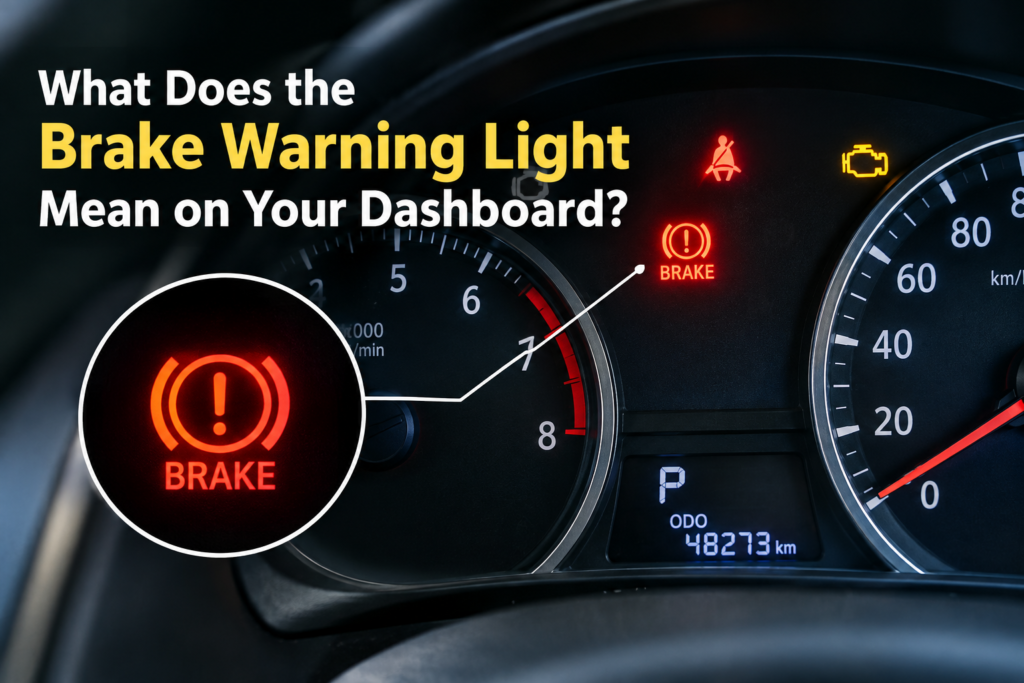
Your dashboard just lit up with a brake warning light. Should you worry? Yes, you should act fast. The light tells you that your car may have lost some stop power. A quick check shows you if the fix is simple or if you need a tow truck.
Most cars carry one or two brake lights, according to HowStuffWorks. Each light carries a different message. This guide covers each symbol, cause, and fix, so you can act with confidence.
What Does a Brake Warning Light Look Like?
Which symbol does your car show? US vehicles use one of three common indicators.
| Symbol | Where You See It | Usual Meaning |
| The word “BRAKE” | Most US-spec vehicles | Parking brake on, or a hydraulic problem |
| An exclamation mark in a circle with parentheses: (( ! )) | Many newer models | Parking brake, low fluid, or lost pressure |
| A “P” in a circle: (( P )) | Cars with an electronic parking brake | Parking brake is engaged |
Color matters too. Red signals a critical issue. Amber or yellow points to the anti-lock brake system (ABS) or to worn pads. Your owner’s manual shows the exact symbol for your make and model.
Why Do the Dashboard Lights Come On at Startup?
Turn the key and watch the dash. All lights should come on, then go out in a few seconds. That flash is the bulb check.
A light that stays on tells you the car found a problem. A light that never comes on tells you the bulb needs a replacement. Why does that matter? A dead indicator cannot warn you when trouble starts.
What Causes the Brake Warning Light to Come On?
Five causes cover nearly every case. The table ranks them by urgency, based on guidance from PowerStop, HowStuffWorks, and Firestone Complete Auto Care.
| Cause | Urgency | What It Means | What You Do |
| Engaged parking brake | 🟢 Low | The lever or switch sits even one notch up | Release it fully |
| Low brake fluid | 🔴 Critical | The master cylinder reservoir sits below the safe line | Check the reservoir and find the leak |
| Hydraulic pressure loss | 🔴 Critical | One half of the brake system lost pressure | Pull over and call a tow truck |
| Worn brake pads | 🟡 Moderate | Pads reached about 4.5mm or less | Book a replacement soon |
| ABS fault | 🟡 Moderate | The anti-lock system shut itself off | Visit a mechanic soon |
Why does the hydraulic item rank as critical? Your car splits the brake system into two circuits. HowStuffWorks explains that the light can signal lost pressure in half of that system. The other half still works, so the car can stop. Expect a longer stop distance, though.
What Should You Do When the Light Comes On at Startup?
Leave the car parked. Turn the engine off. Then run the checks below in order.
- Release the parking brake all the way. Push the lever down or press the electronic switch.
- Restart the car and watch the light.
- Open the hood and check the brake fluid level.
- Press the pedal and feel the response.
If the light stays on after step 1, treat the issue as hydraulic. Have a shop inspect the car before you drive it.
What Should You Do When the Light Comes On While You Drive?
Stay calm. Slow down gradually and test the pedal. Panic makes the situation worse.
Does the pedal feel firm? Then ease over to a safe spot and stop. Try the parking brake release once more. If the light stays on, call a tow truck.
Does the pedal feel soft, spongy, or low? Pull over right away. Those signs point to a severe leak or air in the lines. Use the emergency brake to stop if the brakes fail completely. A red light that stays on is extremely dangerous, so act at once.
How Do You Check Brake Fluid?
How does brake fluid work? You press the pedal, and pressurized fluid moves through the brake lines. The fluid pushes a piston in each caliper. The piston squeezes the pads against the rotor, and the car slows.
Follow these steps to check the level:
- Find the master cylinder. It is also called the brake fluid reservoir. The plastic tank is usually white or yellow and sits on the driver’s side.
- Read the markings on the side. You will see a minimum line and a maximum line.
- Compare the fluid level to those lines.
Is the level low? A low level usually points to a leak or to heavily worn pads. A top-off hides the symptom and leaves the cause in place. PowerStop advises a brake fluid flush before you add new fluid. Ask a shop to inspect the system, and follow your manual on fluid type.
How Do You Test the Brake Pedal?
Sit in the car with the engine on. Press the pedal with force. A firm pedal is a good sign. A pedal that sinks to the floor points to a leak or air in the system.
Do you feel any doubt? Call a tow truck. A tow costs far less than a crash.
Why Does the Parking Brake Trigger the Light?
The parking brake causes more false alarms than any other part. Even one notch of lever travel keeps the light on. Electronic switches can stay half engaged too.
Release the brake fully and wait a moment. Did the light go out? Then you solved the problem in seconds. Did it stay on? Move on to the fluid and pad checks.
How Do Worn Brake Pads Trigger the Light?
Pads wear down with every stop. PowerStop recommends replacement once the pad thickness falls to about 4.5mm. A pad below that point loses stop power and starts to damage the rotor.
Some cars add an electronic wear sensor to the pad. The sensor touches the rotor once the pad reaches minimum thickness. Then the dash lights up. You get an early alert before metal meets metal.
Why act early? Worn pads that reach the rotor turn a small repair into a large one. Rotors cost more than pads, so fast action saves money.
What Does the Anti-Lock Brake (ABS) Light Mean?
The ABS light is amber or yellow and usually reads “ABS.” It connects to the anti-lock system, and the main hydraulic circuits stay separate from it.
If the light stays on after the bulb check, the ABS controller has shut the system off. Your regular brakes still work like brakes on a car without ABS. HowStuffWorks says you can drive to a mechanic in this case. Expect longer stops on wet roads, because the anti-skid protection is offline.
Do the ABS light and the red brake light show together? Treat the red light as the priority. Stop and have the car inspected.
Can You Drive With the Brake Warning Light On?
Release the parking brake first. If a red light stays on, leave the car parked and call a tow truck. A red light can signal pressure loss in half the system. The car may still stop, but the distance grows and the risk climbs.
An amber ABS light is different. Most drivers can reach a repair shop with extra care. Leave more space between you and the car ahead.
Why Is the Brake Warning Light On When the Brakes Feel Fine?
Does the light glow while the pedal feels normal? Four causes explain it:
- The parking brake sits slightly engaged.
- The fluid sits just under the minimum line.
- A pad sensor tripped before you felt a change.
- A sensor or switch has failed.
A faulty sensor is the least dangerous cause. You still need a mechanic to confirm it. You cannot tell a bad sensor from a real leak by feel alone.
Why Does the Brake Light Blink When You Turn?
Do you see the light blink on and off in turns? Fluids may move around in a low reservoir. The level sensor picks up the motion and triggers the light. Check the fluid level first. A low level confirms the cause, and a shop should find the leak.
How Do You Reset the Brake Warning Light?
Fix the cause first. The light then clears on its own in most cars. A reset without a repair hides the warning, and the danger stays.
Some cars with pad wear sensors need a new sensor wire after a pad replacement. Ask the shop to install one. Electronic parking brake systems may need a service reset, so check your manual.
How Do You Choose the Right Replacement Brakes?
Pads that need a replacement deserve a good kit. Off-the-shelf parts vary in quality, and brakes differ in build. Compare reviews and match the kit to your driver profile. A daily commuter, a tow driver, and a performance fan all have different needs.
Many brake makers offer online finders. You enter your year, make, and model, and the tool lists kits that fit. A complete kit saves extra trips to the parts store. You can install it yourself, or you can hand it to a trusted mechanic.
FAQ: Brake Warning Light Questions Answered
What does the brake warning light mean?
Your brake system needs attention. The four common causes are an engaged parking brake, low brake fluid, worn pads, and lost hydraulic pressure. Red signals a critical issue. Amber usually points to ABS or pad wear.
What does the brake (!) symbol mean?
The symbol covers the same ground as the word “BRAKE.” It points to the parking brake, low fluid, or a pressure problem. Check the parking brake first. Then check the fluid level.
What does the “P” brake light mean?
The parking brake is engaged. Release it fully. The light should go out within a moment.
Why does the brake light stay on after you release the parking brake?
Pressure on one side of the system may sit lower than on the other. A leak or low fluid can create that gap. HowStuffWorks notes that brake performance drops in this case. Have a shop repair the car before you drive it again.
How thin can brake pads get before you replace them?
Replace them at about 4.5mm. A thinner pad loses stop power and can damage the rotor.
What is the difference between the brake light and the ABS light?
The red brake light relates to the main hydraulic system and the parking brake. The amber ABS light relates to the anti-lock system only. Your regular brakes still work when the ABS light is on.
Why do all the dashboard lights come on when you start the car?
Your car runs a bulb check at startup. All lights should come on and then go out within a few seconds. A light that stays on signals a problem.
What Is the Final Takeaway on the Brake Warning Light?
The brake warning light carries a clear message. Your car needs a check before it needs more miles. Read the color first. Red means stop and inspect. Amber means book a visit soon.
Next, run the simple checks. Release the parking brake all the way. Read the fluid level in the master cylinder. Press the pedal and feel the response. Which check gave you a clue? HowStuffWorks explains that lost pressure in half the system weakens your stop power, so a shop should repair the car before you drive it again.
Stay alert to the pedal as well. Does it feel soft or sink toward the floor? Pull over and call a tow truck. A tow costs far less than a crash. PowerStop recommends pad replacement at about 4.5mm, so early action protects your rotors and your budget.
CarRevix is an automotive knowledge and service platform focused on car care, maintenance, repairs, SEO/link building, sponsored content, and automotive advertising. It provides practical automotive guides while helping automotive brands, repair businesses, and related companies improve their online visibility and reach targeted audiences.