
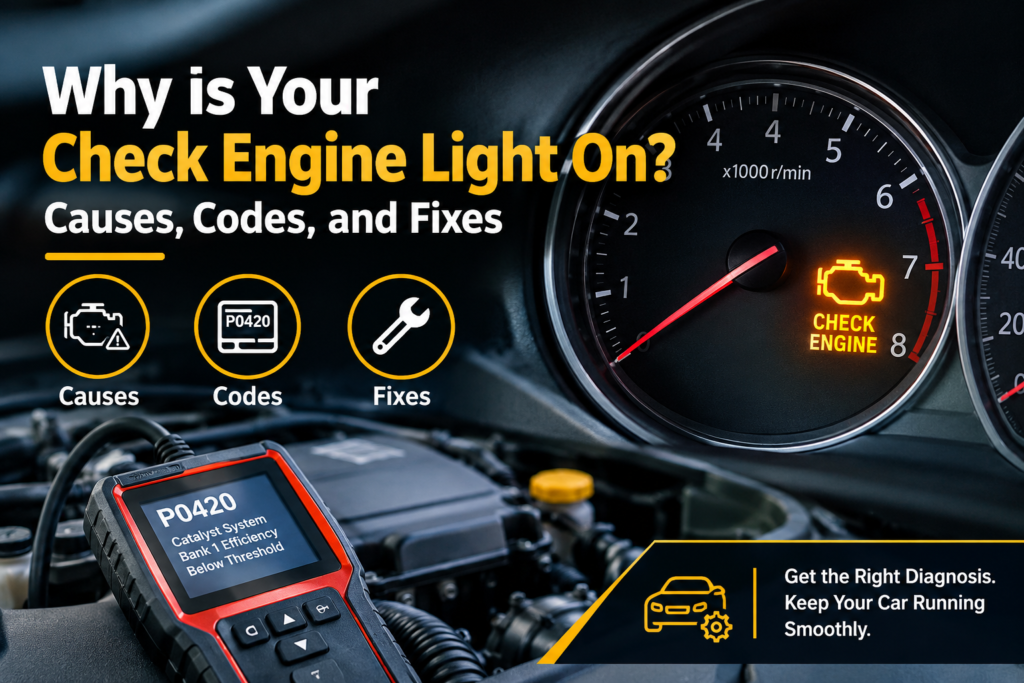
Your check engine light suddenly turns on. What does it mean, and how urgently should you respond? The answer depends on your vehicle’s onboard diagnostic system. In this guide, you’ll discover the common causes, understand engine trouble codes, and learn the right steps to diagnose and fix the problem.
What Does the Check Engine Light Mean?
The light signals that the On-Board Diagnostics system (OBD-II) found a fault. The system monitors the emission, ignition, fuel, and exhaust circuits. Sensors send data to the engine control unit (ECU). Some makers call the ECU the powertrain control module (PCM).
The ECU stores a diagnostic trouble code (DTC) when a sensor value leaves its normal range. It then switches on the malfunction indicator lamp (MIL). That lamp is your check engine light.
Why does the standard matter to you? The EPA required OBD-II on every car and light truck sold in the US from model year 1996. Therefore your car has a standard 16-pin port and standard codes. Any shop or scanner can read them.
Is It Safe to Drive With the Check Engine Light On?
The light’s behavior tells you the urgency. Check it first.
| Light status | What it signals | What you should do |
| Steady | A fault exists, but the engine can run safely for a short time | Book a diagnostic check soon. Drive gently until then. |
| Flashes | A severe engine misfire | Pull over safely and shut off the engine. Call a tow. |
A misfire sends raw fuel into the exhaust. That fuel overheats and can melt the catalytic converter. As a result, a short drive can turn a small repair into a major bill.
Stop at once if you notice any of the signs below:
- The temperature gauge climbs fast.
- The oil pressure light comes on.
- You see smoke or smell burnt fuel.
- The engine knocks loudly.
- The car loses power suddenly.
Does the car run smoothly and stay cool? Then lower your speed, carry a light load, and head to a service center. One Mercedes-Benz dealer guide gives the same advice to owners whose lamp flashes.
What Are the Most Common Causes of a Check Engine Light?
Dozens of faults can trigger the lamp. Nine causes appear most often. The table lists each one with its urgency.
| Cause | What it does | Typical symptoms | Urgency |
| Loose or damaged gas cap | Seals the fuel system and holds vapor pressure | Fuel smell, light after you refuel | Low |
| Failing oxygen (O2) sensor | Measures unburnt oxygen in the exhaust | Poor fuel economy, rough idle | Moderate |
| Catalytic converter failure | Turns carbon monoxide into safer gases | Rotten-egg smell, weak acceleration | High |
| Worn spark plugs or wires | Create the spark that starts combustion | Misfires, hard starts, poor acceleration | Moderate |
| Faulty mass airflow (MAF) sensor | Measures air that enters the engine | Stalls, rough idle, high fuel use | Moderate |
| EVAP system leak | Captures and reuses fuel vapors | Fuel odor, hard starts after fill-up | Low to moderate |
| Vacuum system leak | Controls emissions and helps the brake booster | Hiss under the hood, rough idle | Moderate |
| Clogged EGR valve | Cuts nitrogen oxide output | Pings, rough idle | Moderate |
| Weak or dead battery | Powers every electrical part | Slow crank, odd dash lights | Moderate |
How Does a Loose Gas Cap Trigger the Light?
The cap keeps the fuel system sealed. A loose, cracked, or worn cap lets vapor escape. The ECU detects the pressure drop and stores a code, often P0455 or P0442. Twist the cap until it clicks. Then drive a few miles and watch the lamp.
Why Does a Bad Oxygen Sensor Matter?
The O2 sensor tells the ECU how much unburnt oxygen leaves the exhaust. The ECU uses that data to tune the fuel mix. A weak sensor wastes fuel. It can also damage the catalytic converter over time. Replace it soon after the code appears.
What Happens When the Catalytic Converter Fails?
The converter turns carbon monoxide and other harmful gases into safer compounds. It uses platinum, palladium, and rhodium to do this job. It rarely fails alone. Ignored spark plug or O2 sensor faults usually kill it first.
Repair it at once, since a clogged converter chokes the engine. Federal emissions law covers the catalytic converter and ECU for 8 years or 80,000 miles in most cases. Check your warranty before you pay for the repair.
Can Worn Spark Plugs and Wires Light the Dash?
Yes. Worn plugs cause misfires and weak acceleration. Misfires then harm the converter. Replace plugs at the interval in your owner’s manual. Also check the ignition coils, because a failed coil causes the same symptoms.
How Does a Dirty MAF Sensor Affect Your Car?
The MAF sensor measures incoming air. The ECU uses that figure to decide how much fuel to inject. A dirty sensor sends bad data. The engine then stalls, idles rough, and burns extra fuel. Clean the sensor with MAF sensor spray first. Replace it if the code returns.
What Is an EVAP Leak?
The evaporative emissions (EVAP) system captures fuel vapor and sends it back to the engine. Cracked hoses, a stuck purge valve, or a bad cap cause leaks. Small leaks set low-urgency codes. A mechanic can run a smoke test to find the exact spot.
Can a Vacuum Leak Turn On the Light?
Yes. The vacuum system lowers emissions and assists the brake booster. A cracked hose lets in extra air. The fuel mix then runs lean, and you may see code P0171. You may also hear a hiss under the hood. Schedule service soon, since the leak can weaken your brake assist.
Why Does a Clogged EGR Valve Cause Trouble?
The exhaust gas recirculation (EGR) valve sends a small share of exhaust back into the intake. The move lowers nitrogen oxide output and helps the engine run efficiently. Carbon buildup can jam the valve open or shut. A shop can clean or replace it.
Can a Dead Battery Set Off the Light?
Yes. A weak battery drops system voltage. Low voltage confuses sensors and modules. Test the battery and alternator before you replace costly parts.
What Other Causes Should You Know?
Several less common faults also trigger the lamp:
- Aftermarket alarms and electronics: Poor installs can disrupt the ECU. An OEM part usually fits better.
- Failed thermostat: The engine stays too cool, so the ECU logs a code.
- Dirty fuel injectors: They spray an uneven pattern and cause misfires.
- Bad ignition coil: It causes a cylinder misfire even when the plug is fine.
- Faulty crankshaft or camshaft sensor: It sends bad timing data to the ECU.
How Do You Read the Check Engine Code?
A scanner shows you the exact fault in minutes. Most auto parts stores read your code for free. Many repair shops offer the same service. You can also buy a basic scanner for home use.
Use the steps below:
- Find the diagnostic port under the dash, near the steering column.
- Plug in the scanner.
- Turn the key to “On” and leave the engine off.
- Select “Read Codes” and write down every code.
The SAE J2012 standard defines the code format. A “P” at the start marks a powertrain fault. A “0” as the second character marks a generic code that works on all makes. A “1” marks a maker-specific code. Which codes should you expect most?
| Code | Meaning | Likely culprit |
| P0455 | Large EVAP leak | Gas cap, hose, purge valve |
| P0442 | Small EVAP leak | Gas cap, cracked hose |
| P0420 | Catalyst efficiency below threshold | Catalytic converter, O2 sensor |
| P0300 | Random misfire | Plugs, coils, fuel delivery |
| P0301–P0312 | Misfire in one cylinder | Plug, coil, injector |
| P0171 | Fuel mix too lean | Vacuum leak, MAF sensor |
| P0101 | MAF sensor range problem | Dirty or failed MAF sensor |
| P0135 | O2 sensor heater circuit fault | O2 sensor |
| P0401 | Low EGR flow | Clogged EGR valve |
| P0128 | Coolant temperature below thermostat range | Stuck-open thermostat |
| P0562 | System voltage low | Weak battery, alternator |
Keep one rule in mind. A code points to a system and may blame the wrong part. For example, P0420 can come from a bad O2 sensor instead of a dead converter. Therefore confirm the cause before you buy parts.
How Do You Fix a Check Engine Light?
Follow this order. It saves money and time.
- Check the light status. A light that flashes means you stop at once.
- Tighten the gas cap. Twist until it clicks. Drive a few miles to see if the light resets.
- Inspect the basics. Check fluid levels, hoses, and battery terminals.
- Scan the code. Record it and research the matching system.
- Repair the root cause. Replace the part or book a shop visit.
- Clear the code. Use a scanner after the repair is complete.
- Confirm the fix. Drive normally for a few days and watch the lamp.
Do you feel unsure at step five? A certified technician can run a full diagnosis. Mercedes-Benz owners can also run a remote diagnosis through the Mercedes me app.
How Do You Reset the Check Engine Light?
The light often stays on after a repair. Why does that happen? The ECU keeps the code until it confirms the fix over several drive cycles. You have three options.
- Wait. The lamp usually clears on its own after several normal trips with no fault.
- Use a scanner. Select “Clear Codes” after the repair. This option is the cleanest.
- Disconnect the battery. The method works on some cars. It also erases readiness data, which can hurt an emissions test.
Many Mercedes-Benz models let you check and reset the lamp from the instrument cluster. Try the steps below:
- Turn the key to “On” and leave the engine off.
- Press the lower left button on the left side of the steering wheel.
- Read the fault message on the display. Press the same button to see the mileage.
- Locate the reset button on the left side of the instrument cluster.
- Hold the button until the display prompts a three-second reset.
- Press the button until the display confirms the reset.
Menus differ by model, so check your owner’s manual. Clear the code only after the repair. An early clear hides the fault, and the light will return. If the lamp still flashes after the reset, book a service visit.
Why Does the Check Engine Light Come On and Go Off?
An intermittent fault is the usual reason. A loose gas cap, a damp connector, or a weak battery can cause it. The ECU reruns its tests each trip. It turns the lamp off when the fault no longer shows.
However, the stored code stays in memory. A scanner can still read it. Therefore scan the car even when the lamp is off.
Can You Pass an Emissions Test With the Light On?
Usually no. Most states fail a car that shows an active MIL. The ECU must also finish its readiness monitors. A recent battery disconnect or code clear resets those monitors.
Many states allow one incomplete monitor on 2001 and newer cars. Cars from 1996 to 2000 often get two. As a result, drive several days after a repair before you book the test.
How Can You Prevent Check Engine Light Problems?
Routine care prevents most causes. Try the habits below:
- Tighten the gas cap after every fill-up.
- Replace spark plugs on schedule.
- Change the air filter and oil on time.
- Buy fuel from reputable stations.
- Test the battery once a year.
- Choose OEM parts for alarms and sensors.
- Fix small faults before they spread.
Check Engine Light FAQs
What is the most common reason for a check engine light?
A loose or faulty gas cap tops the list. Failed O2 sensors and worn spark plugs follow close behind.
How do I fix my check engine light?
Scan the code, find the cause, and repair it. Then clear the code and confirm the lamp stays off.
Why is my check engine light suddenly on?
A sensor value left its normal range. A loose cap, a failed sensor, or a misfire can cause it. A scan gives you the exact answer.
Is it safe to drive with the check engine light on?
A steady light allows a short, gentle drive to a shop. A light that flashes means you stop at once and call a tow.
Final thought :
Your check engine light is a message from your car’s computer. The ECU spots a fault early and asks you to act. An OBD-II scanner reads that message in minutes.
Read the light first. A steady lamp gives you time to book a check. A flashing lamp means you stop at once. Then scan the code, find the root cause, and repair it before it grows.
Small faults cost little. A loose gas cap costs you one twist. An ignored misfire can cost you a catalytic converter. Which bill do you want to face? Act on the first sign, and your car will reward you with lower repair costs, better fuel economy, and an easy emissions test.
CarRevix provides helpful automotive guides covering car maintenance, repairs, warning lights, replacement parts, repair costs, and troubleshooting. It helps drivers understand common vehicle problems, make informed repair decisions, and keep their cars safe, reliable, and well-maintained