
Meta title: What Is ABS? Anti-lock Braking System Explained
Meta description: Learn what ABS is, how it works, its parts and types, and when it became standard in the US. Find out what your ABS light means.
Picture a wet road and a sudden hazard. You hit the brake pedal hard. Your tires lock, and your car slides forward. Can you still steer out of trouble? An Anti-lock Braking System (ABS) says yes. ABS is an automated safety feature that stops wheel lock-up and skids in emergency stops.You likely have a few questions. How does ABS work? Which parts does it use? When did it become standard in the US? What does your ABS light mean? Read on for clear answers.
What Does ABS Mean?
ABS stands for Anti-lock Braking System. The system works with your regular hydraulic brakes. It pumps the brakes for you in a sudden stop. As a result, you can steer around a hazard while you slow down hard.
Most modern cars, trucks, and SUVs carry ABS. Many also pair it with traction control and electronic stability control (ESC). Newer models often run all three systems together.
Why Do Wheels Lock Up Without ABS?
Picture a hard stop. The brake pads grip harder than the tires grip the road. The wheels cease to rotate, but momentum still pushes your car forward. Your car skids, and you lose steer control. Wet roads make the problem worse.
Drivers once learned to pump the brakes by hand. Experts call the method cadence braking or stutter braking. It let the tires roll, so the driver could steer. However, you have only a few seconds to react in a real emergency. Even professional drivers struggle to pump the pedal at the right pace.
ABS solves the problem. Therefore, you no longer need to recall a technique under stress.
How Does ABS Work?
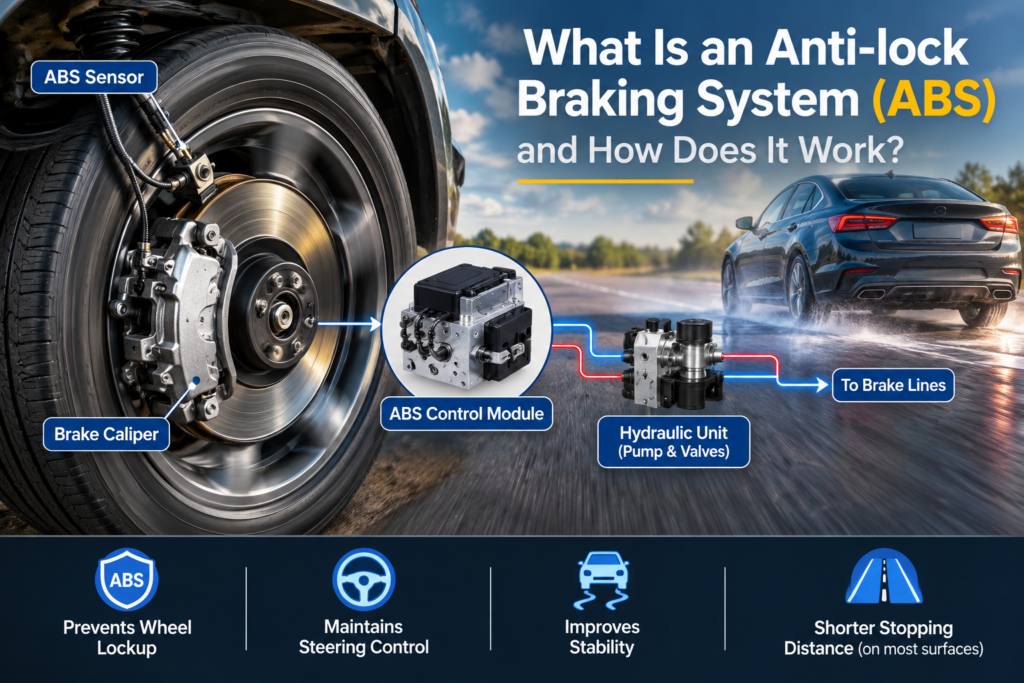
An ABS uses four basic parts: wheel speed sensors, valves, a pump, and a controller. A four-wheel system repeats this cycle:
- A wheel speed sensor at each wheel measures how fast that wheel turns.
- The sensors send the data to the controller.
- The controller compares each wheel’s speed with the speed of the vehicle.
- The controller spots a wheel that slows too fast or stops. It then signals the valve.
- The valve cuts pressure in that wheel’s brake line, so the wheel keeps rotation.
- The pump restores pressure once the wheel regains traction.
The cycle repeats until your car stops. How fast is it? The system can release and apply the brake up to 20 times per second. No human foot can match that pace.
What Are the Core Parts of an ABS?
Each part has one clear job. Which part does what?
| Component | Primary Function |
| Wheel speed sensors | Track how fast each wheel rotates and send live data to the controller. |
| ABS electronic control unit (ECU) | Acts as the brain. It detects rapid slowdown that signals an impending lock-up. |
| Hydraulic modulator and valves | Hold, release, or block brake fluid pressure in the lines to each caliper. |
| Hydraulic pump | Restores fluid pressure to the brake lines once traction returns. |
What Types of ABS Setups Exist?
Not every vehicle uses the same layout. The year, make, and class of the vehicle decide the setup. A channel is a valve circuit that controls pressure. Here are the four common setups:
| Configuration | Description |
| Four-channel, four-sensor | Each wheel has its own sensor and valve. Most modern passenger vehicles use it for the best control. |
| Three-channel, four-sensor | Four sensors track all wheels. The rear wheels share one valve. Select mid-sized vehicles use it. |
| Three-channel, three-sensor | The front wheels get individual control. The rear wheels share one sensor and one valve on the rear axle. |
| One-channel, one-sensor | One sensor and one valve control the rear axle only. Older commercial trucks, trailers, and rear-wheel-drive vans use it to curb spin-outs. |
Which one does your car have? Your owner’s manual will tell you.
When Did Anti-lock Brakes Become Standard in the US?
The National Highway Traffic Safety Administration (NHTSA) set the key date. Every new passenger car, minivan, and light truck built on or after September 1, 2011, must carry ESC. That date matches the 2012 model year. ABS forms the base of ESC, so four-wheel ABS became standard on new passenger vehicles.
Older cars may lack ABS. How do you know if yours has it? The next section explains.
How Can You Tell If Your Car Has ABS?
Check your dashboard first. Many ABS cars show an ABS icon on the instrument panel. The icon should light up for a moment when you start the car. That quick test is the bulb check.
Next, watch what the light does. Does it stay on after the bulb check? Does it come on as you drive? Either case points to a likely fault. Take your car in for service.
Do you see no icon at all? Read your owner’s manual. You can also ask your dealer to confirm.
How Do You Use ABS in an Emergency?
You do not need a new skill. ABS starts on its own when you slam the brake pedal. Some systems also start when the sensors detect a skid on a wet or loose surface. Follow these habits:
- Press firmly and hold steady. Do not pump the pedal.
- Expect pedal pulses. You may feel the pedal push back against your foot.
- Expect noise. You may hear a buzz, grind, or groan.
- Steer to safety. Keep full pressure on the pedal and aim around the hazard.
Do the pulse and noise mean your brakes failed? No. Those signs show that ABS works as designed.
Why Is Your ABS Light On?
A lit ABS light means the system found a fault. Several causes exist:
- A faulty ABS module
- Low fluid in the brake reservoir
- Faulty or blocked wheel speed sensors
The risk is clear. A lit light means the anti-lock function is off. Your car then reverts to standard brakes until a mechanic fixes the fault. Your wheels can lock again in a hard stop. Book service with a qualified mechanic soon.
ABS runs a self-check on its own parts. The check helps you learn of a fault early.
What Are the Advantages of ABS?
ABS offers four clear benefits:
- Effective stops: You can apply maximum brake force without a skid.
- Better traction: The wheels hold grip on wet or gravel surfaces.
- Reliable performance: The self-check flags faults and malfunctions.
- Improved driver control: You keep steering control in hard stops to avoid obstacles.
Does research back these claims? Yes. A 2009 NHTSA study used crash data from 1995 to 2007. ABS cut the rate of non-fatal crashes. It also cut collisions with pedestrians and collisions with other vehicles on wet roads. However, ABS did not improve the rate of fatal run-off-road crashes.
Does ABS Shorten Your Stop Distance?
Sometimes. Four-wheel ABS can shorten the distance on dry pavement. It helps most on wet or slippery roads. On gravel or loose snow, it may actually lengthen the distance.
Even then, ABS keeps your wheels in motion. You can still steer around a hazard. Many drivers value that control more than a few feet of distance.
Does ABS Replace Safe Habits?
No. ABS is a powerful tool, but it cannot fix poor habits. Excess speed, a short gap behind the car ahead, and fatigue all cut your reaction time. Reaction time decides how well you handle an emergency. Therefore, keep a safe speed and stay alert. Good judgment lets ABS work at its full potential.
How Does ABS Differ From ESC and Traction Control?
ESC and traction control are separate systems. They solve different problems. Yet they work together with ABS in many newer cars and trucks. ABS handles wheel lock-up in hard stops. ESC and traction control help you hold your path and your grip.
What Are the Most Common Questions About ABS?
Is ABS automatic or manual?
ABS is automatic. The system acts on its own when it senses wheel lock-up.
What is the purpose of an anti-lock braking system?
It keeps your wheels in motion in a hard stop. You keep steer control and avoid a skid.
Do you need to pump the brakes with ABS?
No. ABS pulses the brakes for you. Apply firm, steady pressure instead.
What are other names for ABS?
Common names include anti-lock brakes and anti-skid braking systems. Some brands once used their own names for the same system.
Do all cars have ABS?
Most passenger vehicles, trucks, and SUVs built after September 1, 2011, have it. Older cars may lack it.
What Should You Remember About ABS?
ABS keeps your wheels in motion in a hard stop. Sensors, a controller, valves, and a pump work together up to 20 times per second. You press firmly, hold steady, and steer. A lit ABS light means you need service. Which vehicle do you own? Check its dashboard and manual today.
CarRevix provides helpful automotive information, including car maintenance tips, repair cost guides, troubleshooting advice, and detailed explanations of vehicle parts and systems. It helps car owners understand common problems, make informed repair decisions, and keep their vehicles in good condition.