
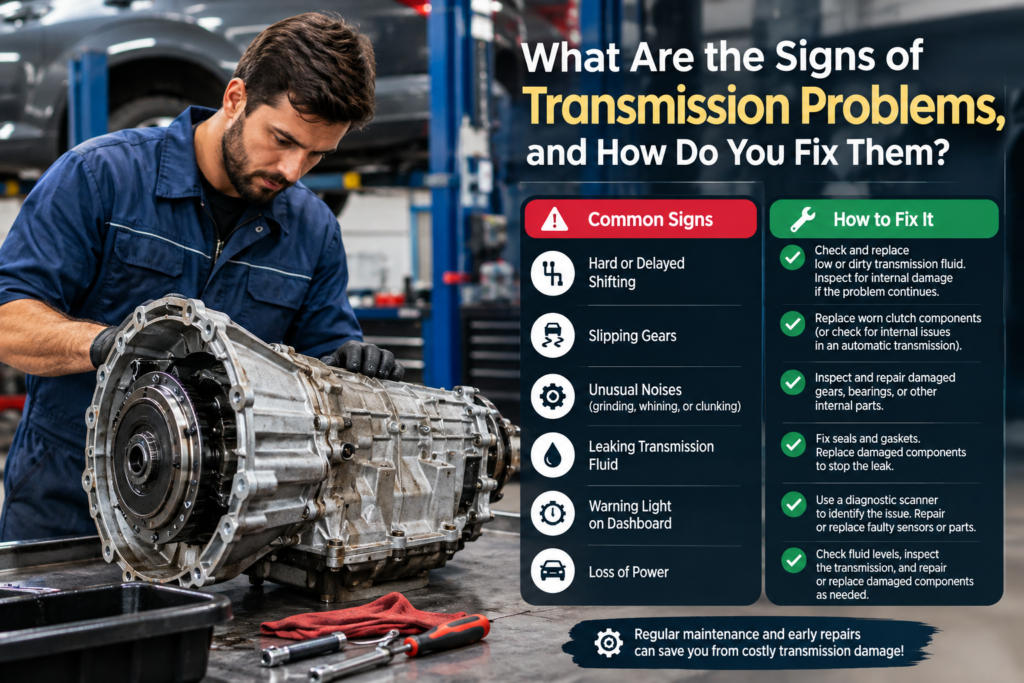
Your transmission sends power from the engine to the wheels. It lets your car move at every speed. A fault here costs time and money. Small symptoms grow fast, and a minor shift lag can end in a roadside failure. How do you catch the problem early? You read the signs, find the cause, and act at once. This guide pulls together the nine problems that Cutter CDJR Pearl City lists, the seven warning signs from the diagnostic overviews, and the repair steps that technicians use.
What Are the Key Takeaways?
- Low or degraded fluid triggers most early symptoms.
- Early action separates a fluid top-off from a multi-thousand-dollar rebuild.
- A code scan hands the technician the data they need.
- Severe slip or limp mode means you call a tow truck.
What Does a Transmission Do?
Your transmission converts engine output into wheel motion. An automatic unit shifts gears on its own through fluid pressure and the Transmission Control Module (TCM). A manual unit relies on a clutch and your shifter. Transmission fluid serves three roles. It lubricates the parts, it carries hydraulic pressure, and it moves heat away. Low fluid therefore harms every internal part at once.
What Is the Most Common Transmission Problem?
Your fluid level causes most early faults. Leaks and skipped service intervals drain or age the fluid. Slip, heat, and late shifts follow. Consequently, you should check the fluid before you assume the worst.
The numbers back this up. Eight of the nine problems in the Cutter CDJR Pearl City list involve low fluid or a fluid leak. Only the dashboard light entry stands apart. Fluid faults also copy the symptoms of deeper failures. Have you ever paid for a clutch repair that a top-off could have solved?
What Are the Signs Your Transmission Is Going Out?
How do you know the transmission is failing? Watch for these signals.
- Gear slip: The engine revs high (high RPMs), but the car gains little speed. The car may also pop out of gear into neutral.
- Delayed engagement: A lag follows your move from Park to Drive or Reverse.
- Rough shifts: Gear changes feel harsh and jerky. Automatic cars shudder under acceleration. Manual cars grind.
- Strange noises: Whine, hum, buzz, and clunk sounds appear. They stand out at idle or in neutral.
- Fluid leaks: Bright red, dark red, or brown puddles form under the car. A failed gasket, pan, or cooler line is the likely source.
- Burnt smell: The fluid breaks down or runs low, and internal parts overheat.
- Overheat: Low fluid, a faulty cooler system, or heavy loads raise the temperature. Hot fluid loses its lubrication.
- Stall: The engine cuts out at a stop or between gears. Traffic makes a stall dangerous.
- Dashboard lights: The Check Engine light or the Transmission light comes on.
- Worse fuel economy: Your miles per gallon drop. Slip and extra friction force the engine to burn more fuel.
Do you notice two or more of these signs? Then book a diagnosis soon. Each sign points to a different part, so the next section matters.
What Do the Dashboard Lights Mean?
Two lights relate to the transmission. They are the Check Engine light and the Transmission light. Sensors track internal temperature, fluid pressure, and shift patterns. The onboard diagnostics system then reports any irregularity to the computer long before total failure. Therefore, you should treat either light as an early alert. The Check Engine light covers many systems, so a scan tells you which one needs attention.
Why Do Transmissions Fail?
Which parts cause the trouble? Most faults trace back to a short list.
| Faulty part | Typical symptom | Why it happens |
| Low or degraded fluid | Slip, overheat, delayed shifts | Leaks or skipped service |
| Shift solenoids | Erratic shifts, stuck in one gear | These electro-hydraulic valves control fluid flow, so an electrical fault stops gear changes |
| Torque converter | Severe shudder, stall at stops | Worn needle rollers or a faulty internal clutch fail to couple the engine and transmission |
| Clutch packs and gears | High revs with little acceleration | Friction wear over time, sped up by heat |
| Synchronizers | Clunk or grind at gear changes | Worn or damaged internal components |
| Transmission pump | Whine from the unit | Low fluid or a pump fault |
| Seals, gaskets, pan, cooler line | Fluid loss and puddles | Damage and age |
| TCM | Rough or late shifts | Control faults disrupt shift timing |
Four of these parts, the fluid, the solenoids, the torque converter, and the clutch packs, account for the most common faults in the diagnostic overviews. Mister Transmission, Audi West Palm Beach, and the Placentia Super Service guide to automatic issues all help you match a symptom to one of them.
How Do You Read Your Fluid?
Fluid color gives you a fast health check. Healthy fluid looks transparent and pink or red. Burnt fluid looks dark brown or black and smells toasted. A puddle under the car looks bright red, dark red, or brown.
Do you own a car with a dipstick? Then check the level when the engine is warm and on. Many modern cars have sealed transmissions. Those units need special tools, so a shop must check them.
What Can Be Mistaken for Transmission Problems?
Some faults look worse than they are. The Check Engine light points to many systems, so a code scan separates transmission faults from engine faults. Low fluid also mimics a deep mechanical failure. A simple top-off can cure a slip that looks like a clutch pack fault. However, you should still find the leak that caused the loss. Otherwise, the slip returns.
How Do You Fix Transmission Problems?
Can you fix a transmission without a full replacement? Often you can, if you act early. Follow these steps.
- Check the fluid first. Test the level and condition on a dipstick car. Top off or service the fluid as needed.
- Scan for trouble codes. Plug an OBD-II scanner into the port and read the codes the TCM stored. Leave the codes in place and keep the battery connected. A technician needs that data.
- Trace the leak. Inspect the pan, gasket, and cooler line. Replace the failed part.
- Match your symptoms to a guide. Compare your signs with the Mister Transmission, Audi West Palm Beach, and Placentia Super Service resources.
- Book a professional diagnosis. A technician can test the solenoids, the torque converter, and the clutch packs. Targeted repair often costs far less than a rebuild.
How Much Does Transmission Repair Cost?
Cost depends on the failed part and how long you wait. A fluid top-off sits at the low end. A multi-thousand-dollar rebuild sits at the high end. Early action keeps you near the low end. Delay lets heat and friction destroy the internal gear assemblies. Ask your shop for a written estimate after the scan.
When Should You Tow Instead of Driving?
Stop and call a tow service in these cases.
- The transmission slips severely.
- The car pops out of gear without warning.
- The car enters protective “limp home” mode. A long trip in this state wrecks the gear assemblies. Pull off the road safely first. A tow costs far less than a new transmission.
How Do You Prevent Transmission Problems?
What keeps a transmission healthy for years? Build these habits.
- Service the fluid on schedule.
- Fix leaks the day you spot them.
- Check fluid color and level often.
- Avoid heavy strain, because it overheats the fluid.
- Scan dashboard lights as soon as they appear.
What Are the Most Common Questions About Transmission Problems?
What are some common transmission issues in cars?
Delayed shifts, gear slip, overheat, fluid leaks, strange noises, dashboard lights, stalls, rough shifts, and worse fuel economy lead the list.
What are signs that your transmission is going out?
You notice high revs with little speed, a lag after you select a gear, grind or clunk sounds, a burnt smell, or red and brown puddles.
How do you fix transmission problems?
You check the fluid, scan the codes, trace the leak, and book a diagnosis. Early repair often avoids a full replacement.
What can be mistaken for transmission problems?
Low fluid, a Check Engine light from another system, and a simple leak all copy deeper faults
.
What Are the Final Thoughts on Transmission Problems?
Your transmission works hard every time you drive. It sends power from the engine to the wheels through fluid pressure, gears, and the TCM. A fault in one part affects the whole system. Therefore, you should treat every new noise, lag, or dashboard light as an early alert.
Fluid sits at the center of the topic. Eight of the nine problems in the Cutter CDJR Pearl City list involve low fluid or a fluid leak. Consequently, a quick fluid check costs you little and can save you a multi-thousand-dollar rebuild. Have you checked your fluid color and level this month?
Next, scan the codes with an OBD-II scanner and keep the battery connected. The TCM stores the data that a technician needs. Then compare your symptoms with the Mister Transmission, Audi West Palm Beach, and Placentia Super Service guides. Finally, book a professional diagnosis. Targeted repair often costs far less than a full replacement
CarRevix provides helpful automotive guides, car maintenance tips, repair cost information, troubleshooting advice, and vehicle parts guides to help drivers make informed decisions and keep their cars running smoothly.