
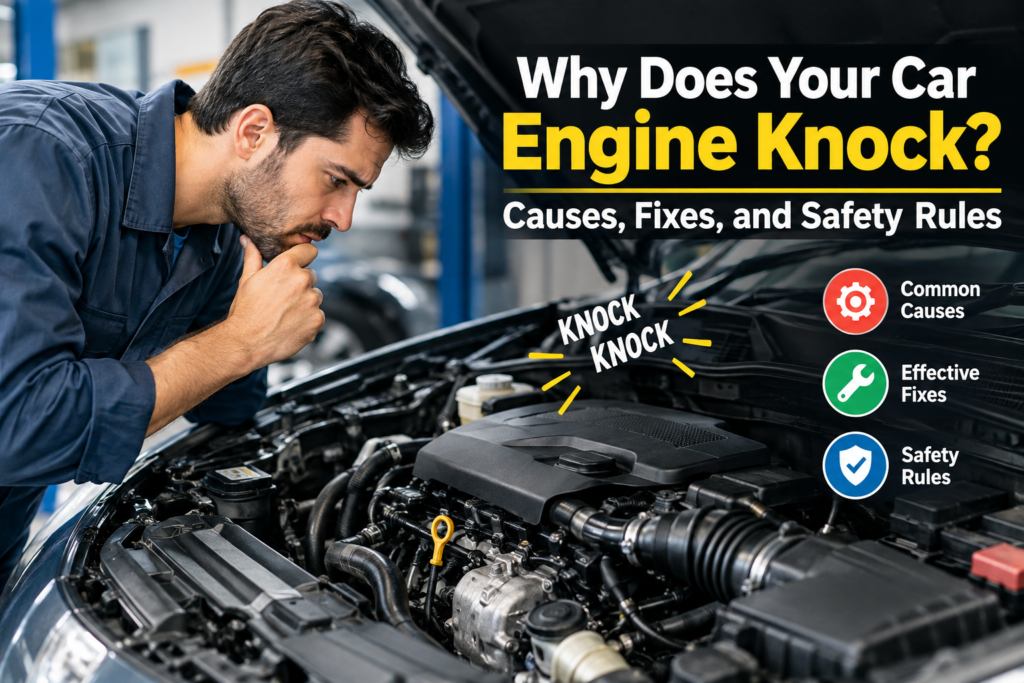
Meta description: Hear an engine knock? Learn five causes, simple fixes, and the sound clues that tell you when to stop the car at once.
You hear a metallic rattle when you press the gas pedal. Does your stomach drop? Engine knock can mean a cheap fix or a ruined engine, so you should act fast. You will learn the five main causes, the fix for each, and the signs that tell you to stop the car.
What Is Engine Knock?
Engine knock, also called detonation or ping, happens when the air-fuel mixture ignites unevenly or too early inside a cylinder. The mistimed blasts create shockwaves, and you hear them as a knock.
Why does it start? A healthy cylinder burns fuel in small, controlled pockets, like a sparkler instead of a firework. Each pocket sets off the next one with a small shock. Knock starts when the pockets burn unevenly and the shocks fire at the wrong time. You hear an annoying noise, and your cylinder walls and pistons take the damage.
What Are the Five Main Causes of Engine Knock?
| Cause | What happens | Fix |
| Low-octane or bad fuel | Regular 87-octane gas in an engine built for premium 91+ can ignite early under heat and load | Switch to the grade your maker lists, and add an octane booster as a short-term aid |
| Worn or wrong spark plugs | Old plugs throw off combustion timing, so pockets of unburnt fuel detonate | Replace the plugs |
| Carbon deposits | Carbon builds on cylinder walls and pistons, shrinks the combustion space, and creates glowing hot spots | Use a fuel system cleaner or book a professional decarbonization |
| Low oil level | A low level breaks the protective film between moving parts and raises friction | Check the dipstick, top off with the right viscosity, and look for leaks |
| Failed knock sensor | The ECU relies on the sensor to retard timing when it senses abnormal vibration | Read the fault codes with an OBD2 scanner and replace a faulty sensor |
Which cause fits your car? Read each section below to find out.
Can Low-Octane Fuel Cause Engine Knock?
Yes, it can. Octane rating shows how much compression a fuel handles before it ignites, and a higher number means more resistance. Your engine may need premium 91+ fuel, yet you may fill the tank with 87 regular to save money. The fuel then ignites early under heat and load, so you hear a knock.
Does the saving last? Rarely. You get fewer miles per gallon and risk repair bills, so the cheaper gas saves you nothing. Long-term use of the wrong fuel can damage your engine.
Check your owner’s manual first. Does it list the fuel type you use? Switch to the listed grade at your next fill-up, and add an octane booster for extra support. Try a few fill-ups. The knock may stem from another cause if it stays.
Do Worn Spark Plugs Cause Engine Knock?
Yes, they do. Spark plugs deliver the electric spark that ignites the fuel and air mixture, and they age over time. A worn plug fires late or weakly, so pockets of unburnt fuel detonate abruptly. A plug of the wrong type causes the same problem.
How often should you replace them? Makers recommend a fresh set every 30,000 to 100,000 miles, and the plug type and condition set the exact interval. Old plugs also cut engine power and fuel economy, so the damage reaches your wallet fast.
Replace the plugs with the type your manufacturer lists. You pay little for new plugs, so it is a budget-friendly fix. A tune-up adds new air and fuel filters and a fuel system cleaning, and it restores power and efficiency.
How Do Carbon Deposits Cause Engine Knock?
All fuel sold in the United States must include carbon-cleaning detergents. Some deposits still form. They take up room in the cylinder, so compression rises and knock follows. Deposits also glow hot and ignite fuel too early.
What else happens? Heavy buildup hurts combustion, lowers gas mileage, and can cause overheating. It also damages the cylinders over time.
Add a targeted fuel system cleaner as a first step. A professional decarbonization service cleans the cylinders in severe cases.
Can Low Oil Cause Engine Knock?
Yes, and it ranks as the most dangerous cause. Oil forms a protective film between moving parts. A low level breaks the film, and the parts grind with severe friction.
Pull the dipstick right away. Top off the oil with the viscosity grade your manual lists. Check the ground under your car for leaks, because a leak will drain the new oil too.
How Does a Failed Knock Sensor Cause Engine Knock?
The engine control unit (ECU) relies on the knock sensor to retard timing when it senses abnormal vibration. A faulty sensor leaves the ECU blind, so the knock goes uncorrected.
Plug in an OBD2 scanner and read the fault codes. Replace a malfunctioning sensor.
How Do You Tell Mild Knock From Rod Knock?
The sound tells you how much danger you face. Does it sound like marbles in a tin can, or like a heavy hammer?
| Sound | What you hear | Likely cause | What you do |
| Mild ping | Light rattle, like marbles in a tin can, only when you press the gas pedal or climb a hill | Fuel or spark plugs | Fix it soon, and drive carefully to a nearby shop |
| Rod knock | Deep, rhythmic, heavy thud from the bottom of the engine | Worn internal parts after severe oil starvation | Stop at once |
Rod knock can destroy your engine completely. The repair can escalate into a multi-thousand-dollar total replacement, so a quick stop saves you real money.
Is It Safe to Drive a Car With Engine Knock?
It depends on the sound. A mild ping needs prompt attention, yet you can usually drive carefully to a nearby shop. A deep thud means you must stop the engine immediately.
Which lights are on? Check these two signals:
- The oil light signals low oil, so stop the car and check the dipstick.
- The check engine light signals a stored fault, so read the codes with an OBD2 scanner.
How Do You Find the Cause Step by Step?
Follow these steps in order. Each one costs little, and each one narrows the cause.
- Note when the noise happens. Does it appear at idle or only when you press the gas pedal?
- Decide on the sound. Is it a light tap or a heavy thud?
- Pull the dipstick and check the oil level.
- Compare your fuel grade with your owner’s manual.
- Check the date of your last spark plug replacement.
- Read the fault codes with an OBD2 scanner.
FAQs:
Why does my engine knock when I press the gas pedal?
Load raises pressure and heat inside the cylinders. A light ping at that moment points to low-octane fuel or worn plugs.
Does a deep knock at idle mean serious damage?
A deep, rhythmic thud from the bottom of the engine points to rod knock. Stop the engine and call a professional.
Is engine knock expensive to fix?
The cause sets the price. Fuel and spark plug fixes cost little. Rod knock can end in a multi-thousand-dollar engine replacement.
Does an octane booster fix engine knock?
It helps when low octane causes the noise. It cannot repair worn plugs, carbon deposits, or low oil.
Can other noises sound like engine knocks?
Yes. Cars squeal, clunk, rumble, and roar, and the sounds overlap. Book an inspection when you cannot place the noise.
What Is the Final Thought on Engine Knock?
Engine knock is a warning from your engine. It tells you that fuel burns at the wrong moment inside a cylinder. You can fix most causes early, so you keep the repair bill small.
Which cause do you face? Low-octane fuel, worn spark plugs, carbon deposits, low oil, and a failed knock sensor top the list. Makers recommend fresh spark plugs every 30,000 to 100,000 miles. Engines built for premium need 91+ octane, not 87 regular. A few simple checks often solve the problem, so you can act with confidence.
Which sound do you hear? A light ping gives you time to act. A deep, rhythmic thud from the bottom of the engine gives you none. Stop the car at once, because rod knock can turn a small fault into a multi-thousand-dollar engine replacement.
Act today. Check the oil, match the fuel grade to your manual, and read the codes with an OBD2 scanner. Your engine will reward you with smooth, quiet power. Have you checked your dipstick yet?
CarRevix is an automotive information website providing helpful guides on car maintenance, repairs, troubleshooting, replacement parts, repair costs, and vehicle care to help drivers make informed decisions and keep their cars running smoothly.