
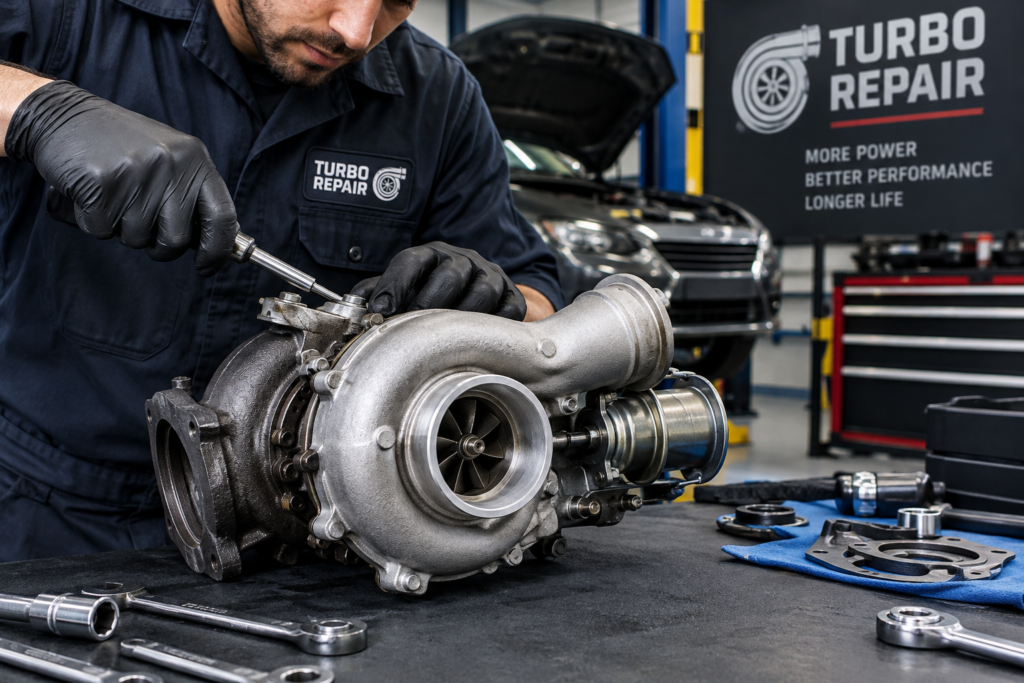
Meta title: Turbo Repair in the USA: Costs, Top Shops & Rebuild Guide (2026)
Meta description: Compare turbo repair costs, nationwide ship-in shops, symptoms, and rebuild steps. Learn when to repair, rebuild, or replace your turbo.
Primary keywords: turbo repair, turbo rebuild, turbocharger repair cost, diesel turbo rebuild, turbo repair near me, ship-in turbo service
Entities: Garrett, BorgWarner, Holset, IHI, Cummins, Duramax, Powerstroke, CHRA, VGT actuator, wastegate, Schenck balancer
A weak turbo drains your power and your budget. Do you want a clear path from symptom to fix? You get one below.
Turbos are big business. MarketsandMarkets estimates the automotive turbocharger market at $15.94 billion in 2026, with growth to $22.35 billion by 2033 at a 4.9% CAGR. Millions of owners will face a turbo decision, and you are one of them.
What Does a Turbocharger Do?
A turbocharger forces extra air into your engine. Exhaust gas spins the turbine wheel. A shaft links that wheel to the compressor wheel, and the compressor pushes fresh air into the intake.
More air lets the engine burn more fuel. Power and torque rise as a result. Diesel pickups, semis, and many small gas engines depend on this design.
The shaft can pass 100,000 RPM. The turbine side sits in hot exhaust. Tiny faults grow fast under those conditions.
What Are the Symptoms of a Worn-Out Turbo?
Your vehicle usually tells you before the turbo dies. Watch for these signs:
- Low boost or power loss. The engine feels flat under load.
- A high-pitched whine. Worn bearings or a damaged wheel often cause a siren-like sound.
- Blue, gray, or black smoke. Blue and gray point to oil. Black points to too much fuel or too little air.
- High oil use. Seals may leak oil into the intake or exhaust.
- Slow spool. The turbo takes too long to build boost.
- Check engine light. Boost and actuator codes often show first.
- Oil in the intercooler pipes. A weak seal can push oil downstream.
Do you notice any of these? Ease off the throttle and get the unit checked. Metal fragments can reach the engine and turn a repair into a disaster.
Why Do Turbos Die?
Most turbos die from outside causes. Garrett Motion reports that more than 90% of turbocharger failures come from oil starvation or oil contamination. BTN Turbo adds a surprising point. Only 1% of so-called turbo failures come from a fault in the turbo itself.
You should therefore treat the turbo as the victim, not always the culprit. The common causes are:
- Oil starvation. The shaft rides on a thin oil film. A low oil level, a blocked feed line, or weak oil pressure removes that film in seconds.
- Dirty oil. Contaminants score the bearings. Skipped oil changes are a leading cause.
- Foreign objects. Dust, debris, or a loose clamp can hit the compressor wheel and unbalance the shaft.
- Hot shutdowns. Garrett notes that a hot engine shutdown can leave carbon buildup that leads to bearing failure.
- Cold hard drives. The oil needs time to circulate before you ask for a boost.
- Actuator or VGT faults. Electronic actuators and variable-geometry vanes stick, drift, or lose calibration.
Why does the cause matter so much? A rebuild restores the turbo. It cannot fix an oil leak elsewhere in your engine.
Should You Repair, Rebuild, or Replace Your Turbo?
You have three paths. Each fits a different case.
Repair fits a single faulty part. Actuator work often costs 150–450 when the turbo itself is healthy. Reviewers of Turbo Reman Center praise technicians who fix actuators instead of pushing a full replacement.
Rebuild fits a worn core with sound housings. The shop strips the unit, replaces wear parts, and balances the assembly. Savings can be large. N C Machinery quotes a CAT 3516 example where a rebuild costs $9,988.43 against $20,384.51 for a new cartridge, a 51% saving.
Replace fits catastrophic damage or an upgrade plan. A cracked housing or a destroyed wheel points here. You can pick a remanufactured or a new unit.
A simple rule helps you decide. Choose a rebuild when the housings are intact and the quote sits well below a new unit. Choose replacement when the core is destroyed.
How Much Does Turbo Repair Cost in the USA?
Standard rebuilds from specialist shops start between $385 and $550. Bearing type drives much of the gap.
| Service | Starting price (shop-listed) |
| 3-stage balance and blueprint (Pelham, AL) | From $385 |
| Journal bearing rebuild (Boost Lab Inc.) | From $400 |
| Ball bearing rebuild (Boost Lab Inc.) | From $550 |
Replacement costs more. TP Auto Repair lists diesel pickup turbos for Duramax, Power Stroke, and Cummins engines at 1,800–3,500 new and 1,200–2,400 remanufactured. Diesel Power Products puts stock replacements for many diesel trucks near $1,000 to $1,700. Prices vary by source, brand, and year.
Remember that a quote covers the unit only. Mail costs for both directions add to the bill. Labor to pull and refit the turbo costs extra, since most specialist builders skip vehicle-side work. What raises the final price? Cracked housings, damaged wheels, billet upgrades, and electronic actuator replacement all push it up.
Journal Bearing or Ball Bearing: Which Do You Need?
Journal bearings use an oil film to support the shaft. They cost less and handle rough conditions well. Most factory turbos use them.
Ball bearings cut friction. Your turbo spools faster and responds sooner. Performance builders favor them, but a rebuild costs more.
Which one fits you? A daily diesel truck does fine with journal bearings. A tuned car or track build gains more from ball bearings.
What Happens During a Professional Turbo Rebuild?
A good shop follows a strict process:
- Teardown and inspection. Technicians strip the unit and check each part.
- Ultrasonic wash. Sound waves clear carbon and sludge from oil passages.
- Failure analysis. The shop finds out why the original unit died. You should get that answer.
- Part replacement. New bearings, thrust collars, O-rings, and seals go in.
- Precision balance. VSR or Schenck machines spin the parts and the full rotating assembly (CHRA). Balance removes tiny faults that destroy a turbo at 100,000+ RPM.
- Bench calibration. Electronic actuators and variable-geometry mechanisms get matched to the assembly.
Ask each shop if the balance covers the complete CHRA. A shop that skips it saves time but risks your engine.
Which Shops Offer Nationwide Turbo Repair?
Several US shops accept mailed units. The details below come from public Google listings. Confirm scores, warranty terms, and prices with each shop before you ship.
Mike Turbo Diesel & Performance The shop sells and repairs Garrett, BorgWarner, Holset, and IHI units. Motorsport and commercial diesel owners both use it. The score is 4.4 from 223 reviews. Reviewers praise quick turnaround and honest diagnostics. You get a 7-day approval window after the shop evaluates your mailed unit.
Turbo Reman Center Inc The team remanufactures turbos for diesel trucks, semis, and cars such as the BMW N55. The score is 4.9 from 111 reviews. Technicians use Schenck balancers to meet factory specs.
Turbo Repair The shop offers a 3-stage balance and blueprint service from $385. The process covers teardown, ultrasonic wash, housing changes, and wastegate recalibration. A 1-year warranty backs OEM replacements.
Boost Lab Inc The shop runs a structured ship-in program. Journal bearing rebuilds start at $400, and ball bearing units start at $550. It offers 360-degree thrust bearing upgrades. It also supports CAT, John Deere, Cummins, Precision, and GReddy. The score is 4.5 from 176 reviews.
Turbo Time USA / TTP Turbos The shop serves diesel pickups only. It builds drop-in upgrades for Dodge Cummins, Chevy Duramax, and Ford Powerstroke engines. CNC work and balance happen in-house. The score is 4.7 from 79 reviews.
Turbo Performance The West Coast shop builds Holset and Cummins ISX/ISB turbos. Its strength is bench calibration of electronic actuators. Local drop-offs often get same-day or next-day turnaround. The score is 4.8 from 35 reviews.
Local full-service shops Performance Auto Repair in Montgomery, AL, and All About Diesel handle diagnosis, repair, and replacement. They suit you if you want one shop to do the whole job.
How Does Mail-In Turbo Service Work?
The process is simple. Follow these steps:
- Confirm the diagnosis. Check oil feed, boost leaks, and codes first.
- Remove the turbo. Do it yourself or hire a local mechanic.
- Drain the oil and pack the unit well. Use a sturdy box. Cap all openings to keep dirt out.
- Add your details. Include vehicle info, symptoms, and contact data.
- Wait for the quote. The shop inspects the unit and sends a price.
- Approve the work. Compare the quote with replacement cost.
- Refit with fresh parts. Install new oil, a new filter, and new gaskets.
Do you need your vehicle back fast? Ask about turnaround before you mail anything. Local drop-off shops often beat mail-in timelines.
Local Shop or Ship-In Specialist: Which Is Better?
Pick a ship-in specialist when your engine is a diesel truck, semi, or performance build. You also gain expert balance and calibration. You must remove and refit the turbo yourself, though.
Pick a local shop when you want one stop for diagnosis, removal, and install. You get faster return of your vehicle and face-to-face service.
Many owners combine both. A local mechanic pulls the unit, a specialist rebuilds it, and the mechanic refits it.
How Do You Choose a Good Turbo Repair Shop?
Use this checklist before you commit:
- Brand experience. Does the shop work on Garrett, BorgWarner, Holset, or your exact brand?
- Balance method. Ask what machines they use and if they balance the full CHRA.
- Warranty. Get the length and coverage in writing.
- Failure analysis. A good shop explains what killed your turbo.
- Clear quotes. Look for transparent prices and an approval window.
- Recent reviews. Read them for honesty and speed.
- Application match. Pickup specialists and semi specialists differ. Pick the right one.
A low price attracts attention. Poor balance and cheap parts cost you more later.
How Long Does a Turbo Last, and How Can You Extend It?
Turbos last a long time with good care. Diesel Power Products says a diesel turbo usually lasts at least 150,000 miles, and the average unit still works at 200,000 miles. Carwow adds that many turbos last well beyond 100,000 miles, with no fixed failure point.
Prevention costs far less than a rebuild. Tomorrow’s Technician suggests an oil change every 3,000 miles and an auxiliary oil cooler to prevent oil breakdown and coking. Add these habits:
- Change oil and filters on schedule. Clean oil and clean air protect the shaft and wheels.
- Let the engine idle after hard drives. A short cool-down prevents oil coke.
- Warm the engine before you boost. Cold, thick oil reaches the bearings slowly.
- Fix leaks fast. Boost, oil, and exhaust leaks stress the turbo.
- Check intake pipes. Loose clamps let debris in.
- Keep boost within the design range. Extra boost shortens turbo life.
Frequently Asked Questions
How long does a turbo rebuild take?
Local shops often finish in one or two days. Mail-in jobs add transit time both ways. Ask for a written estimate.
Can you fix a turbo without a full rebuild?
Yes. Actuator faults, stuck vanes, and minor leaks sometimes need only a targeted fix and recalibration.
Is a rebuilt turbo as good as a new one?
A rebuild with new bearings, seals, and full balance can match factory performance. Shop quality decides the result.
Does turbo repair include install?
Most dedicated builders skip removal and install. You or a local mechanic handle that step.
Why do rebuilt turbos die early?
The root cause usually stays in place. Oil starvation, contamination, and boost leaks kill the new unit too. Fix them first.
Is it worth rebuilding an older turbo?
Usually yes, if the housings are sound. A rebuild costs well below a new unit on most applications.
Can you drive with a weak turbo?
It is risky. Metal debris can enter the engine. Get the unit checked quickly.
What Are the Final Thoughts on Turbo Repair?
A turbo rarely dies without a reason. Garrett Motion links more than 90% of turbo failures to oil starvation or oil contamination. Fix the oil system first, and your next turbo lives longer.
garrettmotion
Next, match the repair to the damage. An actuator fix costs $150–$450. A specialist rebuild starts near $385 to $550. A new diesel pickup turbo can reach $3,500. The gap grows on heavy units. N C Machinery shows a 51% saving on a CAT 3516 rebuild.
Then pick your shop with care. Ask about balance on the full CHRA, a written warranty, and a failure report. Do the reviews mention honest quotes and fast turnaround? Those details separate a good builder from a cheap one.
Finally, protect your investment. Change the oil on schedule, idle after hard drives, and check intake pipes for leaks. Diesel Power Products says a diesel turbo often still works at 200,000 miles with proper care. You can reach that number too.
Ready to act? Pull the codes, check the oil, and call two shops for quotes today. Send me your make, model, year, and symptoms, and I will tailor your next step.
CarRevix is an automotive information website that helps readers understand car maintenance, repairs, common vehicle problems, troubleshooting, repair costs, and automotive parts through practical, easy-to-follow guides.