
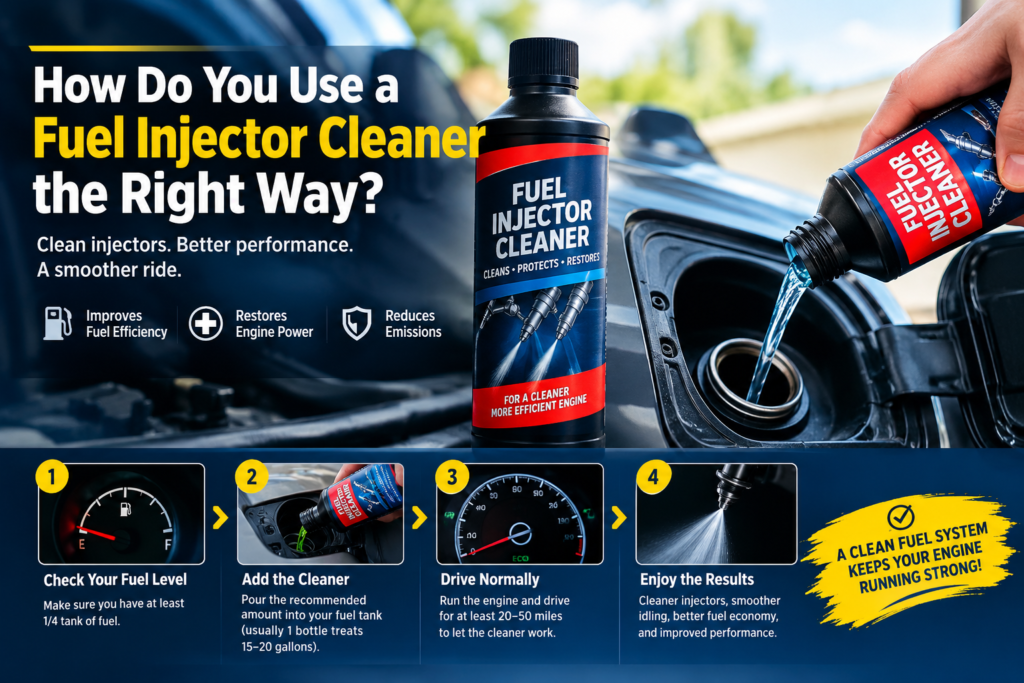
You can add fuel injector cleaner at the gas pump in about five minutes. The job needs one bottle and one fill-up. Yet the order of each step matters. Do you know when to pour the cleaner in? Do you know how often to repeat the dose? Most manufacturers recommend one treatment every 3,000 to 5,000 miles, and this guide covers every step in between.
Quick answer: Wait until your tank runs low. Pour the whole bottle into the tank, then fill the tank with fresh fuel right away. Drive normally until the tank drops to about a quarter.
What Is Fuel Injector Cleaner and How Does It Work?
Fuel injector cleaner is a fuel additive. It reaches the small spaces inside your engine. Gasoline and diesel both carry contaminants, and those contaminants build deposits on your injectors. Deposits restrict flow, so fuel travels less efficiently from the tank to the combustion chamber.
A good cleaner has two working parts. Dissolvents break down carbon and tough debris. Detergents then wash loose debris out of the system and clear blockages. As a result, the formula dissolves varnish, carbon, and dirt that cut your efficiency. The cleaner works best on the spray ports of the injectors, where fuel delivery starts. Some formulas also leave a thin lubricant layer that protects against future contaminants.
Do You Really Need a Fuel Injector Cleaner?
You need it more than you might expect, because clean injectors protect your engine over the long term. A regular dose helps you avoid early injector replacement. Chevron states that its Techron Concentrate Plus helps restore lost power, improve fuel economy, and reduce emissions.
Watch your engine for warning signs. Does it idle roughly? Does it stutter or sputter when you accelerate? Do you see a drop in your miles per gallon? Each symptom points to deposits, so a concentrated cleaner every 10,000 miles can help.
You do not need a dose at every fill-up, though. Treatment at every pump stop drives your costs up. Stick to the schedule on the label instead.
What Benefits Does Fuel Injector Cleaner Give You?
Clean injectors deliver fuel efficiently from the tank to the combustion chamber. A good cleaner enhances engine performance, restores fuel economy, and decreases emissions. It also prevents future fuel system problems and costly repairs. Do the gains justify the price?
Cost matters, because a dose at every fill-up adds up fast. Pick a cleaner that stays effective in cost as well as in results. A single 12-ounce bottle treats 15 to 22 gallons of fuel, and one dose every 3,000 to 5,000 miles keeps your spend low.
Track your results after each dose. Does the engine respond faster? Does your fuel economy improve? Record both answers in your maintenance log, and you will know which product earns its place.
How Do You Choose the Right Fuel Injector Cleaner?
Four factors decide the best choice. Check each one before you buy.
- Compatibility: Match the cleaner to your fuel type. Gasoline engines need a gasoline cleaner, and diesel engines need a diesel cleaner. Never mix them up.
- Formulation: Look for polyetheramine (PEA), polyisobutene (PIB), or polyisobutylene amine (PIBA) on the label. PEA dissolves carbon and gum deposits well.
- Ease of use: Pick a bottle that pours cleanly into the fill neck.
- Brand reputation: Chevron Techron, Sea Foam, Gumout, and STP lead the US market. Ask a mechanic or a friend for a recommendation.
Chevron Techron Concentrate Plus suits gasoline engines, including GDI, PFI, and carbureted systems. It works with all gasoline blends, including ethanol fuels. Sea Foam Motor Treatment is another popular pick. You can buy either one at AutoZone, Walmart, or another auto parts retailer.
How Do You Use a Fuel Injector Cleaner Step by Step?
The process stays simple once you try it a time or two. Follow these seven steps.
- Match the cleaner to your engine. Confirm that the bottle fits your fuel type before you leave the store.
- Wait for a low tank. Drive until the tank sits near a quarter full or lower. Less fuel means a stronger cleaner concentration. Never let the tank run completely dry, though.
- Read the label. Most standard 12-ounce bottles treat 15 to 22 gallons of fuel. Confirm the exact amount for your product.
- Pour in the cleaner. Open the fuel door and remove the gas cap, or open the capless adapter. Pour the full bottle, or the measured amount, straight down the fill neck.
- Fill the tank right away. Fresh fuel rushes in and creates turbulence. That turbulence blends the cleaner evenly through the tank.
- Drive normally. Add some highway miles and run the engine at slightly higher RPMs. The cleaner then flows through the injectors and burns off stubborn carbon. Run the tank down to about a quarter before you refill.
- Log the treatment. Note the date and mileage in your maintenance records. Watch your engine response and fuel economy for changes.
Do You Add Fuel Injector Cleaner Before or After You Fill the Tank?
Add the cleaner first. Fresh fuel then mixes it into the tank as it flows in. The reverse order leaves the cleaner sitting on top of the fuel, so it blends less evenly.
Can You Add Fuel Injector Cleaner to a Half Tank?
You can, but the cleaner works at a lower concentration. A fuller tank dilutes the formula. Aim for a quarter tank or less to get the best result. Always read the label first, because each brand sets its own treatment volume.
How Long Should You Drive After You Add a Fuel Injector Cleaner?
Drive until the tank falls to about a quarter. That distance gives the cleaner time to travel through the fuel lines and injectors. Highway miles speed up the cleanup because higher RPMs push the formula through faster.
How Often Should You Use a Fuel Injector Cleaner?
The right schedule depends on your product and your engine.
- Standard maintenance: Use one dose every 3,000 to 5,000 miles. Many drivers time it with an oil change.
- Deep clean: Use a concentrated cleaner every 10,000 miles if your engine idles roughly or stutters.
- High-strength PEA formulas: Some brands allow a dose as often as every 1,000 miles. Check the label for your exact guidance.
Chevron recommends Techron Concentrate Plus every 3,000 miles. Does your bottle give a different number? Follow the bottle.
What Mistakes Should You Avoid?
Four errors waste money or risk your engine.
- Wrong fuel type: A diesel cleaner does not belong in a gasoline engine, and the reverse holds true.
- Full tank at the start: A full tank dilutes the formula.
- Skipped label: Treatment volumes differ from bottle to bottle.
- Empty tank: A dry tank starves your engine of fuel. Refill before the gauge hits empty.
Motorcycle and Liqui Moly owners should read their own bottle as well. Each product carries its own directions.
What Are the Fuel Injector Cleaner Rules at a Glance?
Use this table as your quick checklist before each dose.
| Factor | Best practice |
| Tank level | A quarter full or lower, never completely empty |
| Order of steps | Pour the cleaner first, then fill the tank |
| Dose size | Read the label; a standard 12-ounce bottle treats 15 to 22 gallons |
| Standard schedule | Every 3,000 to 5,000 miles, often at an oil change |
| Deep clean | A concentrated cleaner every 10,000 miles |
| Fuel type | Match gasoline or diesel to your engine |
| Key ingredients | PEA, PIB, or PIBA |
| After the dose | Drive normally with some highway miles until the tank hits a quarter |
| Popular brands | Chevron Techron, Sea Foam, Gumout, STP |
What Should You Remember About Fuel Injector Cleaner?
Pour first, fill second, and drive on. Pick a PEA-based formula from a reputable brand such as Chevron Techron, Sea Foam, Gumout, or STP. Repeat the dose every 3,000 to 5,000 miles. Your injectors stay cleaner, your engine runs smoother, and your fuel economy holds up longer.
FAQs:
What is the proper way to use fuel injector cleaner?
Pour the cleaner into a low tank. Fill the tank with fresh fuel right away. Drive normally until the tank drops to about a quarter. Read the label first, because each bottle sets its own treatment volume.
Do you put fuel injector cleaner in before or after you fill the tank?
Put it in first. Fresh fuel then blends the cleaner evenly as it flows into the tank.
How long should you drive after you add fuel injector cleaner?
Drive until the tank falls to about a quarter. Add some highway miles, because higher RPMs push the formula through the injectors faster.
Are you supposed to use a fuel injector cleaner?
Yes, on a regular schedule. Most manufacturers recommend one dose every 3,000 to 5,000 miles. The cleaner helps you delay injector replacement. You do not need it at every fill-up, though.
Can you put fuel injector cleaner in a half tank?
Yes, but the formula works at a lower concentration. A quarter tank or less gives the best result.
Final Thought:
Fuel injector cleaner is a simple habit that protects your engine. You pour it into a low tank, fill up right away, and drive normally. Repeat the dose every 3,000 to 5,000 miles, or follow the schedule on your bottle. Your injectors stay clear, so fuel reaches the combustion chamber efficiently.
Next, match the cleaner to your fuel type and pick a PEA-based formula from a trusted brand such as Chevron Techron, Sea Foam, Gumout, or STP. Then log each dose and watch your fuel economy. Are you ready to treat your tank at your next oil change? Start with one bottle and see the difference.
CarRevix is an automotive-focused website that provides helpful information about car maintenance, repair costs, troubleshooting, automotive parts, and vehicle care. It helps readers understand common car problems, identify possible causes, explore practical solutions, and make informed decisions about maintaining their vehicles.