
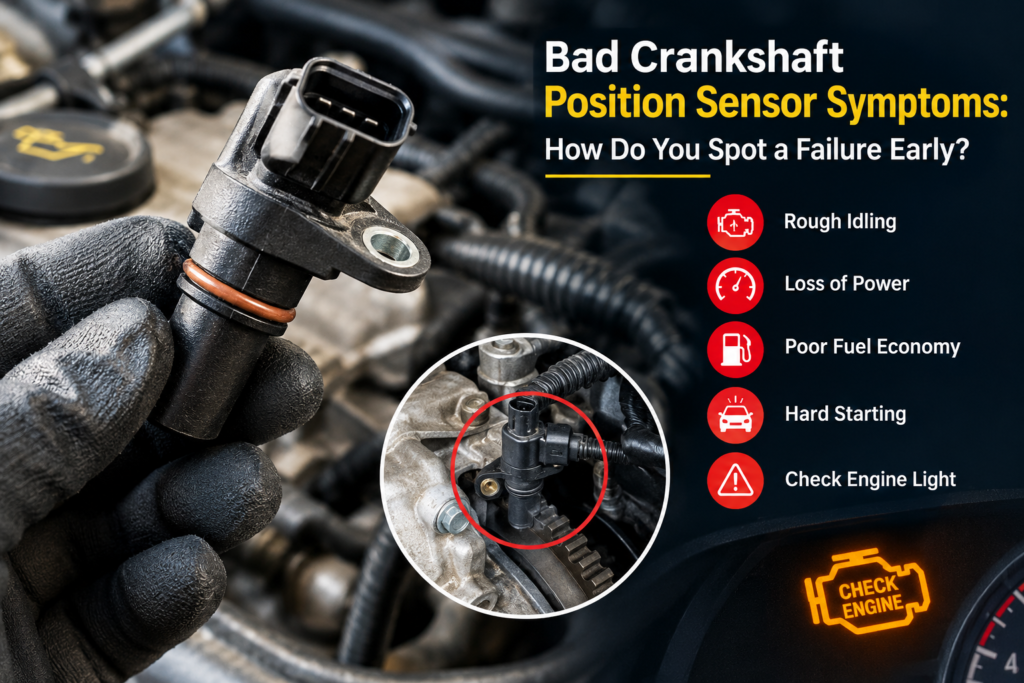
Learn the symptoms, causes, tests, and fixes for a bad crankshaft position sensor (CKP). Find out when you can drive, when you must stop, and what a repair costs.
A bad crankshaft position sensor (CKP) starves your engine control unit (ECU) of data. The ECU needs that data to set spark and fuel injection. What happens when the data stops? Your engine loses sync, and power drops fast. Read on to learn every symptom, cause, test, and repair step.
What Does a Crankshaft Position Sensor Do?
The CKP sensor sits on the engine block. It tracks the rotation of the crankshaft and sends that signal to the ECU. The ECU then adjusts spark and fuel injection to match piston position.
Your engine runs at the right speed when the signal stays accurate. Fuel efficiency and power both rise as a result. However, a failed signal drops both. Next, you will see how that failure shows up on the road.
What Happens When a Crank Sensor Fails?
The ECU loses track of piston position. It loses the cue to fire the spark plugs or open the injectors. As a result, the engine may refuse to start, stall, or misfire.
Why does one small part cause so much trouble? Every ignition decision depends on its signal. The ECU stores a fault code when the signal breaks. P0335 (Crankshaft Position Sensor Circuit Malfunction) is the most common one.
How Do You Know If a Crank Sensor Is Bad?
The table below lists eight symptoms. Some appear alone, and others arrive together. Which ones match your car?
| Symptom | What You Notice | Why It Happens |
| No-start | The engine cranks but never catches | The ECU loses piston position, so it sends no spark or fuel |
| Intermittent stall | The car shuts off at a red light or on the highway | The signal drops out, often from heat or vibration |
| Check engine light | The dashboard light stays on or flashes | The ECU detects a circuit fault and may store P0335 |
| Misfire and vibration | The car stumbles, hesitates, or shakes | Spark and fuel fall out of sync, so combustion stays incomplete |
| Poor acceleration | The car responds slowly to the gas pedal | The ECU lags on spark control |
| Low fuel economy | Your miles per gallon (MPG) drops | Bad data pushes the ECU to over-inject fuel |
| Odd engine noise | Knock or pop sounds come from the engine | A wrong spark schedule causes uneven combustion |
| Rough shifts | The transmission shifts erratically | Wrong signals reach the ECU and upset shift logic |
Why Does Your Engine Crank but Refuse to Start?
A no-start is the clearest sign of CKP failure. The engine turns over, but the ECU gets no piston data. Spark and fuel never arrive.
Does the problem come and go? It can. The engine may start one day and refuse the next. That pattern points to a weak connection or a sensor on the edge of failure. Check the connector first, because it costs little.
Why Does the Engine Stall Without Warning?
A weak sensor can lose its signal for a moment. The ECU then loses spark data, and the engine shuts off. You may see it at idle or at highway speed.
Highway stalls carry the most risk. Some vehicles lose power assist on the steering and brakes after a stall, and traffic keeps moving around you. Treat any random stall as a reason to book a diagnosis.
Does the Failure Show Up When the Engine Is Hot or Cold?
Heat and vibration can break the sensor signal. A stall after warm-up therefore points to the CKP sensor. A cold-start failure can also trace back to it. Track when each event happens, and give your technician those notes. Patterns of heat and cold speed up the diagnosis.
What Does the Check Engine Light Tell You?
The ECU watches the CKP signal all the time. It stores a trouble code and lights the check engine light when the signal looks wrong. A handheld OBD-II scanner reads the code in seconds.
Many repair shops also run the scan for you. The code often points to the sensor or its wires. A light that flashes signals a more urgent fault, so pull over safely and get help.
Why Do You Feel Misfires, Vibration, and Poor Acceleration?
Spark and fuel must arrive at the right instant. A bad CKP signal shifts both. The air-fuel mix turns erratic, and combustion stays incomplete across the cylinders. You then feel hesitation, shake, and weak throttle response. Knock or pop sounds also join the list, because uneven combustion creates them.
Can you drive normally in that state? You can try, but the engine loses power again and may stall.
Can a Bad Crank Sensor Hurt Fuel Economy and the Transmission?
Yes, on both counts. The ECU adds extra fuel to offset bad data, so your MPG falls. Wrong signals also reach the transmission logic, which can cause erratic shifts.
What Causes a Crankshaft Position Sensor to Fail?
Four causes cover most failures.
- Wear and tear: The sensor ages with mileage. Wires corrode, and the signal weakens.
- Electrical faults: Damaged wires, a loose connector, or a blown fuse interrupt the signal.
- Heat and contaminants: The sensor sits near the engine. Dirt, oil, and coolant leaks shorten its life.
- Manufacturing defects: A poor-quality part can fail early. That cause appears less often.
Which cause fits your car? A technician can tell after a scan and a visual check.
How Do You Diagnose a Bad Crankshaft Position Sensor?
You or a technician can confirm the fault with four checks. Each check narrows the cause.
- Scan for codes. Plug an OBD-II scanner into the port and pull the stored codes. Look for P0335.
- Watch live RPM. Crank the engine and watch the tachometer or the live data stream. RPM that stays at zero while you crank hard points to a dead sensor.
- Inspect the wires and connector. Look for frayed wires, loose plugs, and oil on the connector. Confirm that the sensor sits in the right position near the crankshaft.
- Test with a multimeter. Measure the sensor resistance and compare it to the manufacturer’s range. A value outside that range, such as a short circuit or an open circuit at 0 ohms, confirms a fault.
Check the fuse before you buy a part. A blown fuse mimics sensor failure. Which step should you do first? Start with the scan, because it costs the least time.
Is It a Crankshaft or a Camshaft Position Sensor?
Both sensors send position data to the ECU, so their symptoms overlap. Stalls, a rough idle, and a check engine light can come from either one. The stored trouble code separates them. Scan before you replace any part.
Is It Safe to Drive With a Bad Crankshaft Position Sensor?
Treat it as unsafe. The engine can stall or misfire without warning, and highway speed raises that risk sharply. Drive only a short distance to a repair shop, and stay off fast roads. Call a tow service if the car stalls repeatedly or refuses to start.
Is There a Temporary Fix for a Crankshaft Position Sensor?
A dead sensor needs replacement. You can still rule out simple faults first. Reseat the connector, wipe away dirt and oil, and repair any damaged wire. Retest after each step, and replace the sensor if the symptoms return. A proper repair beats any short-term patch.
How Do You Replace a Crankshaft Position Sensor?
Replacement takes about 1 to 2 hours on most vehicles, depending on the model. Follow these five steps.
- Locate the sensor. Look near the crankshaft, often on the engine block or the engine front cover.
- Disconnect the battery. Disconnect it to avoid electrical faults while you work.
- Remove the old sensor. Unplug the connector and unbolt the sensor. Protect the parts around it.
- Install the new sensor. Fit it in the same spot and fasten the bolt.
- Reconnect the battery and test. Start the engine and confirm that the symptoms are gone. Then rescan for codes.
How Much Does a Crank Sensor Cost?
Price depends on your make, model, and year. Part quality and shop labor also change the total. Labor runs about 1 to 2 hours, so a quote from your repair shop gives the clearest number. Which details should you bring? Bring your car’s make, model, year, and any OBD-II codes.
Do Chevy Owners See Different Symptoms?
The symptoms stay the same across brands. A Chevy with a bad CKP sensor can crank without a start, stall, or set a check engine light. Your vehicle details only change the part number and the labor time.
FAQs:
What are the signs of a failing crankshaft position sensor?
Expect hard starts, stalls, weak acceleration, and a check engine light. A scan tool confirms the cause.
Can a bad crankshaft sensor cause poor fuel economy?
Yes. Bad data makes the ECU over-inject fuel, so your MPG drops.
How long does replacement take?
Plan for 1 to 2 hours, depending on the vehicle.
Can a bad crankshaft sensor affect the transmission?
Yes. Wrong signals can cause erratic shifts.
What does P0335 mean?
P0335 flags a Crankshaft Position Sensor Circuit Malfunction.
Can I clean the sensor and skip a new part?
A wipe removes dirt and oil from the tip and connector. A dead sensor stays dead after a wipe.
Does a bad CKP sensor always trigger the check engine light?
Some failures begin as stalls or hard starts before the light appears.
Final Thought:
A bad CKP sensor cuts the signal your ECU needs to run the engine. You then face a no-start, a stall, a misfire, or a lit check engine light. Each symptom points to the same small part, so you can act with confidence.
Which step should you take first? Scan for codes, and look for P0335. Next, inspect the wires and the connector, and test the sensor with a multimeter. Replace the sensor if the tests confirm a fault. A camshaft sensor fault can look the same, so let the stored code guide your choice.
Safety matters most. A stall at highway speed puts you and other drivers at risk. Therefore, book a repair early, and call a tow service if the car refuses to start. A quick sensor fix today costs far less than a tow or engine damage tomorrow.
CarRevix is an automotive-focused website that publishes practical car maintenance tips, repair guides, troubleshooting advice, vehicle buying guides, and automotive insights. It also offers automotive guest posting, link insertion, SEO link building, sponsored content, and content writing services to help automotive businesses improve their online visibility and reach relevant audiences