
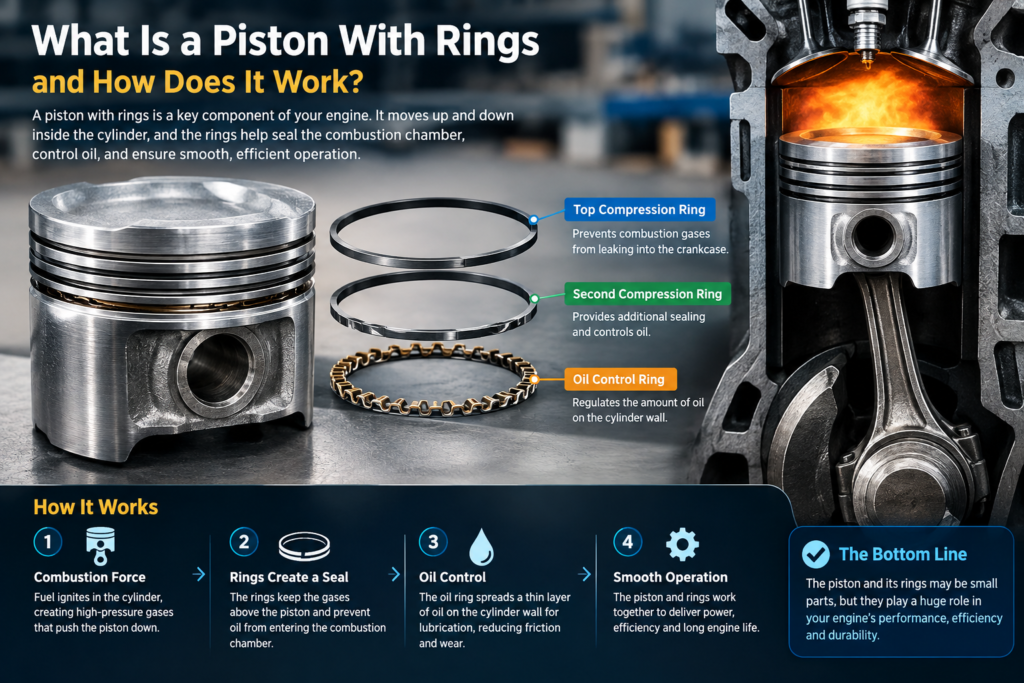
A piston with rings is the core power unit of an internal combustion engine. The piston slides back and forth in the cylinder bore. Combustion forces drive it. The rings sit in grooves around the piston and close the gap between the piston and the cylinder wall.
Why should you care? An engine makes power only when the combustion chamber holds pressure. Worn rings let that pressure leak. Power drops, oil burns and wear rises. You can catch the problem early once you know how each part works.
How Does a Piston Work Inside the Cylinder?
The piston is the movable end of the combustion chamber. The cylinder head forms the fixed end. The air-fuel mixture ignites, and gas pressure hits the piston head. The piston travels toward the crankshaft. A connecting rod then turns that push into rotation.
Most pistons use die-cast or gravity-cast aluminum alloy, according to Briggs & Stratton technical material. Why does the industry choose aluminum? It is light, strong, cheap to make and it conducts heat well. A light piston needs less force to start and stop. The engine then sends more combustion force to the load.
Aluminum expands when hot. Builders therefore set an exact piston-to-cylinder clearance. Too little clearance can seize the piston. Too much clearance causes compression loss and piston noise. Do you see why the correct fit matters?
What Are the Main Parts of a Piston?
A piston has six key features:
- Piston head: The top surface. It takes the highest heat and force.
- Ring grooves: Recessed channels that hold the rings.
- Ring lands: The two parallel surfaces of each groove. They form the seat for the ring.
- Piston pin bore: A through hole across the piston that receives the pin.
- Piston pin (gudgeon pin or wrist pin): A hollow shaft that links the piston to the small end of the connecting rod.
- Skirt: The lower section that keeps the piston aligned in the bore. Some skirts have cutouts that cut weight and clear the crankshaft counterweights.
What Are Piston Rings and What Do They Do?
A piston ring is an expandable split ring. It seals the piston against the cylinder wall. Rings do three jobs. They seal the combustion chamber, carry heat to the cylinder wall and return oil to the crankcase. Ring size and layout change with engine design and cylinder material.
How much heat do rings carry? The top compression ring transfers about 70% of the combustion chamber heat from the piston to the cylinder wall. Rings therefore protect the piston from overheating as well as gas leaks.
What Are the Three Types of Piston Rings?
Small engines, cars and motorcycles commonly use three ring types. Briggs & Stratton and Hastings Piston Rings both list the same core set. Each ring sits in its own groove.
| Ring | Position | Main job |
| Compression ring | Top groove, closest to the piston head | Seals combustion gases and carries most of the heat |
| Wiper (scraper) ring | Middle groove | Backs up the seal and wipes excess oil |
| Oil control ring | Bottom groove, closest to the crankcase | Removes excess oil and returns it to the sump |
What Does the Compression Ring Do?
The compression ring sits closest to the piston head. It meets the hottest gases and the most chemical corrosion. Combustion pressure pushes the ring against the cylinder wall. A harder push gives a tighter seal.
You will meet two common face designs. A taper-faced ring has a face angle of about 1°. It wipes oil gently and keeps it out of the combustion chamber. A barrel-faced ring has a curved face. It spreads oil across the full piston stroke and lowers the risk of oil film breakdown at the ring edge.
What Does the Wiper Ring Do?
The wiper ring sits in the middle groove. Mechanics also call it the scraper ring, Napier ring or back-up compression ring. It stops gases that slip past the top ring. It also leaves a thin, even oil film for the compression ring. Its tapered face points toward the oil reservoir. That taper pushes excess oil down to the oil ring.
What Does the Oil Ring Do?
The oil ring sits closest to the crankcase. It has two thin rails. Slots or holes in its center let excess oil drain back to the reservoir. It has the highest inherent pressure of the three rings.
Some engines use a one-piece oil ring with an expander that adds radial pressure. Briggs & Stratton also builds three-piece oil rings with two rails and one expander. The small contact area of the thin rails raises the pressure on the cylinder wall.
How Do Piston Rings Seal the Combustion Chamber?
Two forces seal the chamber. Do you know the difference?
Inherent pressure is the built-in tension of the ring. Ring design and material set it. The free ring gap measures it. Free ring gap is the distance between the two rings ends when the ring is relaxed. A wider free gap means more force once the ring sits in the bore.
Applied pressure comes from combustion gas. The gas flows behind the ring and pushes it outward. The ring presses harder as gas pressure rises. Cylinder wall contact pressure also depends on the elasticity of the ring material.
Some rings have a chamfered edge opposite the contact face. The chamfer twists the ring at low gas pressure. That twist helps the ring seat and control oil.
What Are Piston Rings Made Of?
Cast iron is the standard ring material. It holds its shape under heat and load. It conforms easily to the cylinder wall. Makers also coat it with other materials to raise durability. Every piston ring in a Briggs & Stratton engine uses cast iron.
Cast iron distorts easily, though. Handle new rings with care. Never twist them or over-expand them at installation.
Do Two-Stroke Engines Need Oil Rings?
Two-stroke engines skip the oil ring. The oil mixes into the fuel and lubricates the parts. The engine has no oil reservoir, so it needs no oil ring. Two-stroke pistons often carry two compression rings.
What Are the Symptoms of Bad Piston Rings?
Worn rings lose tension, and the seal weakens. Watch for these signs:
- Blue smoke from the exhaust. Oil slips past the rings and burns.
- High oil consumption. You top up the oil more often.
- Power loss and weak acceleration. Blow-by pushes combustion gas into the crankcase.
- Low compression. A compression test confirms the leak.
Do you notice one of these signs? Run a compression test early. A ring repair costs far less than a scored cylinder.
What Causes Piston Rings to Wear Out?
Several causes shorten ring life. Dirty oil wears the ring face. Dust from a poor air filter acts like sandpaper in the bore. Overheating softens the oil film and distorts the ring. A low oil level starves the cylinder wall of lubrication. Age and heavy mileage finish the job. Which of these can you control today?
Why Does Ring Direction Matter at Installation?
Installation errors ruin new rings fast. A wiper ring with its taper toward the compression ring wipes oil up into the combustion chamber. Oil consumption then jumps. Follow the marks on each ring and the maker’s manual. Check the end gap and the groove fit before you assemble the engine. Space the end gaps apart around the piston so gas cannot find a straight path.
How Much Does Piston and Ring Replacement Cost?
Parts cost little. Labor costs more. A piston kit or ring set for common motorcycles such as the CD70 or YBR 125 often sells for about Rs. 850 to Rs. 3,000+ on Daraz.pk. Prices vary by brand and seller, so compare listings first.
Cars and heavy vehicles cost more. The mechanic must strip the engine block, and that job takes many hours. Would you rather pay for a full teardown now, or fix worn rings before the cylinder wall suffers damage? Early action usually wins.
How Can You Make Pistons and Rings Last Longer?
Follow these habits:
- Change the oil and oil filter on schedule.
- Keep the air filter clean so dust stays out of the cylinder.
- Let the engine warm up before you apply a heavy load.
- Stop the engine at the first sign of overheating.
- Buy pistons and rings that match your exact engine make and model.
Frequently Asked Questions
How Many Rings Does a Piston Have?
Most four-stroke pistons carry three rings. Two-stroke pistons often carry two.
What Is the Function of the Top Ring?
The top ring seals combustion gases and moves heat into the cylinder wall.
Can You Replace Only the Rings?
Yes, if the piston and cylinder are in good shape. Measure both first. Worn parts need a full piston kit or a rebore.
What Is Blow-By?
Blow-by is combustion gas that escapes past the rings into the crankcase. It signals ring or cylinder wear.
What Color Is the Smoke From Bad Piston Rings?
The smoke is usually blue. It comes from oil that burns in the combustion chamber.
What Should You Remember About Pistons and Rings?
The piston takes the force of combustion. The rings make that force useful. Three rings share the work of sealing gas, wiping oil and carrying heat. Watch for blue smoke, oil loss and weak power. Act early, and your engine will run stronger for longer.
CarRevix is an automotive information platform providing helpful guides, tips, and insights on car maintenance, repairs, parts, accessories, and vehicle care. It helps car owners understand their vehicles, make informed decisions, and keep their cars running smoothly, safely, and efficiently.