
Meta title: Low Tire Pressure Light On? Causes, Fixes and Reset Steps
Meta description: Your tire pressure light is on. Learn what the symbol means, how urgent it is, and how to turn it off in minutes.
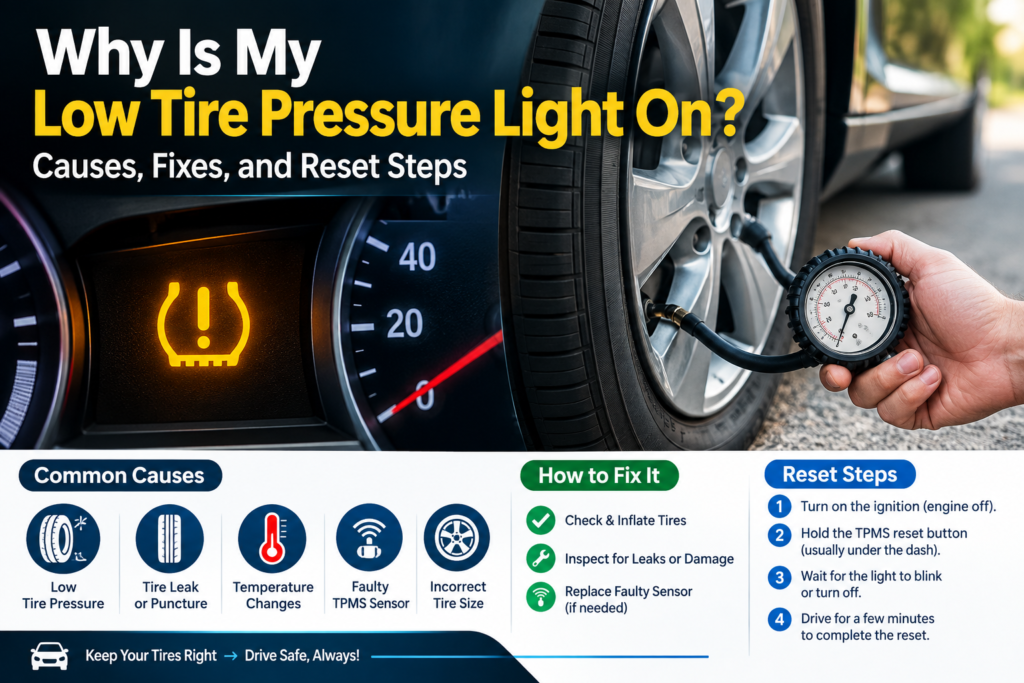
A yellow light glows on your dash. It looks like a horseshoe with an exclamation point. What does it mean? How fast must you act? You will find each answer below.
What Does the Low Tire Pressure Light Mean?
The light belonging to your car’sCC Sensors sends pressure data to the engine control unit (ECU). The system then lights the symbol on your dash. Some cars also show the letters “TPMS” next to it.
Most systems trigger when a tire drops about 25% below the recommended level. Some vehicles alert you at only 10% below. Your eyes cannot spot a drop that small. Does the light ever signal too much air? Yes, on some vehicles. Overinflation raises the risk of tire failure as well.The U.S. required TPMS on all new passenger vehicles from the 2008 model year. The rule exists because low pressure is easy to miss. Newer cars go further. The dash may show which tire is low and the exact PSI at each wheel.
Can You Drive With the Tire Pressure Light On?
You can drive a short distance. Go slowly to the nearest air pump. Check your tires right away. Why the rush? Low pressure causes four problems:
- Handling feels sluggish.
- Stopping distance grows.
- Tires run hotter and wear out faster.
- Fuel economy falls about 0.2% for each 1 PSI lost across all four tires, according to the U.S. Department of Energy.
Pull over at once if a tire looks flat or the car pulls to one side. Call roadside help in that case. A tire can fail fast once it runs flat.
What Should You Do First When the Light Comes On?
Follow these steps in order.
- Find a safe place to stop. A gas station is ideal.
- Find the correct PSI. Look at the sticker inside the driver’s door jamb. Your owner’s manual lists it too.
- Skip the sidewall number. Did you know it shows the tire’s maximum pressure? It is not your target.
- Check every tire with a gauge. A gauge costs about $5. Test tires when they are cold. Cold means parked for three hours or driving less than one mile.
- Add air until each tire matches the sticker. Check the spare too. Many trucks and SUVs have a sensor in the spare.
- Drive 10 minutes at steady speed. Stay above 20 to 50 mph, depending on the model. The system recalibrates and the light should turn off.
Why Is the Light On When Your Tires Look Fine?
A tire can lose a lot of air and still look normal. Which cause fits your car?
Cold weather. Air contracts as temperatures fall. Tires lose about 1 PSI for every 10°F drop. A 40°F drop can cost you 4 PSI overnight. That explains why the light appears at dawn.
Natural air loss. Tires lose about 1 PSI every month, even without a leak. Summer pressure may fall short by winter.
A slow leak. A nail, a bad valve stem, or a damaged wheel can leak for weeks. Do you refill the same tire again and again? Ask a shop to inspect it.
A recent tire change. A shop may have set the pressure too high or too low. Do you carry heavy loads often? Check the PSI your vehicle needs for that load.
Why Does the Light Come On and Go Off?
Tires warm up as you drive. Their pressure rises by about 3 PSI. A tire near the alert level may trigger the light at dawn. The light then turns off by afternoon.
Do you think that means the problem is gone? It is not. The tire is still low. Add air and check pressure once a month.
What Does It Mean When the Light Flashes?
A solid light and a flashing light have different causes. Use the table to tell them apart.
| Light behavior | Meaning | What you do |
| Solid | One or more tires are low | Fill to the correct PSI |
| Flashes 60–90 seconds at startup, then stays solid | The system has a fault | Visit a tire shop |
| Comes on at dawn, goes off later | Temperature swings | Check cold tires and add air |
A flash at startup means the system cannot protect you. A sensor may be broken or its battery may be dead. Sensor batteries last 5 to 10 years. Do you own an older car with the original sensors? A dead battery is a strong suspect. The system cannot alert you to low pressure until a shop repairs it.
Why Is the Light Still On After You Fill the Tires?
You added air, yet the light stays on. What went wrong? Work through this list.
- You have not driven far enough. Drive about 10 miles at steady speed.
- One tire is still low. Recheck all four tires and the spare.
- The system needs a manual reset. Your owner’s manual explains the steps.
- A sensor is faulty. All tires pass the gauge test, but the light stays on.
- A slow leak exists. The pressure drops again within days.
How Do You Reset the TPMS Light?
Reset steps depend on your system type. Which type does your car have?
Direct TPMS uses a pressure sensor inside each wheel. It usually resets after you fill the tires and drive a few minutes.
Indirect TPMS uses your ABS wheel-speed sensors. It compares how fast each wheel spins. It has no pressure sensors, so you must reset it after you adjust the air. Look for a reset option in the dash menu.
Many cars have a reset button under the dash near the driver’s knees. Toyota models often use one. Press and hold it until the light flashes three times. Then start the engine and wait a few minutes. Check your owner’s manual for the exact steps.
Did you rotate your tires or fit new ones? Ask the shop to relearn the sensor positions.
Can TPMS Replace Your Monthly Tire Check?
No. TPMS is an alert. It cannot replace a monthly gauge check. Consider the limits:
- The light may trigger only after a tire falls far below spec.
- A sensor may send bad data.
- Four tires that lose air at the same rate may escape detection.
- The trigger point may sit below the pressure your load requires.
What Happens When Tire Pressure Stays Too Low or Too High?
Both extremes damage your tires. Look at the wear pattern to see which one you have.
- Underinflated tires wear on the shoulders. They run hot and raise your fuel costs.
- Overinflated tires wear in the center. They grip less and absorb bumps poorly.
Correct pressure extends tire life, improves safety, and saves fuel. Is a $5 gauge worth that? Most drivers say yes.
When Should You Visit a Tire Shop?
Book a visit in these cases:
- The light flashes at startup and then stays on.
- The light returns after you fill the tires.
- One tire keeps losing air.
- You see a nail, a bulge, or a cracked sidewall.
- The reset does not clear the light.
A technician can find leaks, test sensors, and replace faulty parts.
FAQ: What Are the Most Common Questions?
Is a low tire pressure light an emergency?
Not always. Treat it as urgent and check your tires soon.
How long can you drive with the light on?
Drive only to the nearest air pump.
What does the tire pressure light look like?
It looks like a horseshoe with an exclamation point in the center.
How much does a TPMS sensor cost to replace?
Prices vary by vehicle and shop. Ask for a quote before you approve the work.
What Is Your Final Takeaway on the Low Tire Pressure Light?
The light is a warning, not a verdict. You can fix most causes in ten minutes with a $5 gauge. Will you act today?
Start with the door-jamb sticker. It lists the correct PSI for your car. Fill each tire to that number and drive for a few minutes. The light should turn off.
Why does this matter so much? Tires lose about 1 PSI every month and 1 PSI for every 10°F drop in temperature. Small losses add up fast. A monthly gauge check catches them early.
Remember the three signals:
- A solid light means low pressure. Add air.
- A flash at startup means a system fault. Visit a tire shop.
- A light that returns means a leak or a bad sensor. Get a professional inspection.
TPMS is your backup. It cannot replace your own monthly check. Keep a gauge in the glove box, and check your tires again when the weather turns cold. A few minutes of care protects your tires, your fuel budget, and your safety.
CarRevix is an automotive-focused platform providing informative content about car maintenance, repairs, automotive accessories, and vehicle care. It also covers automotive SEO, guest posting, link building, and promotional solutions to help automotive businesses improve their online visibility and reach a wider audience