
Meta description: Spot the 8 signs of a bad fuel injector, read the trouble codes, run simple tests, and compare repair costs.
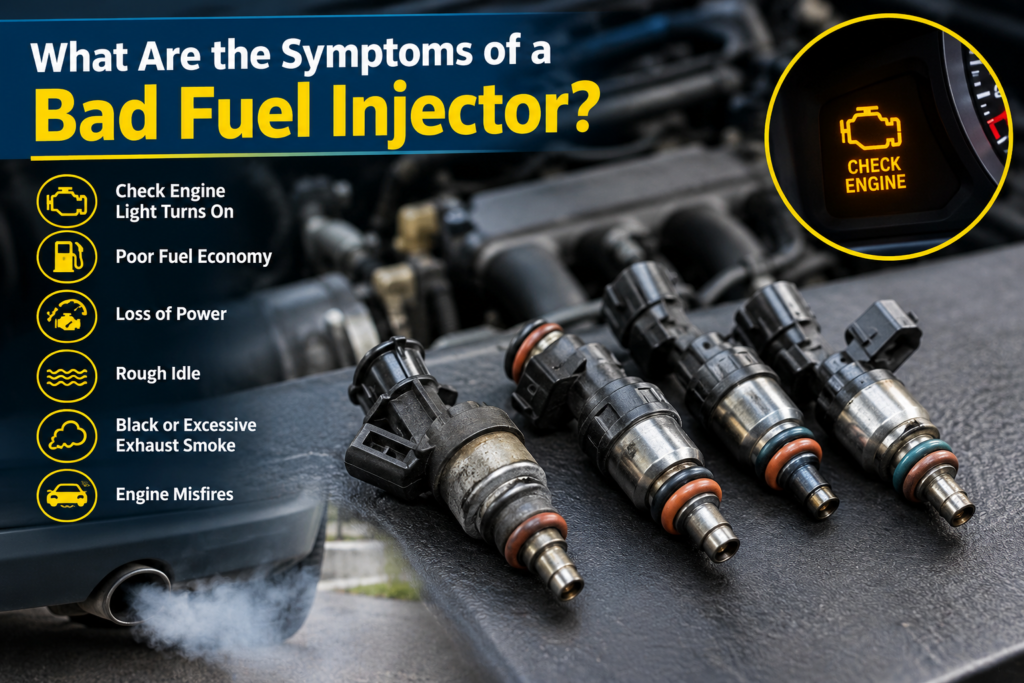
A bad fuel injector disrupts your engine fast. You notice a misfire, a rough idle, weak acceleration, or a check engine light. Your fuel bill rises too. Do you want to know which signs matter most and what to do next? Read on, and you will find clear answers.
What Does a Fuel Injector Do?
A fuel injector is an electronic valve. It sprays a fine mist of fuel into your engine at the exact right moment. The engine control unit (ECU) tells each injector when to open and how long to stay open. The ECU holds each injector open for only a few milliseconds per cycle.
The ECU reads the mass airflow sensor, the oxygen sensor, the throttle position sensor, and the coolant temperature sensor. It then adjusts the spray in real time. Do you see why one weak injector upsets the whole engine?
The numbers show the precision. At 3,000 RPM, one injector in a four-stroke engine fires about 1,500 times each minute. Port injectors spray into the intake manifold at roughly 40 to 60 psi. Gasoline direct injection (GDI) systems spray straight into the cylinder at several hundred psi, and some reach about 3,000 psi. Diesel common-rail injectors often exceed 20,000 psi.
What Are the Most Common Symptoms of a Bad Fuel Injector?
Scan the table first. Then read the details below it.
| Symptom | What you notice | Why it happens |
| Engine misfire | The engine sputters, shakes, or loses power | One cylinder gets too little or too much fuel |
| Rough idle | The car shakes at a red light and the RPM needle bounces | Fuel delivery differs from cylinder to cylinder |
| Poor acceleration | The car hesitates or stumbles when you press the pedal | The injector cannot meet peak fuel demand |
| Low fuel economy | You visit the pump more often | A leaky injector floods the cylinder, or the ECU adds fuel to compensate |
| Check engine light | Misfire, lean, or injector circuit codes appear | Sensors detect a wrong air-fuel mix |
| Hard start or stall | The engine cranks long or cuts out | The cylinder gets too little fuel to burn |
| Fuel smell or leak | You smell raw gas or see wet spots near the fuel rail | Seals crack from heat and age |
| Black smoke or failed emissions test | The exhaust looks dark and hydrocarbons run high | Unburned fuel exits through the exhaust |
Why does an engine misfire?
A starved cylinder cannot burn its charge. You feel a stumble, a shudder, or a brief power drop. A flooded cylinder produces the same effect. Too much fuel also blocks a clean burn.
Why does the idle get rough?
Idle speed leaves no room for error. One weak injector throws the engine off balance. You feel vibration in the steering wheel and the seat. The tachometer needle may jump up and down.
Why does fuel economy drop?
A leaky injector dumps extra fuel. A clogged injector forces the ECU to raise fuel trim on the other cylinders. Both paths cost you money. The U.S. Department of Energy reports that a fix for a serious fault, such as a failed oxygen sensor, can lift fuel economy by as much as 40 percent. A fuel delivery fault deserves the same quick action.
Can an injector cause a hard start?
Yes. A stuck-closed injector gives the cylinder no fuel. A leaky injector floods the cylinder after you shut off the engine. You then crank longer than normal, especially on a warm engine.
Which Trouble Codes Point to a Fuel Injector?
A scan tool turns guesswork into facts. A basic OBD-II reader costs little, and many auto parts stores scan codes for free. Which codes should you look for?
- P0300: random or multiple cylinder misfire.
- P0301 to P0308: misfire in one specific cylinder (P0301 means cylinder 1).
- P0171 and P0174: system too lean on bank 1 or bank 2.
- P0172 and P0175: system too rich on bank 1 or bank 2.
- P0200: general injector circuit fault.
- P0201 to P0208: injector circuit fault in one specific cylinder.
A misfire code points to a cylinder, not to a part. Spark plugs and ignition coils set the same codes. Does one cylinder repeat the misfire? Then focus on that cylinder’s injector, plug, and coil.
What Causes a Fuel Injector to Fail?
Four causes dominate.
- Carbon and varnish deposits. Fuel residue bakes onto the nozzle tip. GDI engines suffer most, since the tip sits inside the hot cylinder.
- Dirty or low-quality fuel. Water and dirt clog the fine filter screen inside the injector.
- Electrical faults. A burned coil, a bad connector, or broken wires stop the injector from opening.
- Age and heat. O-rings and seals harden and crack. Many shops treat 50,000 to 100,000 miles as a typical service range.
Short trips speed up the damage. The engine never reaches full heat, so deposits build faster. Do you make short trips every day? Then plan an earlier check.
Is It the Injector or Another Part?
Several parts mimic injector trouble. Check them before you buy anything.
- Worn spark plugs or weak ignition coils cause identical misfires and rough idles.
- A clogged fuel filter starves all cylinders, not just one.
- A weak fuel pump causes power loss at high speed or under load.
- A vacuum leak lets in extra air and sets lean codes such as P0171.
- A dirty mass airflow sensor sends bad data to the ECU.
Use a simple rule. One cylinder misbehaves? Suspect the injector, plug, or coil on that cylinder. All cylinders misbehave? Suspect fuel pressure, air metering, or the fuel filter.
How Can You Test a Fuel Injector at Home?
Try these checks in order. Each one takes only a few minutes.
- Listen. Touch a long screwdriver or a mechanic’s stethoscope to each injector at idle. A healthy injector gives a steady, rapid click. A silent or uneven injector signals a fault.
- Swap parts. Move the coil and plug from the bad cylinder to a good one. Does the misfire follow? The ignition part is bad. Does the misfire stay? Suspect the injector.
- Read resistance. Place a multimeter across the injector terminals. Compare the reading with the spec in your service manual.
- Inspect the connectors. Look for rust and loose pins.
- Check fuel pressure. Attach a gauge to the fuel rail. The reading shows pump and regulator health.
Many shops also run a flow test or an injector balance test. The result shows which injector delivers too much or too little fuel.
Can You Still Drive With a Bad Fuel Injector?
A mild clog allows a short trip to the shop. Long use raises three risks.
- Catalytic converter damage. Unburned fuel overheats the converter. A new converter often costs $1,000 or more.
- Engine damage. A lean cylinder runs hot and can burn a piston or valve. A stuck-open injector can wash oil off the cylinder wall.
- Fire hazard. A fuel leak near a hot engine is dangerous. Stop at once if you smell raw gas or see fuel on the engine.
Do you smell gas right now? Park the car and call a tow service.
Should You Clean or Replace a Bad Fuel Injector?
A clean service works for mild deposits. Replacement fits electrical failure, leaks, and severe damage.
- Fuel additive: It is cheap and easy. Pick a product with polyether amine (PEA). It suits light buildup and prevention.
- Pressure flush: A technician forces solvent through the fuel rail. It costs more and works better.
- Ultrasonic bath: The shop removes the injectors and cleans them in a tank. The shop also tests spray pattern and flow.
- Replacement: Choose it for leaks, coil failure, or damaged tips.
How Much Does Fuel Injector Repair Cost?
Prices vary by vehicle and region. A professional clean service often runs about $100 to $300. A single injector replacement commonly runs from a few hundred dollars to $1,000 or more. GDI and diesel injectors cost the most. Labor climbs when the intake manifold must come off.
Should you replace all injectors at once on a high-mileage engine? Many technicians say yes. The remaining injectors share the same age and wear, so they tend to fail soon after.
How Do You Prevent Fuel Injector Problems?
Good habits cost little and save a lot.
- Buy fuel from busy, reputable stations. Top Tier gasoline carries more detergent additive than the minimum federal standard.
- Replace the fuel filter on the schedule in your owner’s manual.
- Use a PEA-based cleaner every 3,000 to 5,000 miles if your mechanic advises it. Follow the label.
- Take a longer drive now and then so the engine reaches full heat.
- Fix small faults early. A rough idle today becomes a repair bill tomorrow.
- Keep the tank above a quarter full. Sediment settles at the bottom.
What Are the Symptoms of a Bad Diesel Injector?
Diesel injectors show the same core signs. You may also see hard starts, white or gray smoke, a knock from the engine, and power loss under load. Common-rail injectors run above 20,000 psi. A failure can come fast and cost a lot. Book a diagnosis as soon as you notice a change.
Frequently Asked Questions
How do I know if my fuel injector is bad?
Watch for misfires, a rough idle, weak acceleration, high fuel use, and a check engine light. Confirm the fault with a scan tool and a simple test.
Can a bad fuel injector cause a no-start?
Yes. Several dead injectors or a failed pump can stop the engine from start-up.
How long do fuel injectors last?
Many last 50,000 to 100,000 miles or longer. Fuel quality and drive habits shift that range.
Do fuel injector cleaners work?
They help with light deposits and prevention. A failed coil or a leaky seal needs a new injector.
Can I replace one injector only?
You can. Many mechanics still prefer a full set on a high-mileage engine.
What does a bad fuel injector sound like?
You may hear ticks, taps, or uneven clicks. A dead injector makes no click at all.
Final Thought :
A bad fuel injector never fixes itself. The damage grows with every mile you drive. A small misfire today turns into a ruined catalytic converter, a burned piston, or a failed emissions test tomorrow. Do you want to avoid that bill?
Start with the signs you learned above. Watch for a rough idle, weak acceleration, a misfire, and a drop in fuel economy. Scan the check engine light for codes such as P0300, P0171, or P0201. Then test the cylinder and decide between a clean service and a replacement.
Prevention costs far less than repair. Buy Top Tier fuel, replace the fuel filter on time, and use a PEA-based cleaner when your mechanic advises it. Take a longer drive now and then so the engine reaches full heat. These habits protect your injectors and your wallet.
CarRevix is an automotive website providing helpful information about car maintenance, repairs, engine problems, vehicle troubleshooting, and automotive care to help drivers keep their vehicles safe and reliable