
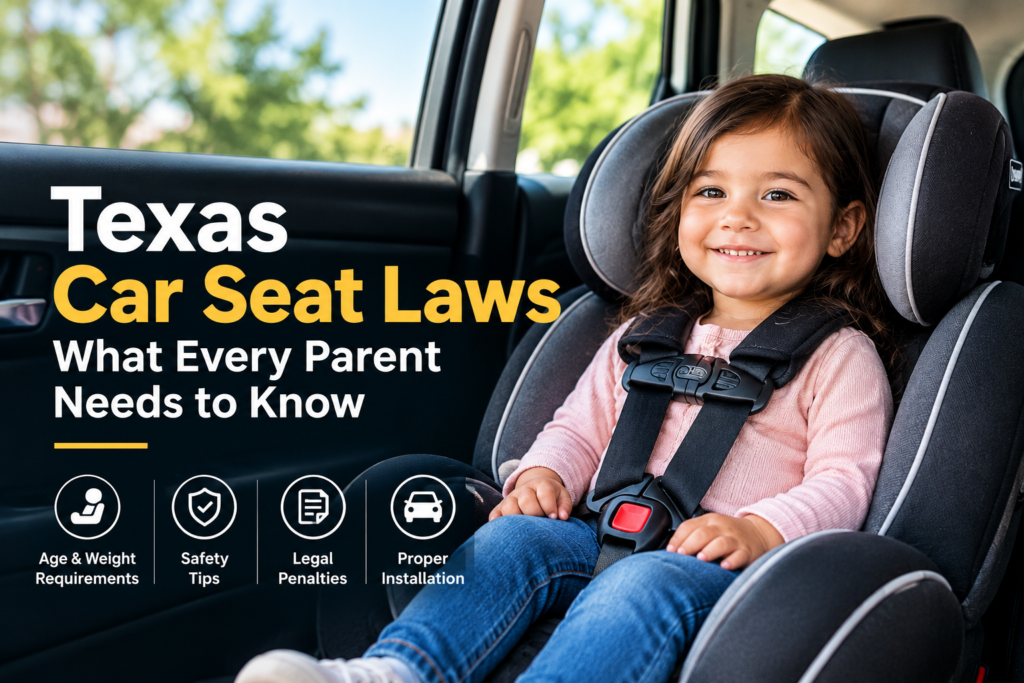
You want your child safe in every car ride. Texas law sets clear rules to help you do that. Car accidents rank among the leading causes of injury for children in the United States. Therefore, the right seat in the right stage matters more than any ticket.
Texas Transportation Code 545.412 sets the base rule. Every child under 8 years old must ride in a child passenger safety seat system. The only exception covers a child taller than 4 feet 9 inches (57 inches). The fine runs from $25 to $250. Still, the fine is the smallest cost of a mistake.
Which seat does your child need today? When can you drop the booster? Can your 9-year-old ride up front? You will find each answer below.
What Does Texas Law Require for Child Car Seats?
The law targets the driver. A driver commits an offense when a child under 8 rides without a child passenger safety seat system. The child must be 4 feet 9 inches or shorter for the rule to apply. Moreover, you must install and use the seat exactly as the manufacturer instructs.
The seat itself must meet federal standards. The National Highway Traffic Safety Administration (NHTSA) sets those standards through crash testing. Consequently, a seat without proper certification does not protect you from a citation.
How do age and height work together? Either milestone ends the requirement. A child who turns 8 may use an adult seat belt. A 7-year-old taller than 4 feet 9 inches may do the same.
| Texas Rule | Detail |
| Law | Texas Transportation Code § 545.412 |
| Who needs a child seat | Children under 8 years old |
| Height exception | Taller than 4 feet 9 inches (57 inches) |
| Penalty | Misdemeanor fine of $25 to $250 |
| Installation | Per the car seat manufacturer’s instructions |
| Back seat guidance | Children under 13 (TxDOT recommendation) |
Which Car Seat Stage Does Your Child Need?
The Texas Department of Transportation (TxDOT) outlines four stages of protection. The Texas Department of Public Safety backs the same approach. Each stage depends on the height and weight limits printed on your seat.
| Stage | Seat Type | Typical Age | Move On When |
| 1 | Rear-facing seat | Birth to age 2 | Child reaches the seat’s maximum height or weight |
| 2 | Forward-facing seat with 5-point harness | Ages 2 to 4 | Child reaches the harness limit |
| 3 | Belt-positioning booster seat | Ages 4 to 8 | Child turns 8 or passes 4 feet 9 inches |
| 4 | Adult seat belt | 8 years and older, or taller than 4 feet 9 inches | Belt fits correctly |
Why Should Your Child Ride Rear-Facing as Long as Possible?
A rear-facing seat cradles the head, neck, and spine of a baby. Those body parts are fragile. Therefore, experts advise you to keep your child in this position until the seat’s maximum height or weight limit.
Many parents want to turn the seat around early. Resist that urge. Read the label on the side of your seat. It lists the exact limits for your model.
When Does Your Child Move to a Forward-Facing Seat?
Your child moves forward only after outgrowing the rear-facing limits. Next, you use a forward-facing seat with a 5-point harness. The harness spreads crash force across the strongest parts of the body.
Keep the harness until your child reaches the upper weight or height limit of the seat. Many harness limits fall between 40 and 65 pounds, depending on the manufacturer. Check your manual for the exact number.
When Does Your Child Need a Booster Seat?
A child who outgrows the harness moves to a belt-positioning booster. The booster lifts your child so the vehicle’s lap-and-shoulder belt sits correctly. Texas booster seat requirements apply until your child turns 8 or passes 4 feet 9 inches.
How do you check the fit? Look at two spots. The shoulder belt must lie snug across the chest and shoulder, not the neck. The lap belt must rest low across the upper thighs, not the stomach.
Can You Put a 40-Pound 3-Year-Old in a Booster Seat?
No, a 3-year-old usually belongs in a harnessed seat. Booster seats serve children who have outgrown a forward-facing harness. Manufacturers also publish minimum age, weight, and height limits for each booster. Read yours first.
A 40-pound toddler may still fit a harnessed seat with a higher limit. Choose that option and keep the harness. Your child gains far more protection there.
When Can Your Child Use an Adult Seat Belt?
Your child graduates to an adult belt at age 8 or at a height above 4 feet 9 inches. Either milestone qualifies. The lap belt must sit low over the hips. The shoulder belt must rest snug across the chest and shoulder.
Does the belt cross the neck or stomach? Then your child still needs a booster, even if the law no longer requires one.
Can a 9-Year-Old Sit in the Front Seat in Texas?
The statute does not list the front seat as a ticketable offense. However, TxDOT and safety experts strongly advise that every child under 13 ride in the back seat. Front passenger airbags can cause severe or fatal injuries to children.
Therefore, place your 9-year-old in the back. Place any booster there as well. The extra distance from the airbag protects your child.
Is There a New Booster Seat Law in Texas in 2026?
The core Texas rule has not changed. Children under 8 still need a child passenger safety seat unless they stand taller than 4 feet 9 inches.
NHTSA has announced stricter side-impact testing for child seats, with new federal rules arriving near the end of 2026. Those rules govern seat manufacturers. They do not alter Texas Transportation Code § 545.412. As a result, the seats you buy will face tougher crash tests, but your legal duties stay the same. Check the NHTSA website for the latest status.
Which Common Mistakes Put Your Child at Risk?
Several errors appear again and again. Avoid each one.
- Turning the seat forward too soon. Wait until your child exceeds the rear-facing limits.
- Using LATCH and the seat belt together. Choose one method unless the manufacturer explicitly permits both.
- Ignoring the manual. The law requires installation per the manufacturer’s instructions.
- Misplacing the belt. A belt across the neck or stomach fails to protect your child.
- Seating a child under 13 up front. Airbags endanger young passengers.
Which Vehicles Does the Law Exempt?
The law exempts vehicles in an emergency. It also exempts vehicles operated for hire, such as taxis, limousines, and rideshares. Still, your child faces the same crash forces in any vehicle. Carry a seat when you can.
What Should You Do After a Crash With a Child Seat?
NHTSA recommends that you replace any child seat that was occupied during a moderate to severe crash. Seat damage can be invisible. Therefore, do not reuse the seat.
Your insurer may cover the replacement as part of a property damage claim. Document the seat’s model and the crash details. In addition, a personal injury attorney can review your claim if the insurer disputes it.
Where Can You Get a Free Car Seat Check in Texas?
Visit LoveMyCarSeat.org to find a local TxDOT district office or a certified safety specialist. These experts inspect your installation at no cost. The TxDOT car seat program also offers resources for Texas families.
Not sure your seat is secure? Book a check today. A 20-minute visit can correct an error that a manual cannot.
FAQs:
Does a 7-year-old need a car seat in Texas?
Yes. A 7-year-old must ride in a child passenger safety seat system, such as a booster, unless the child is taller than 4 feet 9 inches.
What is the height requirement to skip a booster seat in Texas?
The limit is 4 feet 9 inches (57 inches). A child above that height may use the adult seat belt if it fits correctly.
What is the penalty for breaking the child car seat law in Texas?
A violation is a misdemeanor with a fine from $25 to $250.
How long should my child ride rear-facing?
Keep your child rear-facing until the seat’s maximum height or weight limit. The limits appear on the label of your seat.
Do rideshares and taxis require a car seat?
The law exempts vehicles operated for hire. Safety experts still recommend a proper seat.
Final Thoughts:
Texas Transportation Code § 545.412 gives you a clear baseline. Your child needs a child passenger safety seat system until age 8 or a height above 4 feet 9 inches. The fine of $25 to $250 is small. The risk to your child is not.
Therefore, treat the law as a minimum. TxDOT and NHTSA guidance goes further. Keep your child rear-facing as long as the seat allows. Use the harness to its upper limit. Move to a booster only when the harness no longer fits. Then seat every child under 13 in the back.
Do you feel sure about your installation? Visit LoveMyCarSeat.org for a free inspection. A certified specialist can confirm the fit in minutes. Your next drive can start with full confidence.
CarRevix is an automotive website that provides helpful information about car maintenance, engine problems, repairs, troubleshooting, and vehicle care. It also covers automotive SEO, guest posting, link building, and promotional content to help automotive businesses improve their online visibility and reach more customers.