
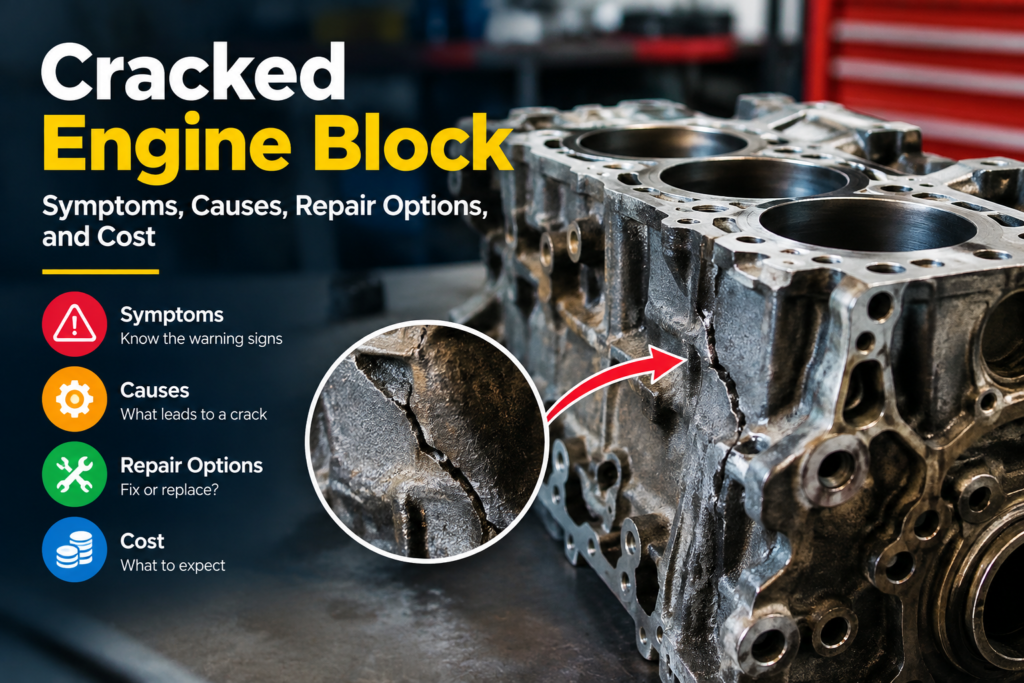
A cracked engine block is one of the most severe mechanical failures your vehicle can face. The block holds the cylinders, the coolant passages, and the oil passages. A crack in that metal lets coolant, oil, and combustion gases flow into the wrong places. Mechanics often recommend a total engine replacement or a vehicle trade-in. In the United States, a replacement engine costs between $4,000 and $8,000. Your vehicle make, your model, and your choice of a new, remanufactured, or used engine set the final price.
Do you suspect a crack in your engine? Read on. You will learn the symptoms, causes, tests, repair options, and costs.
What does a cracked engine block do to your engine?
The block is the core of your engine. Coolant flows through passages in the metal and carries heat away from the cylinders. A crack breaks that path. Coolant escapes or mixes with your oil, and cylinder compression drops. Small cracks grow into major failures fast, so early action matters.
What are the symptoms of a cracked engine block?
Five signs point to a cracked block. Engine House Inc., a Phoenix engine shop, lists the same five signs. You can check most of them yourself.
Does your engine overheat again and again?
The coolant passages regulate engine heat. A crack lets coolant escape, so the temperature gauge climbs. You may lose coolant with no visible leak at a hose or the radiator.
Do you find coolant puddles under your vehicle?
Coolant can leak straight through the crack. Check the coolant level too. A drop with no leak at the hoses or radiator points to the block.
Does your oil look like a milkshake?
An internal crack lets coolant mix with engine oil. The oil turns milky or frothy on the dipstick. Contaminated oil lubricates poorly, so friction and wear rise on every moving part.
Does white smoke come from your tailpipe?
Coolant leaks into the combustion chamber and burns off as white smoke. Take that sign to a mechanic at once.
Does your engine lose power?
A crack lowers compression. You may notice misfires, rough idle, hard starts, or a sharp loss of power.
Which event caused the crack? The next section answers that question.
What causes an engine block to crack?
Three causes account for most cracked blocks.
Severe overheating is the most common cause. Extreme heat makes sections of cast iron or aluminum expand at uneven rates. The metal then snaps under the stress.
Freeze damage hits cold U.S. climates hardest. You need a 50/50 mix of water and antifreeze in winter. Pure water in the coolant jackets expands as it turns to ice. The ice pushes outward and cracks the engine wall from the inside.
Thermal shock happens when you add cold water to an overheated engine. The sudden temperature drop can fracture the metal instantly.
Did one of these events happen to your engine? If so, test for a crack soon.
How do mechanics confirm a cracked engine block?
An external crack is easy to spot. An internal crack is much harder to find. An ASE-certified technician uses three main tests:
- Coolant system pressure test: The technician pressurizes the system and watches for pressure loss.
- Chemical block test: The technician checks your coolant for combustion gases.
- Magnetic particle inspection (Magnafluxing): Shops use it on blocks made of ferrous metal.
Is it a blown head gasket or a cracked block?
Both problems look alike. Overheat, coolant loss, milky oil, and white smoke appear in both cases. Symptoms alone leave you guessing. A visible external crack settles the question at once, but an internal crack needs a test. Run the test first, and you avoid paying for the wrong repair.
Can a motor still run with a cracked block?
A motor may run for a short time with a cracked block. The risk climbs with every mile. Coolant loss pushes engine temperature higher. Coolant in the oil strips away lubrication. Wear then spreads through the moving parts and cylinder walls. Park the vehicle and call a mechanic if you see any sign above.
Can you repair a cracked engine block?
Sometimes you can. Cast iron makes the job hard, because standard steel weld methods fail on a block. Four options exist:
| Method | Best used for | Pros | Cons |
| Engine replacement | Large cracks, high-value cars, daily drivers | Restores long-term reliability | Most expensive route (4,000–8,000) |
| Cold metal stitch | Minor cracks on cast-iron, heavy-duty diesel, or marine engines | Permanent structural repair without heat that warps metal | Needs a specialized machine shop such as Promar Engine |
| Cast-iron weld | Small external cracks on rare or classic blocks | Saves a rare block | High risk of deformation and brittle metal |
| Liquid block sealer | Hairline cracks or emergency fixes | Cheap, and poured into the radiator | Often temporary; fails on large structural cracks |
Why do so many repairs fail? Heat and metal movement are the reasons. An arc weld with the proper rods can join cast iron. The heat often deforms the block, though, and leaves the welded area brittle and open to new cracks.
A cold metal stitch works like sewn fabric, but with metal. It skips heat, yet temperature swings still cause trouble. The metal swells and shrinks, and the stitches can tear. The crack then reopens. Shops use the method mostly on heavy equipment, diesel engines, and marine motors, because it costs so much.
Cold weld products and two-part epoxies face the same problem. A wide range of engine temperatures and metal expansion shorten their life.
How much does a cracked engine block repair cost?
A replacement engine costs $4,000 to $8,000 in the United States. Three factors move the price:
- Vehicle make and model: Parts for some vehicles cost far more.
- Engine type: New, remanufactured, and used engines carry different prices.
- Repair method: Stitch and weld repairs need specialist labor.
Does the repair cost more than your vehicle is worth? Ask that question before you approve any work.
Do liquid block sealers work?
Opinions differ. Makers say their sealers work from the inside. BlueDevil Radiator and Block Sealer is one example. The maker says it flows through the coolant system and bonds to the metal at the leak point. The maker also claims the seal flexes with temperature changes and carries no particles that clog other parts.
Other sources take a more careful view. They call sealers a temporary fix for hairline cracks or emergencies. A sealer fails on large structural cracks. Treat a sealer as a short-term option, and confirm the crack size with a mechanic first.
Should you repair or replace a cracked engine block?
Match the method to the damage and the vehicle:
- Large crack on a daily driver: Replace the engine.
- Rare or classic block: Ask a specialist about a cast-iron weld or cold metal stitch.
- Heavy equipment, diesel, or marine motor: A stitch repair may justify its cost.
- Hairline crack or emergency: A liquid sealer may buy you time.
- Low-value vehicle: A trade-in may cost less than a $4,000 to $8,000 replacement.
How can you prevent a cracked engine block?
You can lower the risk with a few habits:
- Keep a 50/50 mix of water and antifreeze, especially in cold climates.
- Watch your temperature gauge and pull over when it climbs.
- Fix coolant leaks early, before the level drops.
- Let a hot engine cool before you add any liquid.
What are the quick answers to common questions?
What does a cracked engine block sound like?
Expect misfires and rough idle. A mechanic must confirm the cause with a pressure test or chemical block test.
Can a cracked engine block be repaired?
Yes, in some cases. Replacement, cold metal stitch, cast-iron weld, and liquid sealers all exist. Each one suits a different crack.
How much does it cost?
Replacement runs $4,000 to $8,000 in the United States.
Can you drive with a cracked block?
The engine may run briefly. Each drive raises the risk of overheat and oil damage.
Final thought:
A cracked engine block is a serious failure, but you still have choices. Act early, and you protect both your wallet and your engine. Most cracks trace back to severe overheat, freeze damage, or thermal shock. Watch for milky oil, white tailpipe smoke, coolant loss, and power loss.
Which step should you take first? Test the engine. A pressure test or chemical block test gives you a clear answer. A blown head gasket shows the same symptoms, so a test saves you from paying for the wrong repair.
Compare the cost next. You will pay $4,000 to $8,000 for a replacement in the United States. You can use a cold metal stitch or a cast-iron weld on rare, classic, diesel, or marine engines. A liquid sealer may help on a hairline crack, yet it stays a temporary fix. Match the method to the crack size and the value of your vehicle.
CarRevix is an automotive-focused website that publishes informative articles about car maintenance, engine problems, repairs, replacement parts, warning lights, and vehicle troubleshooting. It also offers automotive guest posting, link insertion, SEO link building, sponsored content, and digital marketing services to help automotive businesses improve their online visibility