
Meta description: Compare PPF, ceramic coating, graphene, and colored PPF. See 2026 US prices, top brands, specs, and tips to pick the right protection for your car.
Your car’s paint faces damage every day. Rock chips, UV rays, acid rain, bird droppings, and road salt attack the clear coat. Paint protection adds a barrier that stops that damage early. Which option shields your car best? The answers follow.
What Is Automotive Paint Protection?
The US market relies on two core technologies. Paint protection film (PPF) acts as physical armor. Liquid coatings act as a chemical shield. Each one solves a different problem. You need to know which problem you have.
What Is Paint Protection Film (PPF)?
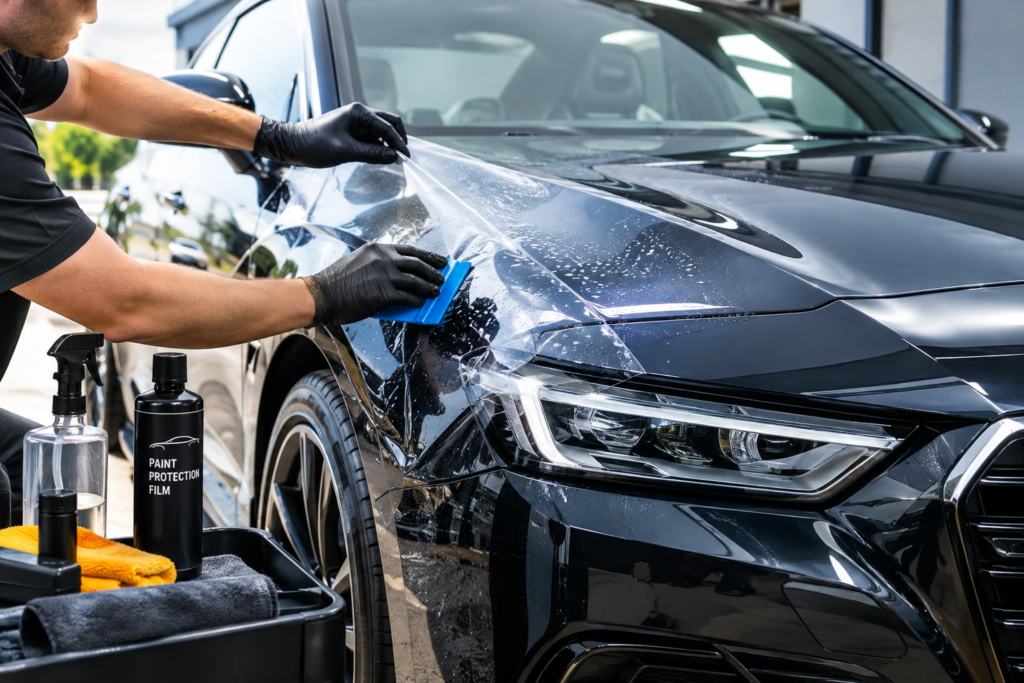
PPF is a clear or colored urethane film. Installers apply it directly to painted panels. People also call it “clear bra.”
The film has three layers. An acrylic adhesive bonds it to the paint. A thermoplastic polyurethane (TPU) core absorbs impact. A topcoat repairs light scratches.
Engineers first developed urethane films for military helicopter rotor blades in the Vietnam War era. Motorsport and luxury car markets adopted the film later.
Does PPF stop rock chips? Yes. PPF is the only common option that absorbs physical impact. Ceramic coatings cannot do that.
How Does Self-Healing PPF Repair Scratches?
The topcoat has shape-memory properties. Heat relaxes the polymer, and it flows back into place. Warm water, sunlight, or engine heat starts the process. Some newer films recover at room temperature within seconds.
Swirl marks from car washes vanish. Deep cuts that pierce the topcoat stay. Do you wash your car often? Then self-healing film pays off quickly.
Why Does the TPU Type Matter?
Aliphatic TPU resists yellowing in sunlight. Aromatic TPU costs less. It yellows and turns brittle over time.
Premium films use aliphatic TPU. Good formulas stretch more than 300% before they break. That stretch lets installers wrap curved bumpers and mirrors without distortion. The topcoat measures about 0.5 to 0.7 mils (12 to 18 microns). Advanced versions reach water contact angles above 100 degrees, so bug splatter and bird droppings slide off.
Ask your installer which resin the film uses. A vague answer signals a problem.
What Is Ceramic Coating?
You apply a liquid silicon dioxide (SiO₂) polymer to clean, corrected paint. It cures into a thin, hard, glossy layer. Water beads and rolls off the surface. Dirt slides away with less effort. UV rays, oxidation, and acid etching find it harder to damage the paint.
Professional coatings last about 2 to 7 years. Wax and sealants last only 1 to 6 months. The gap is large.
Does ceramic stop scratches? No. It adds slight hardness. It cannot stop rock chips or deep scratches. Many buyers learn that the hard way.
What Is Graphene Coating?
Graphene coatings use a carbon honeycomb structure. Makers claim better heat control and less static charge. Less static means less dust on the paint. Owners also report fewer water spots.
Durability runs about 3 to 7 years. Results depend on the product and the installer. Compare written shop warranties. Ignore marketing claims.
PPF vs Ceramic Coating: Which Protects Better?
| Feature | PPF | Ceramic Coating | Graphene Coating | Wax/Sealant |
| Material | TPU film | SiO₂ liquid | Carbon-based liquid | Carnauba/polymer |
| Rock chip defense | High | None | None | None |
| Scratch defense | High, repairs light marks | Light | Light | Minimal |
| UV and acid defense | High | High | High | Low |
| Gloss and slickness | Good | Excellent | Excellent | Short-term |
| Lifespan | 5–10+ years | 2–7+ years | 3–7 years | 1–6 months |
Choose PPF if you cover many highway miles or own a sports car. Choose ceramic if you want easy washes and deep gloss. Choose both if your budget allows.
Why do experts suggest both? PPF stops impact damage. Ceramic on top adds slickness and easy cleanup. The pair covers nearly every threat.
How Much Does Paint Protection Cost in the USA in 2026?
Prices vary by vehicle size, film grade, and shop reputation. Paint correction adds cost. Skipped correction locks swirl marks under the film.
| Package | Typical US Price |
| Professional ceramic coating | $800 – $2,000+ |
| Partial front PPF (bumper and part of hood) | $600 – $1,500 |
| Full front PPF (complete nose) | $1,500 – $3,500 |
| Full-body PPF | $4,000 – $8,000+ |
| Front PPF plus full ceramic (“ultimate pack”) | $2,500 – $5,000+ |
Is full-body PPF worth $8,000? On an exotic car or a matte finish, it can be. A daily commuter rarely needs it. Full front PPF remains the most popular pick.
What Is Colored PPF?
Colored PPF changes your car’s color and protects the paint in one product. Vinyl wraps offer a color change and little else. That gap explains the fast growth in California, Florida, Texas, Germany, and the UK.
How Does Colored PPF Compare with Vinyl Wrap?
| Feature | Colored PPF | Vinyl Wrap |
| Thickness | 6–8 mil | 2–4 mil |
| Protection | High | Low |
| Self-healing | Yes | No |
| Typical lifespan | 7–10 years | 2–4 years |
| Hydrophobic | Yes | No |
| Upfront cost | Higher | Lower |
Vinyl costs less on day one. Colored PPF costs less per year of use. The film removes cleanly, so leased cars keep factory paint safe.
Matte black, satin gray, metallic, and color-shift finishes lead demand. Matte PPF also protects factory matte paint. You cannot polish matte paint, so protection matters even more.
How Fast Is the PPF Market Growing?
Europe held about 31% of the global PPF market in 2024. Industry projections show 6–10% annual growth through 2028. Better TPU films, upgraded topcoats, and wider color ranges drive demand. Rising luxury car sales add to it. California, Texas, Florida, and New York lead US adoption.
Why does growth matter to you? Competition lifts quality and pushes prices down. More installers also mean more skill gaps. Choose with care.
Which Brands Lead the US Paint Protection Market?
- XPEL (San Antonio, Texas) leads the US market. Its Ultimate Plus line comes with a large pattern library.
- 3M (St. Paul, Minnesota) sells the Scotchgard Pro Series. It carries decades of protective-material experience.
- SunTek and LLumar (Eastman, Kingsport, Tennessee) sell through many tint shops that added PPF.
- Avery Dennison (Mentor, Ohio) offers the Supreme Defense series. It has strong ties to the wrap trade.
- STEK offers DYNOshield and specialty films in black, carbon, and tints.
- Hexis makes the BODYFENCE series with matte and satin options.
- Solar Gard (Saint-Gobain) makes Clearshield Pro with a fast-recovery topcoat.
- CarPro (CQuartz), Ceramic Pro, and System X lead professional ceramic coatings.
Do brands decide the result? No. Installer skill decides it. A top film with a poor install lifts at the edges and traps dirt.
Which Specs Should You Check Before You Buy?
Ask about five points:
- Resin. Demand aliphatic TPU.
- Thickness. Premium films run about 7.5 to 8 mils (190 to 203 µm).
- Topcoat. Look for self-healing and hydrophobic properties.
- Adhesive. Quality adhesive reaches full bond in 48 to 72 hours. It should pass peel tests such as ASTM D3330 and remove without residue.
- Warranty. Many premium films carry 10-year warranties. Read the exclusions.
Does the warranty cover install errors? Often not. Ask the shop for its own written guarantee.
How Do You Pick a Good Installer?
Film quality matters only if the installer applies it well. Check five points:
- Inspect finished cars. Look at edges and corners.
- Ask if the shop uses pre-cut patterns or hand cuts.
- Confirm the shop corrects paint first.
- Ask about brand certification.
- Read recent reviews that mention follow-up service.
A cheap quote often hides skipped prep. Walk away from shops that hide their work.
How Do You Care for Protected Paint?
Wait one week before the first wash on the new PPF. Keep pressure-washer jets away from edges. Use pH-neutral soap and clean microfiber towels. Skip automatic brush washes.
Wash ceramic-coated paint every two to three weeks. Many shops recommend a yearly inspection. Regular care keeps the hydrophobic effect strong and extends service life.
Does Paint Protection Raise Resale Value?
Yes, in most cases. Film keeps the factory paint intact. Buyers pay more for clean original paint. Exotic, luxury, and collector cars gain the most. Leased cars return in better shape.
Quality film removes cleanly. Ask about removal costs before you commit.
Which Package Fits Your Situation?
- Highway commuter: Full front PPF plus ceramic.
- New car on a budget: Partial front PPF, or ceramic alone.
- Sports or exotic car: Full-body PPF with ceramic on top.
- Color change with protection: Colored PPF.
- Harsh winters and road salt: PPF on the nose and lower panels, plus ceramic.
- Strong sun and heat: Ceramic or graphene, plus film on the hood and roof.
Frequently Asked Questions
How long does paint protection film last?
Quality PPF lasts 5 to 10 years or more with proper care.
Is PPF worth it?
Yes, if you cover many highway miles or want to protect resale value. PPF is the only option that stops chips.
Can you apply ceramic coating over PPF?
Yes. Many shops do it to make the film easier to clean.
Does PPF damage paint?
No. Factory paint stays safe when a pro installs and removes the film correctly. Repainted surfaces carry more risk.
Is colored PPF better than vinyl?
Colored PPF protects more and lasts longer. Vinyl costs less up front.
Can you DIY ceramic coating?
Yes. Consumer kits exist. Results depend on prep and technique. PPF is much harder to install yourself.
Final Thought:
Paint protection works best when you match the product to the threat. PPF stops rock chips and deep scratches. Ceramic and graphene layers add gloss, slickness, and chemical defense. Colored PPF gives you a new look and real protection in one product.
Which path gives you the best value? Full front PPF plus a ceramic layer ($2,500 to $5,000+) covers most threats for most drivers. Quality films last 5 to 10 years or more. Vinyl wraps last only 2 to 4 years. The better film often costs less per year of use.
CarRevix is an automotive-focused website that publishes informative articles about car maintenance, engine problems, repairs, replacement parts, warning lights, and vehicle troubleshooting. It also offers automotive guest posting, link insertion, SEO link building, sponsored content, and digital marketing services to help automotive businesses improve their online visibility