
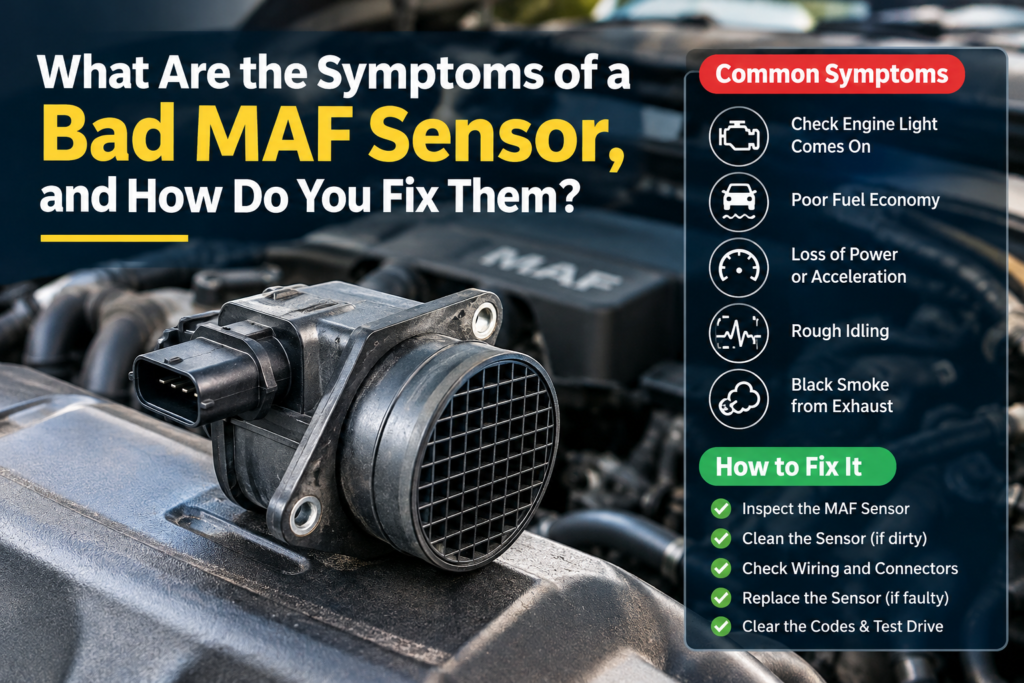
Your engine needs the right mix of air and fuel. The mass air flow (MAF) sensor tells the engine control unit (ECU) how much air enters the intake. The ECU then sets the fuel to match. A bad signal breaks that match, and the car shows it fast.
How do you know the sensor is the culprit? Many other faults copy its symptoms. A vacuum leak, a dirty throttle body, or a weak fuel pump can feel the same. You need a clear test plan before you buy a part.
Here you will find the signs, the OBD-II codes, the tests, the clean-up steps, the replacement cost, and the risks of a long delay. Are you ready to find out what your engine tries to tell you?
What Is a Mass Air Flow Sensor and What Does It Do?
The MAF sensor sits in the intake duct between the air filter box and the throttle body. It measures the mass of the air that enters the engine. The ECU (called the PCM on some makes) uses that number to set the injector pulse width. Many MAF units also hold an intake air temperature (IAT) sensor, so the ECU gets a second input for fuel control.
Why does the sensor measure mass and not volume? Air density shifts with temperature, altitude, and humidity. Mass tells the ECU how much oxygen is ready for each combustion cycle.
Most gasoline engines aim for an air-fuel ratio of about 14.7 to 1. Engineers call that figure the stoichiometric ratio. The ECU holds the target only when it trusts the airflow signal. A wrong signal pushes the mix lean (too much air) or rich (too much fuel). Either way, power drops and emissions rise.
The U.S. Environmental Protection Agency has required OBD-II on new cars since the 1996 model year. That rule is why a scan tool can read your MAF data today.
How Does a MAF Sensor Measure Air?
Most sensors use the hot-wire or hot-film method. The sensor heats a thin element above the temperature of the air. Air flows past and cools it. The sensor then raises the current to hold the element at a set temperature.
The ECU reads the extra current as airflow. More air means more current and a stronger signal. Engineers like the design because it reacts in milliseconds.
Hot-film sensors follow the same logic. A flat film replaces the exposed wire. The film handles rough contact better, yet oil and dust still coat it. Older cars may use a vane meter or a Karman vortex sensor. Both are rare on newer models.
What Are the Most Common Bad MAF Sensor Symptoms?
Symptoms depend on how the sensor misreads the air. A low signal starves the engine of fuel. A high signal floods it. Which signs should you watch?
| Symptom | What you notice | Why it happens |
| Rough idle | Shake, uneven engine note, or a bouncy tach needle | Small air errors hurt most at low rpm |
| Hesitation | Stumble or lag when you press the pedal | The ECU adds fuel late or adds too little |
| Weak acceleration | Slow merge or pass | The fuel surge arrives short |
| Stall | Engine dies at a stop or after a cold start | The mix falls outside the range for a stable burn |
| Poor fuel economy | More trips to the pump | The ECU over-fuels when the sensor reads high |
| Black smoke or fuel smell | Dark exhaust or a raw gas odor | Unburned fuel leaves the tailpipe |
| Hard start | Long crank time | The start mix sits far off target |
| Check Engine Light | Lamp on the dash | The ECU sees data that clashes with throttle and rpm |
| Odd shifts | Harsh or late gear changes | The gearbox uses engine load data from the ECU |
Fuel waste hits your wallet first. The U.S. Department of Energy’s fueleconomy.gov site says a serious repair, such as a fix for a faulty oxygen sensor, can raise mileage by up to 40 percent. The same site adds that repairs on a car that is out of tune or failed an emissions test lift mileage by 4 percent on average. A MAF fault upsets the same air-fuel loop, though the size of the loss varies by car.
Why does the idle suffer first? Small airflow errors matter most when the engine draws little air. At higher rpm, the same error shrinks next to the large air flow.
Can a bad MAF sensor affect the gearbox? Yes, in some cases. Many automatic transmissions read engine load from the ECU. A wrong load value can cause harsh or late shifts. The gearbox itself is often fine.
Which OBD-II Codes Point to a MAF Sensor Problem?
Plug a scan tool into the port under your dash. The ECU stores a diagnostic trouble code (DTC) when airflow data looks wrong. Look for the codes below.
| Code | What it means | Common cause |
| P0100 | MAF circuit malfunction | Wire fault or failed sensor |
| P0101 | MAF range or performance problem | Dirty sensor, air leak, or clogged filter |
| P0102 | MAF circuit low input | Open circuit, weak ground, or dirty element |
| P0103 | MAF circuit high input | Short to power or bad sensor |
| P0104 | MAF circuit intermittent | Loose plug or chafed wire |
| P0171 / P0174 | System too lean, bank 1 / bank 2 | Dirty MAF, vacuum leak, or weak fuel pump |
| P0172 / P0175 | System too rich, bank 1 / bank 2 | A MAF that reads high or a leaky injector |
RepairPal says a MAF code gives a technician a place to start. The sensor may still be healthy. Treat each code as a clue and run the tests below before you buy parts.
Will a Dirty MAF Sensor Set a Code?
Often it will, but sometimes it stays quiet. A mildly dirty sensor can drift off spec and still sit inside the ECU’s fault limits. Your car then runs poorly while the dash light stays dark.
A lean code such as P0171 can also come from a vacuum leak, a weak fuel pump, or a cracked intake boot. Rich codes can come from a leaky injector. Always pair the code with live data.
What Causes a MAF Sensor to Fail?
Four causes cover most cases.
- Dirt and oil film. Dust, pollen, and oil vapor coat the element. The coat insulates it and lowers the output.
- Over-oiled aftermarket filters. Extra filter oil can travel to the element and bake on.
- Wire and plug faults. Corroded pins, chafed wires, and loose plugs send false signals. Check them first.
- Age, heat, and moisture. Vibration and heat cycles wear the sensor over the years.
Intake leaks add a twist. Unmetered air that enters after the sensor makes the ECU undercount the air. The sensor works fine, yet the engine runs lean.
Clean air matters here. YourMechanic lists a routine air filter change as a way to extend sensor life. A clean filter keeps dust off the element.
How Do You Test a MAF Sensor Step by Step?
Test the sensor before you buy a new one. A new part costs money, and the real fault may sit elsewhere. How can you check your MAF at home? Follow the steps below in order.
- Inspect the intake. Check the air filter, the intake boot, the clamps, and the plug. Look for cracks, oil film, bent pins, and loose parts. A split boot after the sensor can mimic a bad sensor.
- Scan for codes and freeze-frame data. Note the code and the rpm. Freeze-frame data shows the engine state when the fault is set.
- Read the live data. Open the MAF value in grams per second (g/s). A warm engine at idle often shows about 2 to 7 g/s. The value climbs to about 15 to 25 g/s near 2,500 rpm. Engine size shifts the numbers, so check your service manual. A frozen or jumpy value points to a bad sensor.
- Check the fuel trims. Short-term and long-term fuel trims show how hard the ECU fights the mix. Values within plus or minus 10 percent suggest a healthy loop. A high positive trim points to a lean mix. A high negative trim points to a rich mix.
- Try the unplug test. Disconnect the sensor with the engine on, if your manual allows it. Many ECUs then switch to a default air table. The idle may smooth out after you unplug it. That result means the sensor sent bad data.
- Use a multimeter. Check power, ground, and signal at the plug. Analog sensors give a voltage that climbs with airflow. Digital sensors give a frequency. Your service manual lists the right values.
- Rule out leaks. Feed smoke into the intake with a smoke machine. Watch for smoke at the boot, the clamps, and the gaskets.
How Do You Clean a MAF Sensor Safely?
A quick clean fixes many mild faults. It costs a few dollars and takes about 15 minutes of work plus dry time. Do it right, because the element is fragile.
You need a can of dedicated MAF sensor cleaner (CRC makes a well-known one), a screwdriver or Torx bit set, gloves, and safety glasses.
- Turn off the engine and let it cool.
- Disconnect the negative battery cable if your manual calls for it.
- Unplug the connector and remove the sensor from the duct.
- Hold the sensor so the element points up.
- Spray 10 to 15 short bursts on the element from a few inches away.
- Let the sensor air-dry for at least 15 minutes.
- Refit the sensor and the plug, then start the engine.
- Check the idle and the throttle response.
Keep brushes, swabs, and fingers off the element. Skip compressed air, because the blast can snap the wire. Replace a dirty air filter at the same time. A clogged or leaky filter lets dirt reach the sensor again.
Which Sprays Should You Avoid on a MAF Sensor?
Brake cleaner, carburetor cleaner, and degreaser carry harsh solvents. The solvents can strip coatings, harm plastic, and damage the element. Use only a spray labeled for MAF sensors, since it dries fast and leaves no film.
How Do You Reset the ECU After a Clean or a Replacement?
You cannot reset the sensor itself. You clear the codes and let the ECU relearn its fuel trims.
- Clear the codes with a scan tool.
- Without a scan tool, disconnect the battery for 10 to 15 minutes. A battery reset can also erase radio presets and other saved settings.
- Reconnect the battery and start the engine.
- Let the car idle for a few minutes.
- Take a 10 to 20 minute drive with some steady cruise.
The ECU relearns fuel trims over several drive cycles. Some cars also need an idle relearn. Look up the steps for your model.
When Should You Replace a MAF Sensor?
A clean cannot fix internal damage. Replace the sensor in four cases:
- The codes return soon after a clean.
- The live data stays frozen or jumps without cause.
- The sensor body is cracked or the pins show corrosion.
- The sensor fails the multimeter test.
Which part should you buy? Match the part number to your VIN. Choose an OEM unit or a trusted brand. Cheap, uncalibrated units can read wrong from day one.
How Much Does MAF Sensor Replacement Cost?
RepairPal puts the typical bill at $250 to $399. Parts run $199 to $324, and labor runs $51 to $75. Prices vary by model. YourMechanic quotes about $193 for a Mazda Protege and $256 for a BMW 325i. Some models cost far more, and RepairPal lists $403 to $1,111 for a Suzuki Equator.
Labor stays low because the job is short. RepairPal calls the swap easy enough for most owners. Why does a sound diagnosis matter then? A $300 part cannot cure a vacuum leak.
How Do You Replace a MAF Sensor?
- Switch off the engine and let it cool.
- Unplug the connector.
- Remove the screws or release the clips that hold the sensor.
- Fit the new sensor in the same direction as the old one.
- Reconnect the plug and check that the intake tube seals tight.
- Clear the codes and start the engine.
- Check the idle, the throttle response, and the dash lights.
YourMechanic advises an inspection of the duct between the sensor and the intake manifold at each replacement. Look for cracks and loose clamps.
Can You Drive With a Bad MAF Sensor?
The car may run, so many drivers ignore the problem. How long can you drive with a bad MAF sensor? A short trip to a shop is usually fine. A long delay raises the risk.
A rich mix can overheat the catalytic converter. The repair then costs a lot. Airtasker lists $945 to $3,416 for a converter job in the U.S. RepairPal shows $1,797 to $1,862 for a Ford Fusion. Stalls in traffic also add a safety risk. Some cars drop into limp mode, which caps power.
Fix the fault early. You protect the catalyst and your wallet.
How Is a MAF Sensor Different From a MAP Sensor?
The MAF sensor measures the air that enters the intake. The MAP sensor measures pressure in the intake manifold, and the ECU estimates air from it. Some engines use one sensor and some use both. A MAF fault skews the direct airflow data. A MAP fault skews the pressure-based load value. The symptoms can look alike, so test before you buy.
Do Nissan, Ford and Chevy Models Show Different Symptoms?
The core symptoms match across brands. Sensor location and plug type differ. Some models mount the sensor on the air box lid, and others place it in the intake tube. YourMechanic lists the Nissan Titan among models where the sensor fails often. Check a repair manual for your year, make, and model before you pull a part.
How Can You Prevent MAF Sensor Failure?
Five habits extend sensor life.
- Replace the air filter at the interval in your manual.
- Oil a reusable filter only to the maker’s mark.
- Check intake boots for cracks at each oil change.
- Keep the plug dry and clean.
- Clean the sensor each year if you drive on dusty roads.
FAQs:
What does a bad MAF sensor feel like?
You feel a rough idle, a stumble under load, and weak power. Fuel use also climbs.
Can a bad MAF sensor make the car hard to start?
Yes, in some cases. A far-off signal can cause a long crank or an instant stall after the start.
How long does a MAF sensor last?
No fixed life exists. Many sensors last for years when the filter stays clean and the intake stays sealed.
Is a MAF sensor the same as an air flow sensor?
In most cars, yes. Both names refer to the same part.
Final Thought:
A bad MAF sensor ruins the air-fuel balance, and your car tells you through a rough idle, hesitation, weak power, and poor mileage. Codes such as P0101 and P0171 back up the story, yet they only mark the place to begin. Test first, clean next, and replace last. That order saves money and protects the catalytic converter. Fix the fault early, and your engine rewards you with smooth power and lower fuel bills.
CarRevix is an automotive information website that helps readers understand car maintenance, repairs, common vehicle problems, troubleshooting, repair costs, and automotive parts through practical, easy-to-follow guides.