
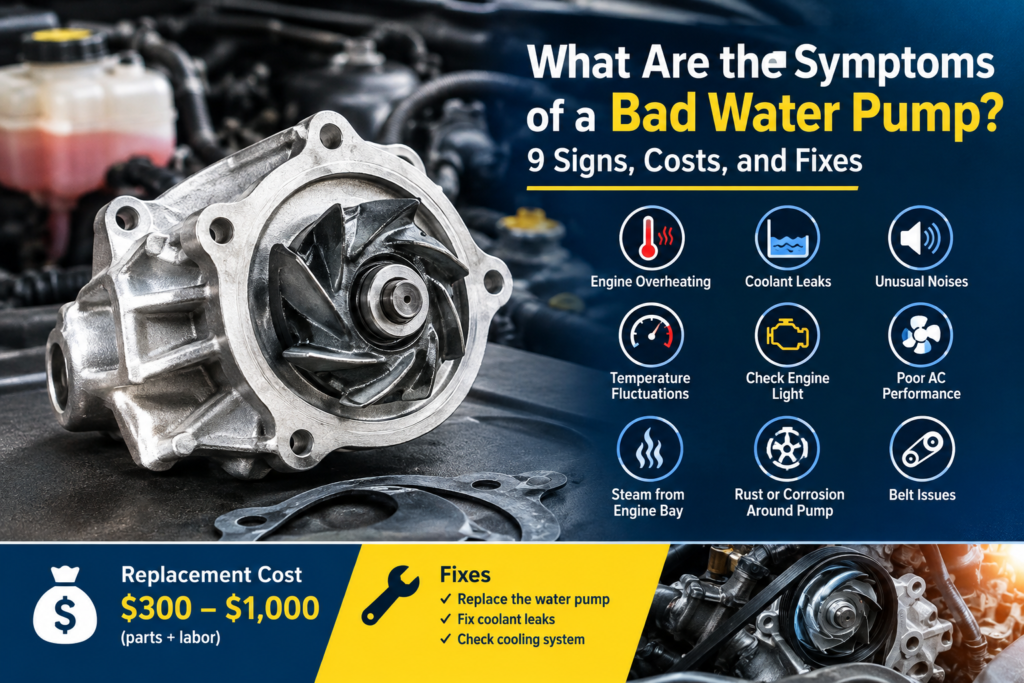
Discover the 9 symptoms of a bad water pump, including engine overheating, coolant leaks, unusual noises, and low coolant levels. Learn how to identify a failing water pump, understand replacement costs, explore repair options, and prevent serious engine damage with this complete car water pump guide.
What Does a Water Pump Do?
The water pump pushes coolant through the engine block, hoses, heater core, and radiator. Coolant pulls heat away from the cylinders. The thermostat controls the flow. The radiator releases the heat to the air.
The pump sits at the front of the engine, and a belt drives it. Some engines use the serpentine belt. Others use the cam belt. A shaft, an impeller, and a seal sit inside the pump body. Worn shaft supports or a dry seal stop the flow or cause leaks.
Why does this matter to you? Shop estimates put a pump replacement at $400 to $800. Heat damage to the engine runs $3,000 to $8,000 or more. Early action saves you thousands.
What Are the Symptoms of a Bad Water Pump?
| Symptom | What you notice | Cause | Urgency |
| Coolant leak | Green, pink, or orange puddle with a sweet smell | Worn seal or gasket | High |
| Whine or grind | Noise that rises with RPM | Worn shaft supports or loose belt | High |
| Hot engine | Gauge climbs or alert light blinks | Coolant stops flowing | Critical |
| Steam from the hood | White vapor from the engine bay | Coolant boils and escapes | Critical |
| Crusty residue | White, brown, or orange deposits on the pump | Slow seal weep | Medium |
| Steady coolant loss | Reservoir drops with no puddle | Leak that dries on hot parts | Medium |
| Weak cabin heat | Cold air from the vents | Poor flow to the heater core | Medium |
| Wobbly pulley | Play in the pulley shaft | Failed internal support | High |
| Rough idle | Misfires or power loss when hot | Heat stress on engine systems | High |
Why Does Coolant Leak Under Your Car?
Look for bright puddles near the front center of the engine. Fresh coolant smells sweet and feels slippery. A small drip grows into a steady stream as the seal wears. Low coolant then leads straight to a hot engine.
What Do Bad Water Pump Noises Sound Like?
A failed pump whines, chirps, or grinds. The pitch changes when you rev the engine. A loose or slipping belt makes similar sounds, so check the belt too. A grind means the pump may seize soon. A seized pump can snap the belt and stop your engine.
Why Does Your Engine Run Hot?
A dead pump cannot move coolant. Heat builds in the block within minutes. The gauge climbs, especially in traffic or on hills. Pull over when the needle nears the red zone.
What Does Steam Under the Hood Mean?
Steam means coolant boils and escapes under pressure. Shut the engine off and step away from the car. Never open the radiator cap on a hot engine. Hot coolant can spray out and cause severe burns.
What Is the White Crust on Your Pump?
Slow leaks dry out and leave mineral deposits. You see white, rust-colored, or orange crust on the pump body. Many pumps also have a small weep hole that drips when the seal fails. Crust tells you the pump has leaked for weeks or months. You still have time to plan a repair.
Why Does Your Coolant Level Drop Without a Puddle?
Small leaks often dry off hot engine parts before they reach the ground. You never see a puddle. You top off the reservoir again and again. Ask a shop for a pressure test to find the source.
Why Does Your Heater Blow Cold Air?
The heater core depends on coolant flow. Weak flow means weak heat. Low coolant causes the same problem, so check the level first.
Does Your Pump Pulley Wobble?
Turn the engine off and let it cool. Grab the pump pulley and try to move it side to side. Any play points to a worn internal support. Replace the pump before it fails.
Why Does the Engine Run Rough?
Extreme heat disturbs fuel, ignition, and sensor output. You may feel misfires or lose power. These signs usually appear after earlier alerts went unnoticed.
Does Milky Oil Mean the Water Pump Is Bad?
Rarely. Milky or foamy oil on the dipstick means coolant has entered the oil. A blown head gasket or cracked head causes that most often. A failed pump can trigger those failures through heat. Treat milky oil as an emergency. Stop the car and call a tow truck.
Which Symptoms Mean You Must Stop Driving Now?
Stop at once for any of these signs:
- A temperature gauge in the red zone
- A temperature alert light that blinks
- Steam from the hood
- A grind from the front of the engine
- Milky oil on the dipstick
Why take it so seriously? Heat can warp cylinder heads and blow head gaskets fast. A tow costs $150 to $400. A warped head costs $1,500 to $3,000. A blown head gasket costs $2,000 to $4,000. A seized engine can cost $5,000 to $10,000. Tow the car.
How Can You Tell a Water Pump Problem from Other Coolant Failures?
Several parts cause similar symptoms. Compare them below. The costs are typical shop estimates.
| Problem | Key clue | Typical cost |
| Water pump | Leak at the front center, noise that follows RPM | 400–800 |
| Thermostat | Hot engine or temperature swings, no leak | 150–300 |
| Radiator | Leak from the radiator body, slow rise in heat | 400–800 |
| Radiator fan | Hot at idle, normal on the highway | 200–500 |
| Coolant hose | Visible leak or swollen hose | 100–300 |
A full coolant system inspection costs about $150 to $250. The shop tests pressure, flow, and temperature. You avoid paying for parts you did not need.
How Do You Check Your Water Pump at Home?
You can run a basic check in ten minutes. Start with a cold engine.
- Park on level ground and let the engine cool fully.
- Check the coolant level in the reservoir.
- Use a flashlight to look for drips, crust, or rust on the pump body.
- Find the weep hole and check for wet residue.
- Move the pulley by hand with the engine off.
- Start the engine and listen near the front for a whine.
- Watch the gauge on a short drive.
Do you find a problem? Book a professional inspection. Cam belt engines need precise timing work, so most owners should leave the replacement to a shop.
What Causes Water Pump Failure?
Five causes show up most often:
- Age and wear. Shaft supports and seals wear out over time.
- Old coolant. Depleted coolant corrodes seals and metal parts.
- Wrong or dirty coolant. The wrong type or a bad mix damages internal parts.
- Belt problems. A loose, tight, or misaligned belt strains the shaft.
- Heat and air pockets. Extreme heat and trapped air stress the pump and cause cavitation.
How Much Does Water Pump Replacement Cost?
Repair guides list these typical costs:
- Standard vehicles: $400 to $800, with parts at $100 to $300 and labor at $300 to $500
- Cam belt-driven pumps: $800 to $1,500 as a combined service
- Luxury and complex vehicles: $1,000 to $2,000
Ask the shop to replace the cam belt with the pump when the belt drives it. The two jobs share most of the labor. You pay for the teardown once. A new thermostat and fresh coolant often go in at the same time.
Can You Drive with a Bad Water Pump?
No. A short trip can turn a $600 repair into a $6,000 one. Move the car only if you must, and keep the trip brief. Add coolant only after the engine cools for 30 to 60 minutes. Cold coolant in a hot engine can crack the block. Plain water works only as a short emergency fix. Use the correct coolant mix afterward.
How Can You Prevent Water Pump Failure?
Follow these habits to extend pump life:
- Change coolant every 60,000 to 100,000 miles, or follow your owner’s manual.
- Check the coolant level each month.
- Inspect for leaks and crust once a year.
- Use the coolant type your maker specifies.
- Keep the belt in good shape with correct tension.
- Act on the first alert light.
A coolant service costs $150 to $300. A pump replacement costs $800 or more at the high end. The math favors regular service.
FAQs
How long does a water pump last?
Lifespan varies by engine and use. Check your owner’s manual for the interval. Ask a shop to inspect the pump at each coolant service.
Will the check engine light come on?
Often it stays off. Watch the temperature gauge and the coolant alert light instead.
Do diesel and Chevy models show different symptoms?
The signs match across engines. Check your model’s service manual for exact intervals.
What is the first sign of water pump failure?
Most owners notice a small coolant leak or a faint whine first.
Can a bad water pump cause no heat?
Yes. Weak coolant flow starves the heater core.
Final Thoughts:
A bad water pump gives you clear warnings. A leak, a whine, a hot gauge, or steam each tells you to act. Which sign did you notice first?
Speed decides your cost. A pump replacement runs $400 to $800 at a typical shop. A seized engine can reach $5,000 to $10,000. Early action keeps you at the low end of that range.
Your plan is simple. Check the coolant level on a cold engine each month. Look for crust and drips on the pump once a year. Change coolant every 60,000 to 100,000 miles, or follow your owner’s manual. Pull over and tow the car if the gauge hits the red zone or steam appears.
Do you want to protect your engine and your budget? Book a pressure test at the first symptom. A small repair today prevents a large bill later.
CarRevix is an automotive-focused website that publishes informative articles about car maintenance, engine problems, repairs, replacement parts, warning lights, and vehicle troubleshooting. It also offers automotive guest posting, link insertion, SEO link building, sponsored content, and digital marketing services to help automotive businesses improve their online visibility